
The State of Tokenomics 2026: 10 Top Takeaways for AI Spending
The Tokenomics Foundation's new State of Tokenomics survey puts a number on something most FinOps and platform teams already feel: everyone's using AI now; almost nobody can explain what it's costing them in terms a CFO would sign off on. Here's what 472 companies, spanning $4.6 trillion in combined revenue across 11 industries, actually said.
- Everyone Uses Frontier Models
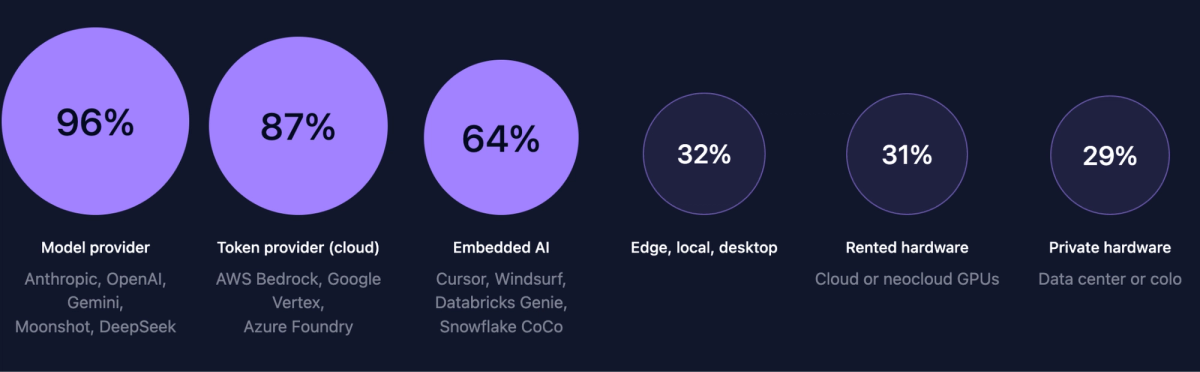
Almost every company here, 96%, uses a frontier model, i.e. a model from a mainstream leading-edge provider like Anthropic, OpenAI, or Gemini.
87% also use a cloud token provider like AWS Bedrock or Azure Foundry, 64% use AI embedded inside tools they already pay for, like Cursor or Databricks, and roughly a third run models on edge devices, rented GPUs, or their own hardware.
The takeaway is that companies aren’t running AI through one unified stack anymore. Half of these companies are active across at least four of those six channels at once. And within any single channel, most aren't running one type of model either: the survey finds companies mixing frontier models, open-weight models, and models they've trained or fine-tuned themselves, all at the same time. Each of those channels is billed and measured differently, creating a major visibility challenge.
Related: Azure OpenAI Cost Optimization: Cut LLM Spend in 2026
- The Frontier-to-Open-Weight Shift
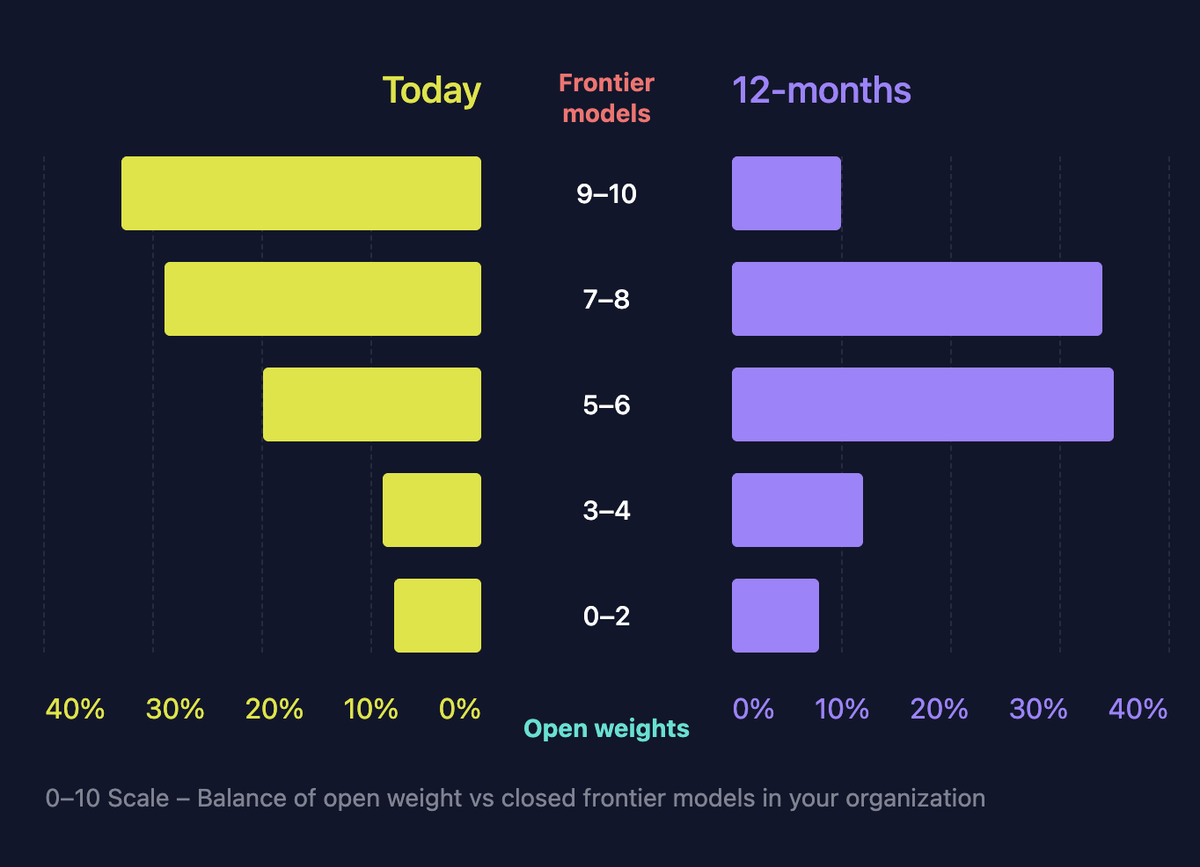
The direction of travel here is fairly one-sided, away from an all-frontier approach to open-weight, even among the companies most invested in it right now.
Right now, just over half of these companies, 51%, say they're almost entirely running frontier models, rating themselves 8 to 10 on a 10-point frontier-to-open-weight scale. A year from now, only 24% expect to still be that concentrated. The companies making the biggest move are, somewhat counterintuitively, the ones most committed to frontier models today: those currently at a 10 expect to drop by close to 3 points on that same scale within a year. And this isn't a two-way split, only 17% of companies expect to shift toward more frontier usage over the same period.
- Most Companies Have Visibility But Can’t Connect Spend to Value
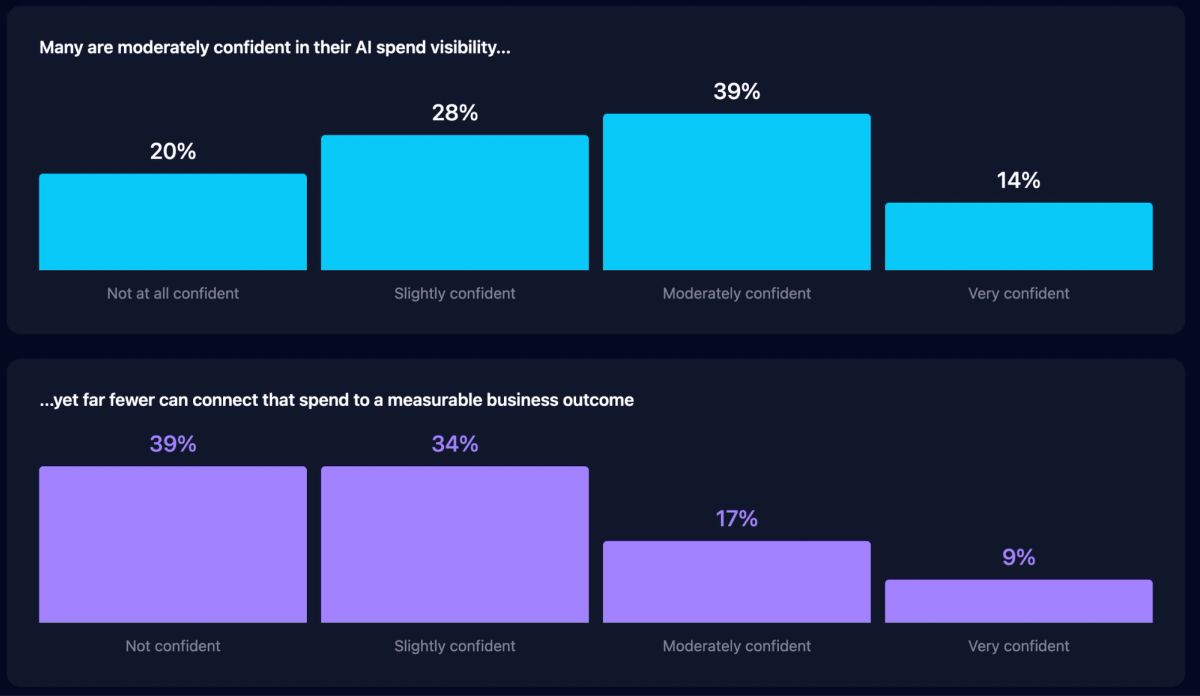
Most companies can see roughly what they're spending on AI. Far fewer can say what they got for it.
- Visibility into AI spend tops out at "moderately confident" for most companies (39%).
- The harder question, whether that spend can be tied to an outcome a CFO would accept, is worse: roughly three in four companies land in the bottom two confidence categories there.
- Confidence in proving value doesn't rise steadily with company size: 34% for companies under $100M, dropping to 14% in the $100M-to-$1B range, then climbing back to 17% and 23% at the two largest bands.
The companies that are genuinely confident share two habits: metered, attributable spend down to individual workloads and teams, and tracking concrete output metrics, tickets closed, PRs merged, revenue generated, rather than just usage.
Related: AI Cost Visibility: The Ultimate Guide
- Tokenomics Ownership Varies Company to Company
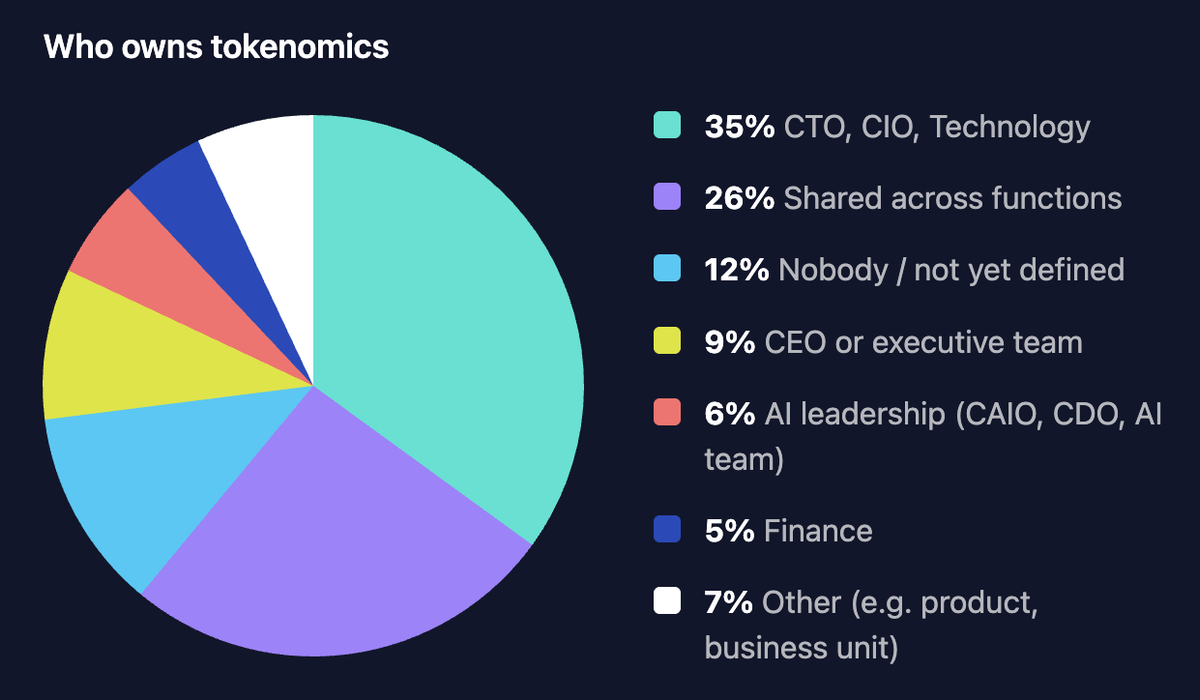
Most companies have decided who's responsible for AI economics. The ones that haven't pay for it directly.
- 88% of companies say ownership of AI economics is clearly defined somewhere in the organization; the other 12% don't have an owner at all.
- Of the defined answers, the CTO, CIO, or a broader technology function is the single most common owner at 35%, but it isn't a runaway majority: ownership is shared across multiple functions almost as often, at 26%. Finance owns it directly in only 5% of companies, and a dedicated AI leadership role, a Chief AI Officer or similar, owns it in 6%.
- Companies with clearly defined ownership, whoever that owner is, are 3.7 times more likely to be able to show their CFO a measurable outcome from AI spend than companies without one. Among the 12% with no defined owner at all, not a single one of them can produce that outcome.
5. Governance Is Still Immature, Still Budget-Cap-First
Governance over AI spending, especially spending tied to developer productivity, is still early almost everywhere. Most companies don't have a formal framework for it yet. Where there is investment, it's gone into monitoring, dashboards that show what's being spent, but those dashboards mostly stop there; they rarely connect back to whether that spend actually improved productivity. In practice, the default control mechanism is a spending cap or a token limit.
6. Challenges: The Full Breakdown, and the Capabilities Wishlist Behind It
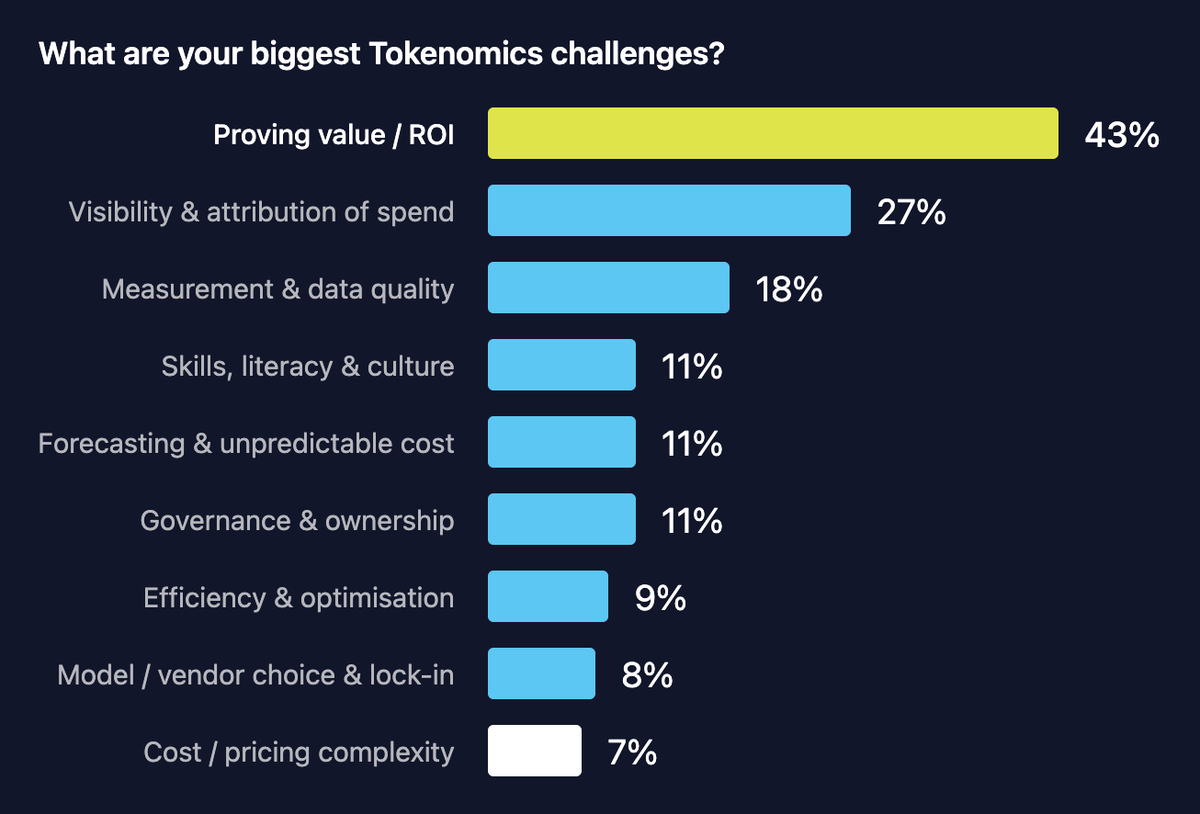
Asked directly what their biggest tokenomics challenge is, 43% of companies say proving value or ROI, by far the largest single answer. Visibility and attribution of spend is a distant second at 27%. The smallest concern, at just 7%, is cost or pricing complexity itself, worth sitting with for a second: the actual dollar amounts and pricing structures aren't really what's keeping people up at night. It's not knowing whether the money was well spent.
The capabilities companies say they need line up exactly with that ranking: the ability to attribute cost to specific users, projects, and business units; a way to model AI's economic impact and calculate real ROI; smarter model routing to control cost without hurting performance; governance controls like spending limits and alerts; and better forecasting for demand that's historically been hard to predict.
Related: AI Token Economics: Complete FinOps Guide 2026
7. Routing is Widely Adopted But Tooling is a Mess
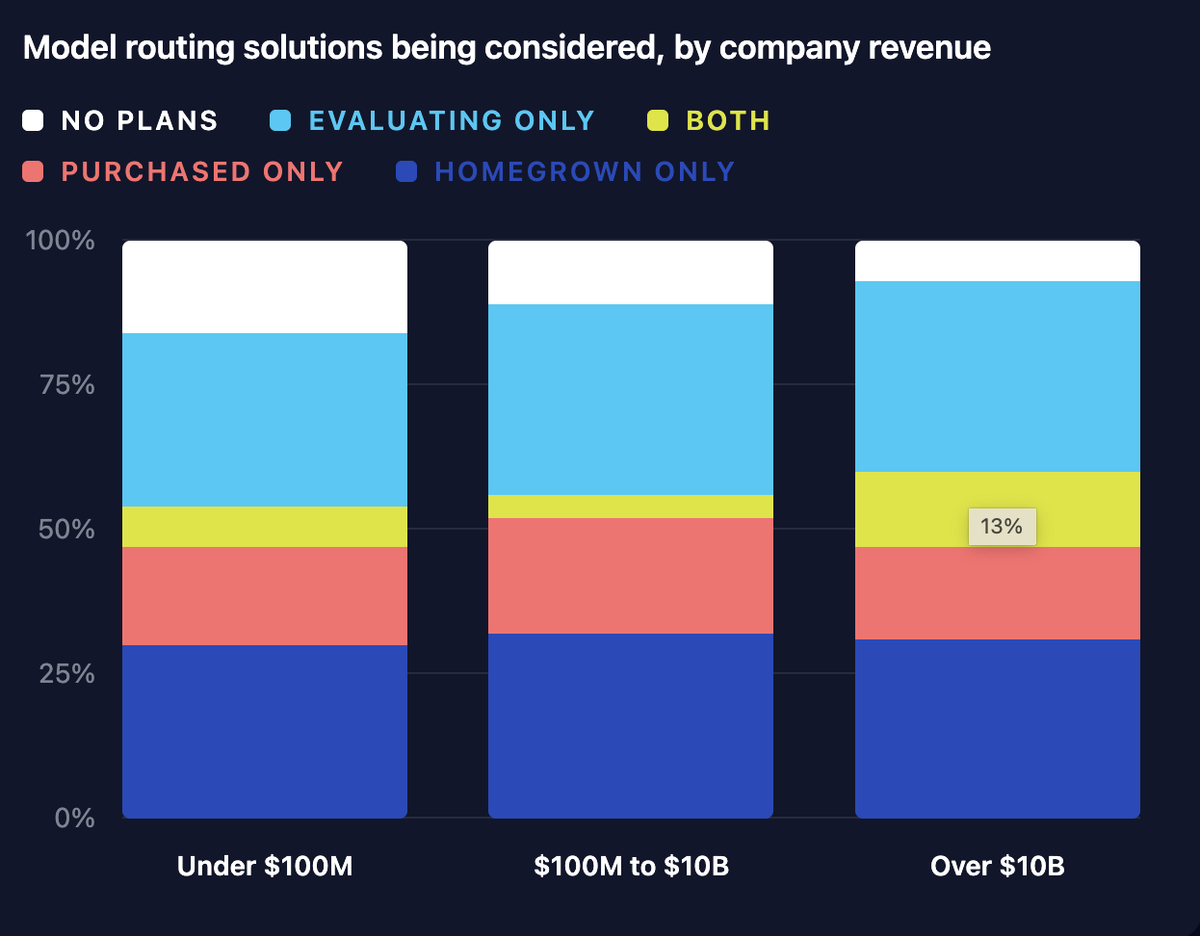
86% of companies are either using or actively evaluating a model router, something that decides which model handles a given request. This is important because companies actually using a router are four times more likely to be able to show their CFO a measurable value outcome than companies that aren't.
That's a strong majority, but the tooling underneath it is still a mess: OpenRouter and LiteLLM see the highest adoption among named tools, but plenty of companies are building their own routing in-house or piecing it together from cloud-native options, and a lot of respondents describe themselves as still early in evaluating what they need. The largest enterprises are the most likely to be running several routing approaches at once rather than settling on one.
Related: LLM Cost Optimization: 10 Tips to Reduce AI Inference & Token Costs
8. Transparency Is What Companies Actually Want From Providers
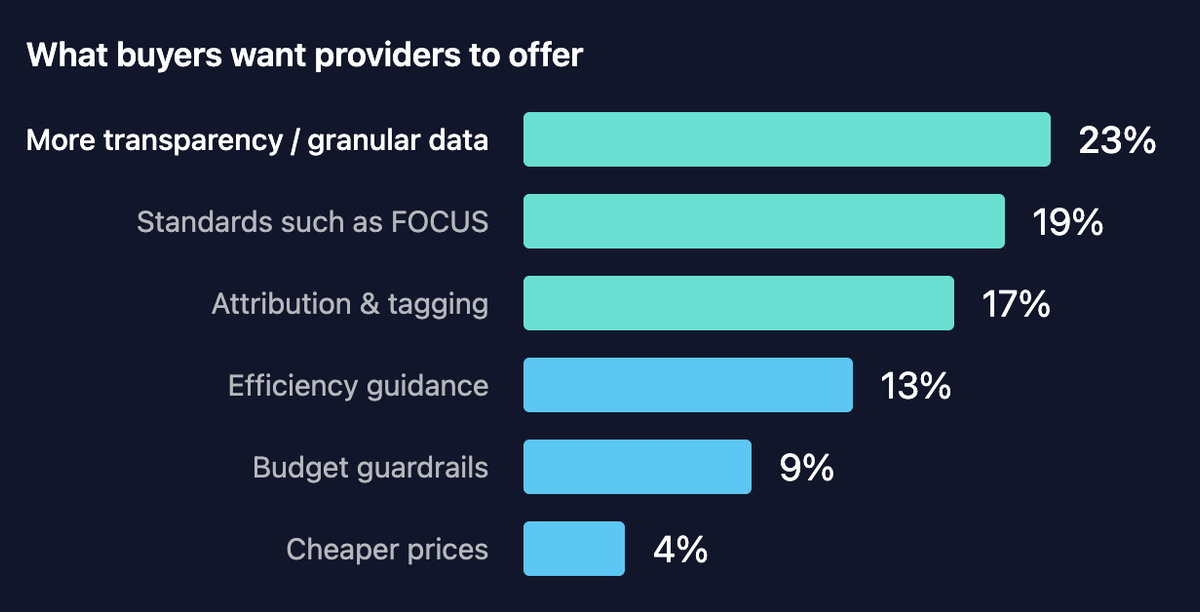
The biggest ask, at 23%, is more transparency and more granular usage data, standardized billing close behind at 19%, with enough people naming the FOCUS billing standard directly in a free-text field that it's worth calling out by name. The smallest ask, by a wide margin, is cheaper prices, at just 4%. Companies care more about being able to explain the bill than about shrinking it.
Related: FinOps X 2026 Day 1 Keynote Recap: The Great Token Panic and Is FinOps Dead?!
9. AI is changing the way companies set their own prices
A few key observations from the survey:
- 52% of companies have already changed their pricing model because of AI costs or are actively considering it. Another 30% report no change, and 18% say it's simply too early to tell.
- Where pricing is shifting, it's moving toward usage-based and outcome-driven models, largely because AI costs are unpredictable enough that they're putting real pressure on existing margins.
One more factor is entering the pricing conversation for a meaningful slice of companies: 38% say they're now considering energy consumption as part of their tokenomics practice. Unsurprisingly, that's concentrated among the companies that own or rent their own hardware and either train first-party models or run open-weight models, the companies for whom electricity is a direct line item instead of bundled into a vendor's per-token price.
10. AI is Having a Real Impact on Labor
AI's effect on staffing shows up in the survey as four distinct, roughly equal-weight themes, and it's worth naming all four rather than just the comfortable ones.
- Companies do report real productivity gains, doing more work with the staff they already have.
- They're also shifting skill requirements, investing more in AI-specialized roles while pulling back on demand for traditional or entry-level positions.
- Budgets are being reallocated too, with money that would have gone to traditional hiring redirected into AI investment instead, effectively treating AI spend as a hiring alternative.
- Companies have implemented actual workforce reductions, with some experiencing significant layoffs directly attributed to AI adoption.
That last one is a harder finding than “upskilling instead of replacing.”
What This Means
Proving value is the thread connecting almost every other section: it's the top-named challenge by a wide margin, it's what routing and attribution tools are shown to actually move the needle on, and it's what companies are asking providers for data to help them do, not asking for a discount instead.
nOps builds the attribution and value-measurement layer this data says is missing across AI providers and multicloud.
- Full AI cost visibility: hourly granularity across a comprehensive set of models and providers with 100% of spend automatically allocated
- Business Unit Economics: define custom units: customers, products, teams — and get cost per unit and margin without a separate allocation project first
- Real-time anomaly detection & forecasting: same-hour alerts when a model, account, or feature spikes past its baseline
Book a free savings analysis to see your own AI unit economics mapped out. nOps manages $5B+ in cloud spend and was recently rated #1 in G2's Cloud Cost Management category.
nOps manages $5 billion in AI and cloud spending and was recently ranked #1 in G2’s Cloud Cost Management Category.