
ProsperOps vs Archera vs nOps: The Essential Guide
AWS Reserved Instances and Savings Plans offer substantial cost savings compared to On-Demand pricing — in exchange for committing to a set amount of usage over time. However, making the right commitments can be complex. Purchasing too much locks you into financial risk, whereas being too conservative might mean missing out on savings.
If you’re looking for a commitment management platform, evaluating the options can be complex. Solutions like ProsperOps focus on automated commitment adjustments, while Archera adds “insurance” to your purchases. nOps takes a broader approach, integrating commitment management with holistic cost optimization and guaranteeing 100% utilization.
This guide breaks down how nOps, ProsperOps, and Archera compare—helping you find the right fit for your needs.
The emergence of ProsperOps and Archera
As cloud adoption grew, businesses faced increasing complexity in managing AWS Reserved Instances (RIs) and Savings Plans (SPs). The challenge is that RIs and SPs each offer unique advantages, and there are literally millions of options to choose from. And as your organization scales and evolves its needs, commitment purchases must be continually reevaluated to ensure you’re still optimized.
This created a demand for automated commitment management solutions that could optimize savings without manual intervention. ProsperOps and Archera emerged to address this challenge, each with a distinct approach to commitment optimization.
What is ProsperOps?

Founded in 2018, ProsperOps was developed as an AWS commitment management platform. The company built an optimization engine that recommends and automatically adjusts Reserved Instance and Savings Plan purchases. By leveraging automation and machine learning, ProsperOps reduces the need for manual decision-making in commitment planning.
What is Archera?
Archera, originally launched as Reserved.ai in 2019, was founded to address risk mitigation in cloud commitment management. It introduced financing options that allow businesses to purchase commitments with built-in “insurance” for usage fluctuations. By incorporating predictive analytics and commitment liquidity, Archera aims to manage financial risk while still delivering savings.
What is nOps?

nOps integrates commitment management into a broader, end-to-end savings strategy. Unlike traditional commitment platforms, nOps offers the industry’s only 100% utilization guarantee, ensuring every dollar committed delivers savings. And instead of just automating RI and SP purchases, nOps optimizes across all cost levers—including rightsizing, Spot optimization, and engineering visibility—maximizing your flexibility and savings while minimizing waste and financial lock-in.
ProsperOps vs Archera vs nOps
ProsperOps, Archera and nOps have some important distinctions in their approach to commitment management, the guarantees they offer, and features included in the platform.
Let’s briefly compare the features offered by ProsperOps, Archera and nOps before diving into a more detailed analysis.
Feature | nOps | Archera | ProsperOps |
Commitment Management | |||
Fully Automated Management of RI and SP | ✅ | ✅ | ✅ |
Commitment Monitoring & Visibility | ✅ | ✅ | ✅ |
100% Utilization Guarantee (or refund of fee) | ✅ | ❌ | ❌ |
Financing and “insurance” | ❌ | ✅ | ❌ |
Fee structure aligns incentives with customer | ✅ | ❌ | ✅ |
Official AWS partner | ✅ | ✅ | ✅ |
Coverage of AWS, Azure and GCP | ❌ (AWS only) | ❌ (AWS and Azure only) | ❌ (AWS only) |
Spot Management & Kubernetes Optimization | |||
Intelligent Instance Selection | ✅ | ❌ | ❌ |
Real-time workload Management | ✅ | ❌ | ❌ |
AWS-certified Spot Partner | ✅ | ❌ | ❌ |
Commitment awareness | ✅ | ❌ | ❌ |
Fully Automated Container Rightsizing | ✅ | ❌ | ❌ |
Resource Optimization | |||
Automated Resource Rightsizing | ✅ | ❌ | ❌ |
Automatically Eliminate Idle EC2 | ✅ | ❌ | ❌ |
Automated EBS Optimization | ✅ | ❌ | ❌ |
Automated Resource Scheduling | ✅ | ❌ | ❌ |
Automated GP2 to GP3 | ✅ | ❌ | ❌ |
Visibility, Reporting, Budgets & Dashboards | |||
Cost Allocation | ✅ | ❌ | ❌ |
Automated Tagging | ✅ | ❌ | ❌ |
Budget Management | ✅ | ❌ | ❌ |
Reports & Dashboards | ✅ | ✅ | ✅ |
Break down costs by any Kubernetes concept | ✅ | ❌ | ❌ |
Break down costs by any finance concept | ✅ | ❌ | ❌ |
Kubernetes Costs Unified with All Spend | ✅ | ❌ | ❌ |
For a complete comparison of cloud cost optimization platforms across the market, you can check out the full Buyer’s Guide to Cloud Optimization.
Related Content
The Ultimate Guide to AWS Commitments
Best practices and advanced strategies for maximizing AWS discounts
Download Now
1.Commitment Management
ProsperOps and nOps both automate AWS commitment management, but the key difference comes down to the guarantee. ProsperOps offers a 99% utilization guarantee, while nOps guarantees 100% utilization—meaning any unused portion of commitments is automatically refunded, no action needed. In contrast, ProsperOps requires customers to manually submit a claim within 10 days to receive a refund. With nOps, customers never carry the financial risk—every commitment under management is either fully utilized or fully refunded.

Archera takes a fundamentally different approach to commitment management from nOps and ProsperOps, positioning itself as an “insurance provider” rather than aligning its fees directly with customer savings. Instead of charging only a portion of actual savings like nOps or ProsperOps, Archera’s pricing is based on a risk-based premium model—meaning customers pay for protection whether or not they actually save money.
While Archera offers flexibility with commitments as short as 30 days, its approach to handling unused commitments is unclear. Some customers have reported granting the platform permissions to attach and detach AWS accounts, presumably to transfer unused commitments. This also raises questions about Archera’s long-term sustainability. AWS has been tightening restrictions on transferring, repurposing, or reselling commitments. If Archera’s model relies on mechanisms that Amazon eventually blocks, customers could be left without a clear path for managing their unused commitments.
2.Spot & Convertible Reserved Instances (CRIs)
While ProsperOps and Archera manage commitments, commitment management is only one piece of maximizing your discounts.
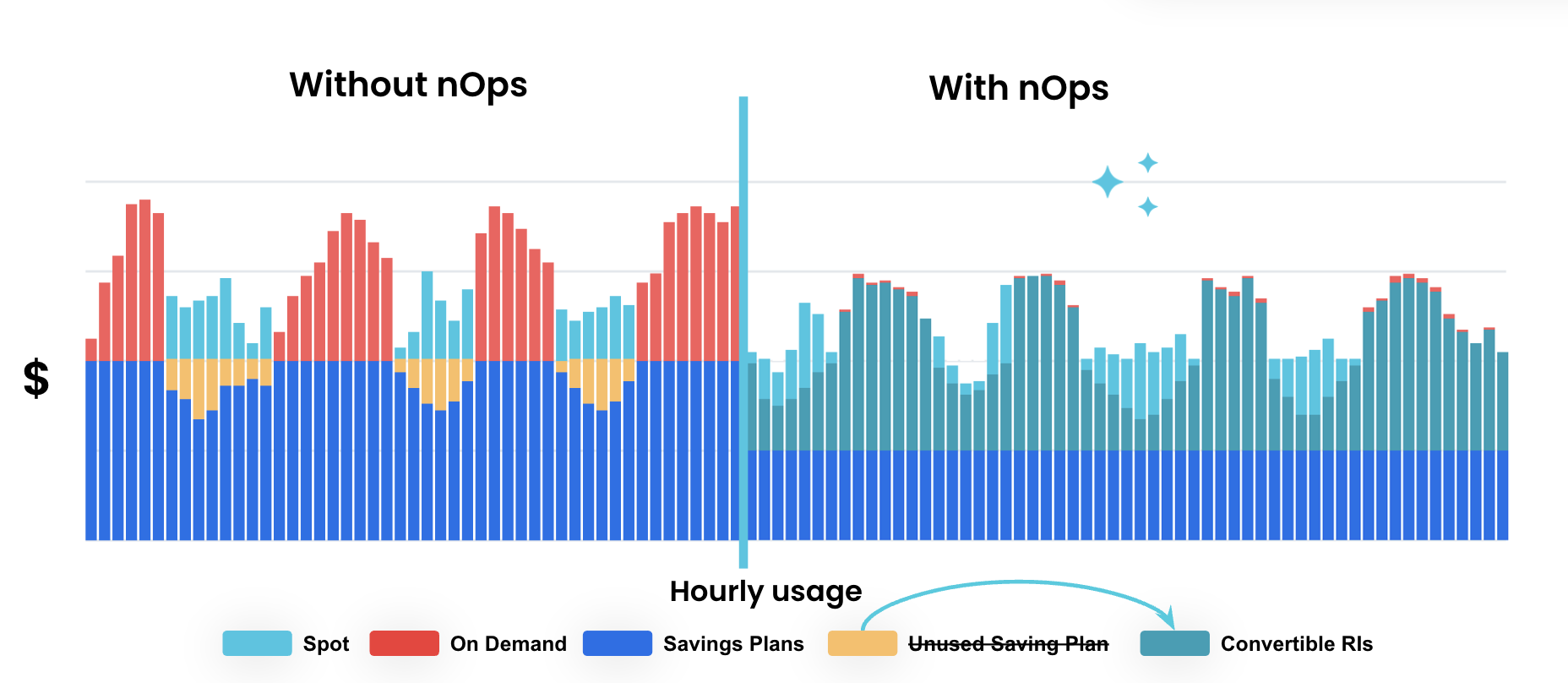
Often, teams think they can cover 100% of their compute by buying Saving Plans or Reserved Instances. But in practice, it’s typically only cost-effective to cover about half of On-Demand usage with traditional commitments.
Why? SPs and RIs apply hourly, and operate on a “use it or lose it” basis. If you commit to $10 every hour but only consume $6 of services in a particular hour, you will lose the remaining $4. Because you can’t cover spikes with commitments, most companies are left with 40-50% of compute usage On-Demand, the highest AWS pricing tier.
To truly get the lowest compute costs, Spot instances offer a powerful solution for handling demand fluctuations, offering up to 90% savings compared to On-Demand. Convertible RIs offer another mechanism for flexibility. Unlike pure commitment management solutions like ProsperOps and Archera, nOps offers full support for Spot, optimizing across RI, SP and Spot without any effort on your part.
3.Cloud Optimization Automation
In an ideal world, you would rightsize your resources, optimize storage, and clean up idle resources before committing to Reserved Instances and Savings Plans. That way, you avoid overcommitting and wasting money on unused capacity.
nOps makes it easy to automate time-consuming cost optimization tasks, such as resource rightsizing, idle EC2 and EBS cleanup, resource scheduling, GP2 to GP3 migration, EBS snapshot cleanup, and more. It integrates with your preferred monitoring tools (Datadog, CloudWatch, etc.) for high-resolution recommendations that can be implemented in one click.
Unlike fragmented solutions that require juggling multiple tools, nOps optimizes across all cost levers in a single platform, streamlining cost management and reducing overhead. By making complete cost optimization quick and easy, nOps frees up your engineering team’s time to focus on building and innovating.
4.Free Visibility and Cloud Management Features
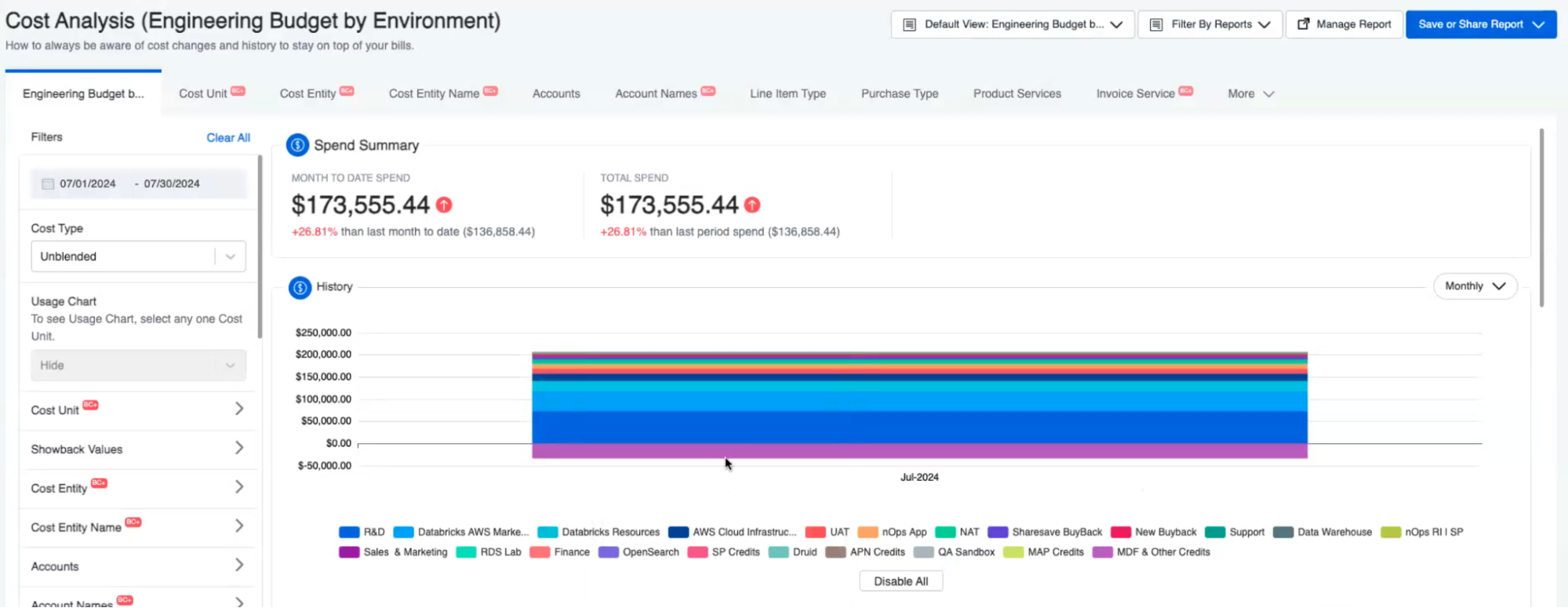
nOps Business Contexts makes it easy to get visibility into 100% of your combined AWS, Azure, GCP, Kubernetes and third-party tool costs. It includes all the visibility features you need for breaking down your unified cloud costs, including:
- Automated & customizable dashboards
- 40+ filtersbuilt for engineering and finance
- Report templatespre-built by experts to show common cost drivers
- Automated tagging & cost allocation
- Advanced budgeting& alerting
About nOps
nOps was recently ranked #1 with five stars in G2’s cloud cost management category, and we optimize $2 billion in cloud spend for our customers.
At nOps, our mission is to make it easy for engineers to optimize. Join our customers using nOps to understand your cloud costs and leverage automation with complete confidence by booking a demo today!