
Top nOps Alternatives & Competitors Compared (2026)
Cloud bills now span more than one cloud, Kubernetes clusters, SaaS tools and fast-growing AI spend, and keeping costs under control means both seeing where that money goes and cutting what you pay for it. Choosing a platform for the job is harder than it looks, because each one covers a different part of the problem, with its own strengths, pricing model and best-fit team.
nOps has become a leading option for teams that want both, pairing cost visibility across AWS, Azure, Google Cloud, Kubernetes, SaaS and AI with automated commitment management. nOps manages more than $5 billion in annual cloud spend for 500+ companies, including Roku, Sonos, Arlo and iSpot, and holds a 4.8 out of 5 rating on G2. In this guide, we break down the top nOps alternatives and how they compare, so you can choose the platform that fits your organization.
nOps Alternatives at a Glance (2026)
The table below compares the leading nOps alternatives.
Tool | Cloud coverage | Core strength | Pricing model | Best-fit team |
nOps | AWS, Azure, GCP; Kubernetes, SaaS and AI spend | Autonomous commitment management across all three clouds plus hourly cost visibility and allocation in one platform | Share of savings (optimization) plus fixed fee based on cloud spend (visibility); 14-day trial | FinOps and platform teams that want savings executed and visibility in the same place |
CloudZero | AWS, Azure, GCP and 50+ sources incl. Kubernetes, Snowflake, Databricks, AI APIs | Cost intelligence and unit economics (cost per customer, feature, token); no commitment execution | Tiered subscription sized to cloud estate; quote-based; unlimited users | Engineering-led orgs where margin analysis is the primary job |
Vantage | 30+ providers incl. AWS, Azure, GCP, Kubernetes, Datadog, Snowflake, OpenAI, Anthropic, Cursor | Self-serve cost reporting and virtual tagging; Autopilot buys AWS Savings Plans only | Published tiers: free to $200/mo by tracked spend; Enterprise custom | Startups and developer-led teams that want visibility fast |
ProsperOps (Flexera) | AWS, Azure, GCP | Autonomous Discount Management for RIs, Savings Plans and CUDs; no allocation or SaaS/AI visibility | Savings Share, including savings on commitments you already owned; ARM flat fee per resource | Teams that want a commitment engine only and already own a visibility tool |
Spot by Flexera | AWS, Azure, GCP | Spot Instance and VM automation (Elastigroup), Kubernetes nodes (Ocean), commitments (Eco) | Contract plus usage-based charges (vCPU-hours managed; savings dimension for Eco) | Enterprises on Flexera One or running Spot-heavy fleets |
Kubex (formerly Densify) | AWS, Azure, GCP, OCI; Kubernetes; GPU | Rightsizing for containers, instances and GPUs; no commitments or allocation | $499/mo up to 500 vCPUs or 50 GPUs; enterprise custom | Platform and SRE teams whose main waste is overprovisioned compute |
AWS native tools | AWS only | Baseline reporting (Cost Explorer) and rightsizing recommendations (Compute Optimizer); manual execution | Console free; API $0.01/request; hourly granularity paid | Single-cloud teams establishing a baseline |
Why Teams Look for a nOps Alternative
Searches for a nOps alternative mostly come from teams running a FinOps evaluation with nOps already on the shortlist. Four requirements decide most of those evaluations. For each one, the useful question is which approach meets it and what that approach costs you somewhere else.
Multi-cloud vs AWS-native requirements
Cloud footprint sorts the category before any feature does. An AWS-only shop with little SaaS or AI spend can get a long way on free native tooling. Once Azure or GCP workloads appear, or Snowflake, Datadog and OpenAI invoices start to rival the EC2 line, the choice becomes whether you want one platform that reports across all of it or one that also optimizes across all of it.
Approach | Tools | What you get | What you give up |
AWS-native only | Cost Explorer, Compute Optimizer | Free, no setup, data straight from the billing source | No view of Azure, GCP, SaaS or non-Bedrock AI; recommendations you purchase by hand |
Multicloud reporting, limited execution | Vantage, CloudZero | One reporting plane across 30 to 50+ billing sources | Savings depend on your team acting; Autopilot covers AWS Savings Plans only; CloudZero hands execution to a partner |
Multicloud execution, single purpose | ProsperOps, Spot Eco | Commitments managed on AWS, Azure and GCP | A second product for allocation, budgets, anomalies, SaaS and AI |
Multicloud execution plus visibility | nOps | Commitments managed on AWS, Azure and GCP; hourly visibility across clouds, Kubernetes, SaaS and AI in the same platform | Resource rightsizing stays with the Kubernetes tooling you already run |
nOps commitment management covers AWS, plus Azure and Google Cloud, with one set of metrics across all three. The visibility layer adds Kubernetes through a lightweight agent, SaaS vendors such as Datadog, Snowflake, MongoDB and Cloudflare, and AI spend from Bedrock, OpenAI, Anthropic, Cursor and Claude Code.
Pricing-model preferences (% of spend vs flat vs pay-for-savings)
Three pricing models cover every tool on this page, and each one changes who carries the risk.
- Spend-based subscription (CloudZero, Flexera Cloud Cost Optimization, Vantage Enterprise). The fee is tiered to the size of your cloud estate or charged as a percentage of spend. It is predictable and usually comes with unlimited users. The tradeoff: the fee is identical in a month where nothing is saved, and it rises as your bill does.
- Flat published tiers (Vantage at free, $30 and $200 a month; Kubex at $499 a month for up to 500 vCPUs). The lowest entry cost and the easiest to approve. The tradeoff: tracked-spend caps and seat limits are what move you up a tier, so growing teams end up on a custom quote anyway.
- Pay for savings (nOps, ProsperOps, Spot Eco). The fee is a percentage of savings generated, so a month with no savings costs nothing. The tradeoff lives in the definition of savings. ProsperOps charges its Savings Share on "Inherited Savings" from commitments you bought yourself and bills unrealized share for up to 12 months if you leave. nOps charges only on incremental savings from commitments it purchases on your behalf, never on what you already own.
Specific feature or integration gaps
The gap that surfaces most often is execution. Visibility platforms are built to inform, and they do it well: CloudZero's unit cost metrics and Vantage's 30+ integrations are why they get shortlisted. Neither manages commitments end to end, and Cost Explorer leaves every purchase to you. The benefit of this model is control. The cost is that savings arrive only when someone acts, and nothing rebalances when usage shifts.
The mirror-image gap sits in the commitment engines. ProsperOps and Spot Eco execute well across three clouds, but allocation, budgets, anomaly detection and SaaS or AI spend come from Flexera One or a separate vendor. That means two contracts, two data models and two renewals to manage.
nOps closes both gaps in one platform: commitments executed across AWS, Azure and GCP, and hourly visibility across clouds, Kubernetes, SaaS and AI. The one function nOps deliberately leaves to other tools is resource rightsizing, which is why it is built to run alongside Karpenter, Ocean, Cast AI or Kubex rather than replace them.
Team size and FinOps maturity fit
The right tool shifts with how much commitment-eligible spend you have and who is available to manage it.
- Early stage. Vantage's free Starter tier (up to $2,500 in tracked spend) and Cost Explorer are enough to see the bill. nOps's free 30-minute savings analysis answers whether there is enough commitment-eligible spend for automation to pay for itself yet.
- Growth and mid-market. This is where spreadsheet-driven commitment management breaks: usage changes faster than anyone can re-plan purchases, and coverage lags. nOps onboards in under five minutes without a FinOps hire, and G2 names it Best Estimated ROI for Mid-Market in cloud cost management.
- Enterprise with a dedicated FinOps function. CloudZero and Flexera sell account-managed contracts built for this segment. nOps serves it with $5B+ under management, AWS Marketplace procurement that counts toward EDP and PPA commitments, SOC 2 Type 2, and a commitment footprint that shrinks over time so that after twelve months there is no ongoing lock-in risk.
Top nOps Alternatives Compared
Each profile covers what the tool specializes in, how it compares with nOps on the requirements above, how it is priced and who it suits. Competitor claims come from their own pricing pages and documentation.
CloudZero
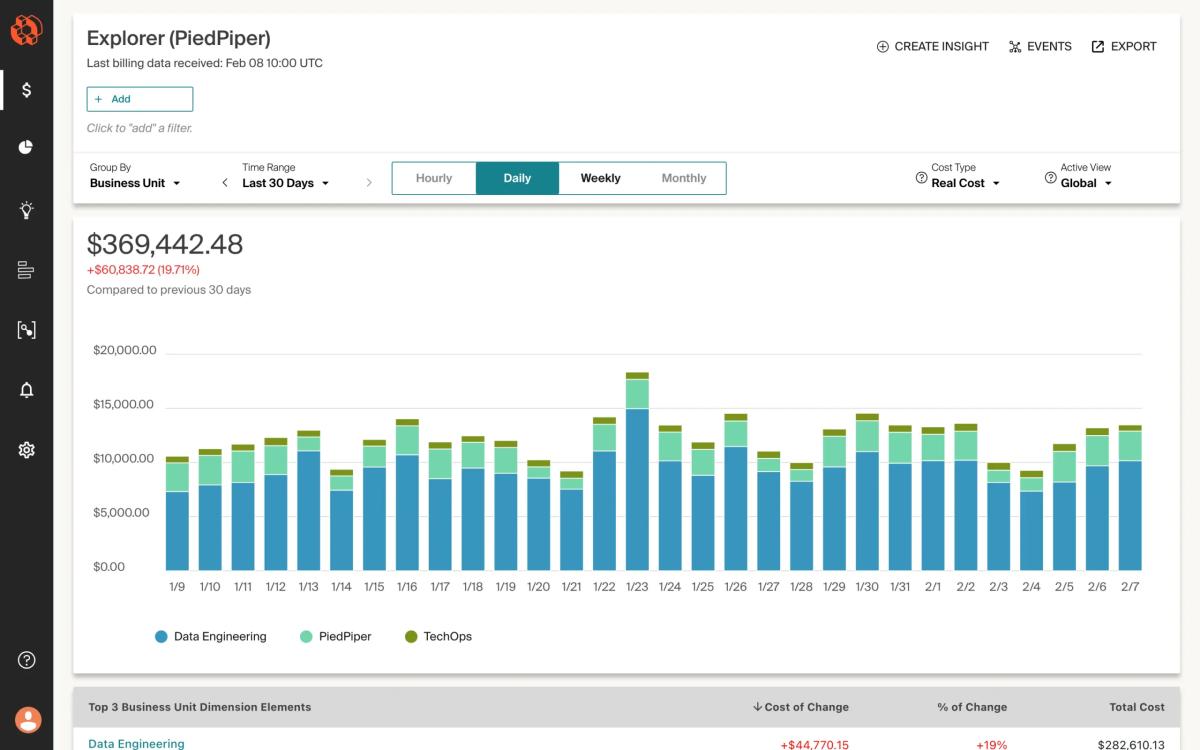
CloudZero is a cost intelligence platform that ingests billing data from more than 50 sources, including AWS, Azure, GCP, Kubernetes, Snowflake, Databricks and AI APIs, and maps it to business dimensions such as customer, feature and team. Its CostFormation approach allocates without requiring tags, and every subscription includes unlimited users and a dedicated FinOps Account Manager.
Where it is strong
- Unit economics: cost per customer, per feature and per token are its signature outputs, useful for SaaS margin analysis.
- Breadth of ingestion across data platforms and AI providers.
- Account management included, which helps teams standing up a FinOps practice from scratch.
Compared with nOps
- CloudZero does not purchase commitments. Its documentation routes automated RI and Savings Plan management to ProsperOps and Spot automation to Xosphere, so realizing savings means your team acting on recommendations or adding a second vendor. nOps executes commitments across AWS, Azure and GCP natively.
- CloudZero's subscription is sized to your cloud estate and costs the same regardless of savings.
- Both allocate without tags. nOps does it at hourly granularity, across Kubernetes, SaaS and AI as well as cloud, with a guarantee that allocated plus unallocated equals total spend.
Pricing
Tiered subscription sized to the cloud estate, quote-based, no published rates, no overage charges.
Best for
Engineering-led organizations where per-customer margin analysis is the primary job and commitment execution is handled elsewhere. More in Vantage vs nOps vs CloudZero.
Vantage

Vantage is a self-serve cost reporting platform with published, fixed pricing and 30+ integrations spanning the three major clouds, Kubernetes, Datadog, Snowflake, OpenAI, Anthropic and Cursor. Virtual tagging, budgets, anomaly alerts, a Terraform provider and an MCP server round out a developer-friendly feature set.
Where it is strong
- Lowest-friction entry in the category: free up to $2,500 in tracked spend, a credit card for Pro and Business, 14-day trials.
- Broad SaaS and AI provider coverage for reporting.
- FinOps-as-code through its Terraform provider and API.
Compared with nOps
- Autopilot, Vantage's commitment feature, buys AWS Savings Plans only. It does not manage Reserved Instances, database or analytics commitments, Azure reservations or GCP CUDs. nOps manages Savings Plans, RIs and CUDs across compute and non-compute services on all three clouds.
- Self-serve tiers cap seats at 3, 5 and 10 users and tracked spend at $2,500, $7,500 and $20,000, with 6 months of data retention on Starter and Pro. Above that is a custom Enterprise quote.
- Vantage reports. nOps reports and executes.
Pricing
Starter free; Pro $30 a month; Business $200 a month; Enterprise custom.
Best for
Startups and developer-led teams that want multi-source visibility quickly and are not yet automating commitments. Detail in Vantage Pricing Explained.
ProsperOps (a Flexera company)
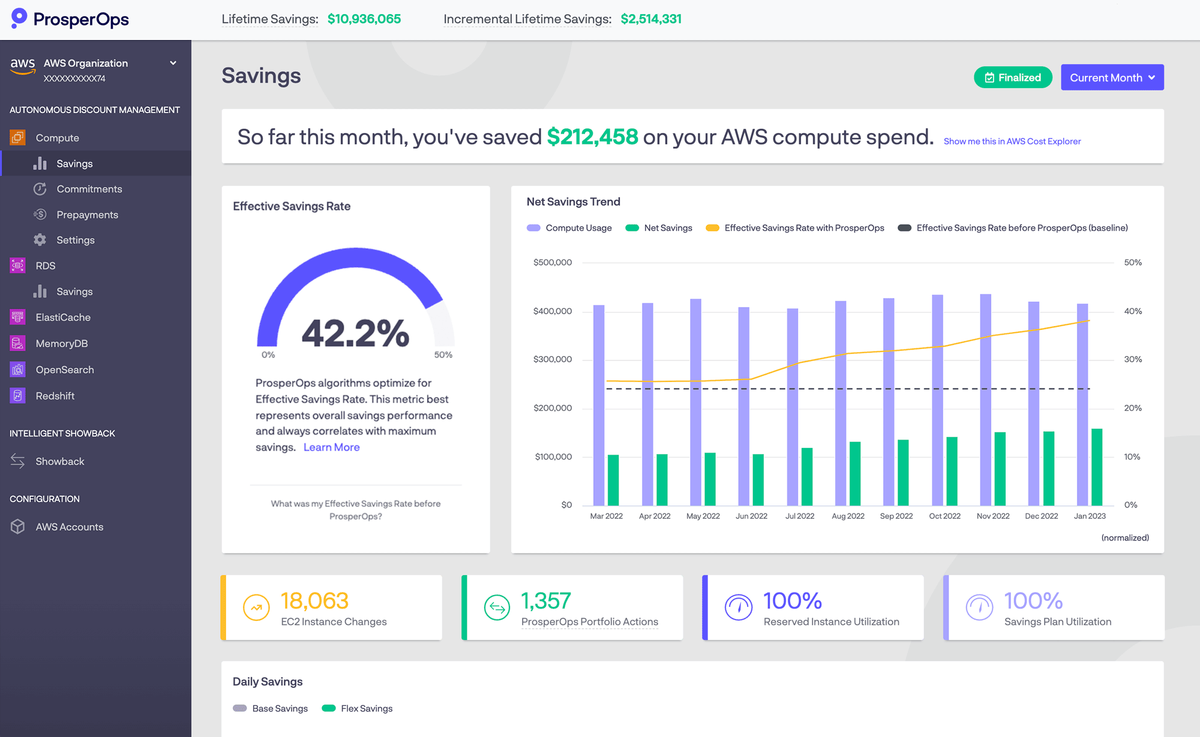
ProsperOps is the closest like-for-like alternative to nOps's commitment engine. Its Autonomous Discount Management buys, exchanges and ladders Savings Plans, RIs and CUDs across AWS, Azure and Google Cloud, with about $6 billion in annual cloud usage under management. Flexera acquired ProsperOps in January 2026 and now bundles it with Spot's Ocean and Elastigroup as ProsperOps+.
Where it is strong
- Mature, fully autonomous commitment execution on three clouds, including AWS database and analytics services.
- Effective Savings Rate reporting and Intelligent Showback for commitment costs.
- Listed on the AWS, Azure and Google Cloud marketplaces.
Compared with nOps
- ProsperOps optimizes rates and nothing else. Cost allocation, budgets, anomaly detection and SaaS or AI visibility come from Flexera One or another vendor. nOps delivers commitment automation and hourly multicloud, Kubernetes, SaaS and AI visibility in one platform.
- ProsperOps's Savings Share is charged on Inherited, Base, Flex and Smart Savings, so a percentage applies to savings from commitments you procured before ProsperOps arrived, and cancellation triggers a final charge for future-to-be-realized savings on managed commitments, up to 12 months. nOps charges only on incremental savings from commitments it buys, with no fee in a month without them.
- nOps reports that customers who switch save 20% more on average than with their previous tool, and that its continuous rebalancing often outperforms competitors by 20%.
Pricing
Savings Share for Autonomous Discount Management; flat fee per managed resource for Autonomous Resource Management.
Best for
Teams that want a commitment engine only and already own a visibility platform. Deeper comparison in ProsperOps vs nOps vs Archera.
Spot by Flexera (formerly Spot by NetApp)
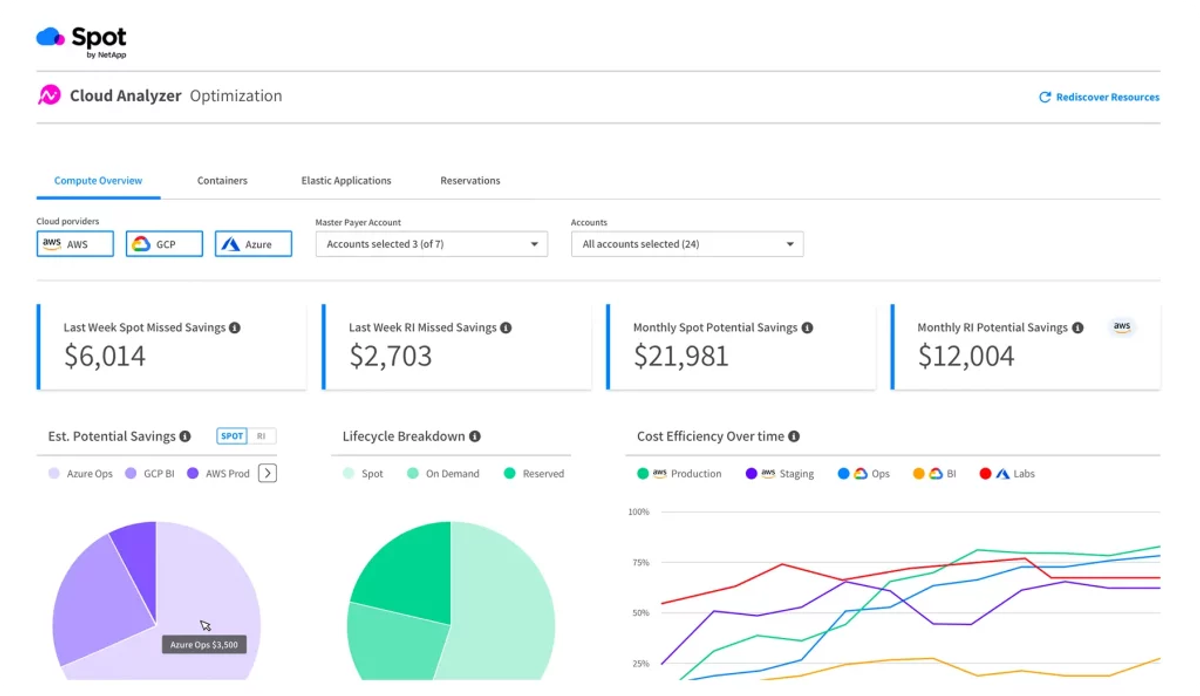
Spot by Flexera is a suite rather than a single product: Elastigroup manages Spot Instances and VMs with interruption prediction, Ocean handles Kubernetes node autoscaling and bin-packing, Eco manages RIs and Savings Plans, and CloudCheckr provides MSP-oriented cost reporting. Flexera closed the acquisition from NetApp in March 2025 and is folding each product into Flexera One.
Where it is strong
- Spot Instance orchestration at scale, with ML-based interruption prediction and automatic fallback to on-demand.
- Kubernetes node optimization through Ocean, which takes over cluster autoscaling.
- Deep integration for enterprises already running Flexera One.
Compared with nOps
- Spot's center of gravity is usage-side compute automation; Eco, the commitment product, is one module among several. nOps is a pricing-side platform that runs alongside Ocean and Elastigroup, so the real comparison is Eco vs nOps for commitments, where nOps adds hourly multicloud visibility in the same product and a fee charged only on savings.
- Spot pricing is a contract plus usage-based charges: per vCPU-hour managed for Ocean and Elastigroup, and a savings dimension for Eco on top. nOps's visibility tier is a flat fee and its optimization tier is savings-only.
Pricing
Contract plus usage-based charges; Eco priced against savings.
Best for
Enterprises standardizing on Flexera One, or teams whose primary lever is Spot orchestration. Related: Cast.ai vs Spot vs nOps.
Kubex (formerly Densify)
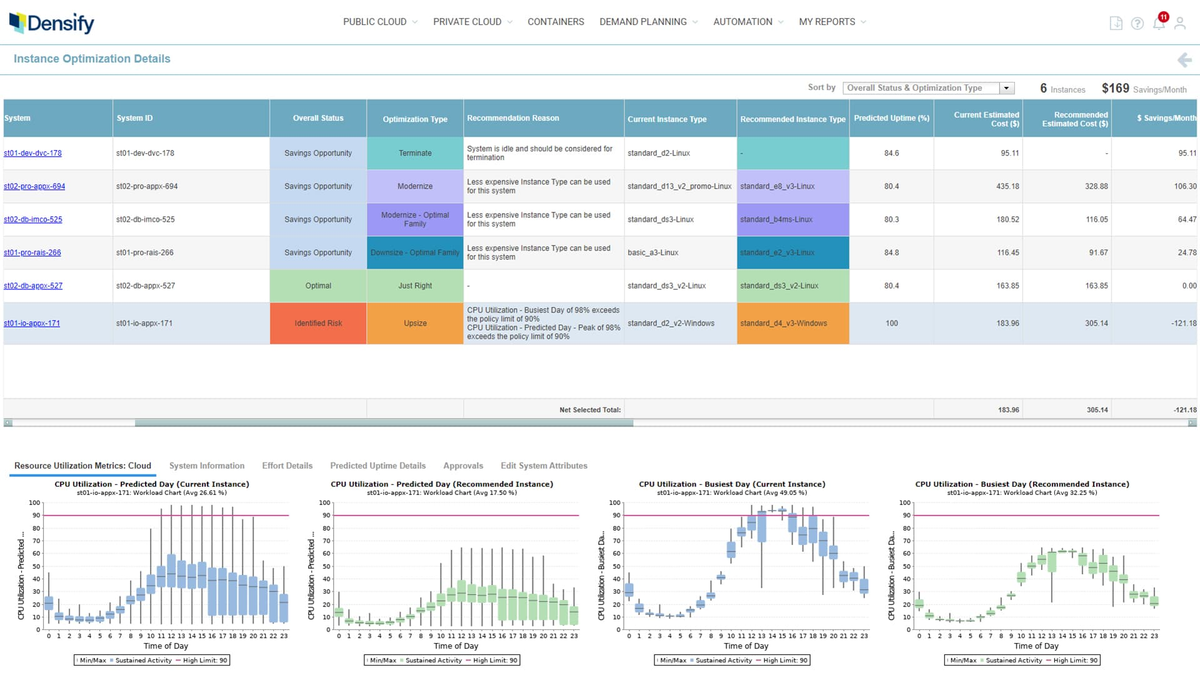
Densify rebranded to Kubex on January 1, 2026, reflecting its focus on Kubernetes, GPU and cloud resource optimization. Kubex recommends, and through its automation controller applies, container request and limit changes, node specs, EC2 and RDS instance families and auto scaling group sizing across AWS, Azure, GCP and OCI, plus GPU allocation and NVIDIA MIG planning for AI workloads.
Where it is strong
- Predictive container sizing that analyzes long lookback periods to catch seasonal patterns.
- GPU utilization tracking and MIG planning, which few cost tools offer.
- Published pricing.
Compared with nOps
- Kubex optimizes resources; nOps optimizes pricing. Kubex does not purchase commitments, allocate spend to business units or track SaaS and AI vendor costs.
- The two are complementary. nOps commitment management is built to coexist with the rightsizing tooling a platform team already runs, and the on-demand usage that remains after Kubex rightsizes a cluster is what nOps covers with commitments.
Pricing
$499 a month for up to 500 vCPUs or 50 GPUs; volume pricing above that.
Best for
Platform and SRE teams whose biggest waste is overprovisioned Kubernetes and GPU capacity, typically alongside a pricing tool.
AWS native tools (Cost Explorer, Compute Optimizer)
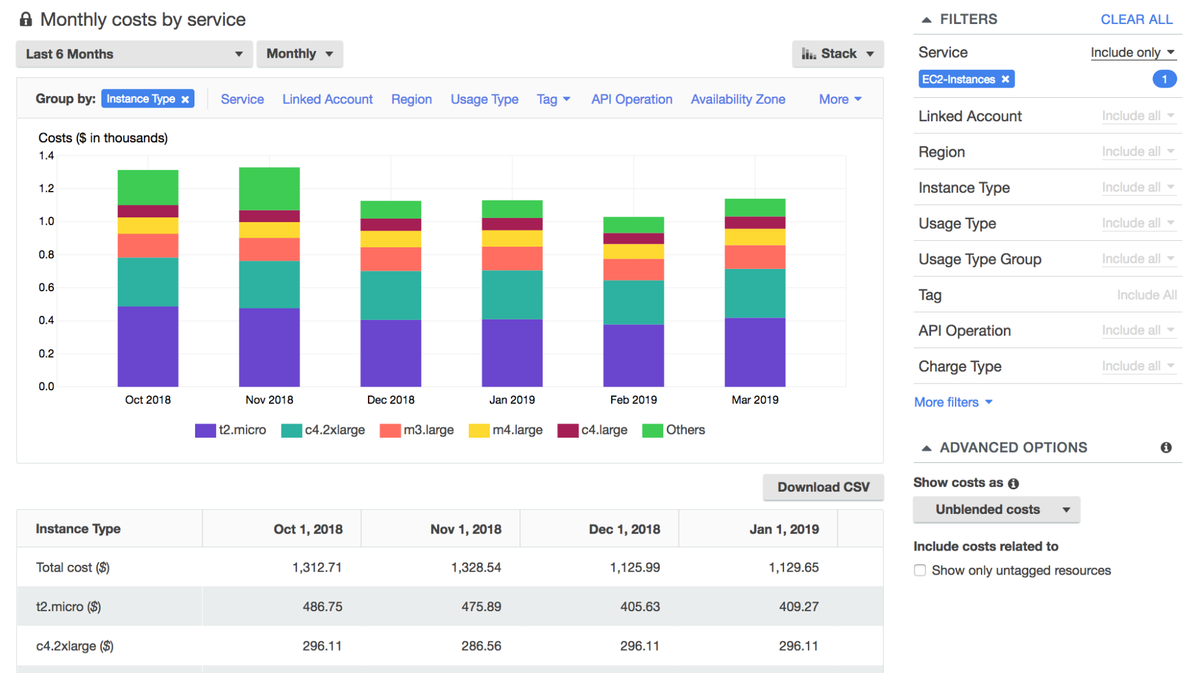
Cost Explorer is free to use in the console and provides 13 months of daily and monthly data, forecasts, Savings Plan and RI purchase recommendations, and coverage and utilization reports. The API costs $0.01 per request and hourly granularity is a paid add-on with a 14-day lookback. Compute Optimizer produces rightsizing recommendations for EC2, EBS, Lambda, ECS on Fargate and RDS at no charge on its default tier, and Cost Anomaly Detection and the first two AWS Budgets are free.
Where it is strong
- Free, native and already enabled in every account.
- The authoritative source for AWS billing data.
Compared with nOps
- Every recommendation is purchased by hand, one at a time, and nothing rebalances as usage changes. nOps purchases and rebalances automatically, in increments as frequent as hourly.
- AWS only: no Azure, GCP, SaaS or non-Bedrock AI spend. nOps unifies all of them.
- Allocation depends on tags being in place, and hourly granularity is paid and limited to 14 days. nOps allocates without tags, at hourly granularity, with a visible unallocated bucket.
Pricing
Console free; API $0.01 per request; hourly granularity paid.
Best for
Single-cloud teams establishing a baseline before adding a platform.
How These Tools Compare on the Things That Matter
Five criteria determine outcomes in a FinOps evaluation. The sections below explain how the tools compare on each.
AWS-native depth and automation
Every tool here reads the AWS Cost and Usage Report. Depth is about what happens next, and there are three levels. AWS's own tools have the most direct data access and cost nothing, but every action is manual. Third-party visibility platforms add tag-free allocation, multi-source reporting and anomaly detection on top of the CUR, then stop at recommendations for commitments; CloudZero formalizes this by partnering with ProsperOps for execution. Execution platforms act on the account through a least-privilege IAM role, purchasing and adjusting commitments without touching workloads.
nOps sits in the third group with the broadest service coverage on this list: Savings Plans and RIs across EC2, Fargate and Lambda plus RDS, ElastiCache, Redshift, OpenSearch, DynamoDB, DocumentDB, Neptune, Keyspaces, Timestream, MemoryDB and SageMaker, adjusted on an hourly basis. iSpot runs discounts on 95% of its EC2 usage this way. nOps is an AWS Advanced Technology Partner and transacts through AWS Marketplace, where purchases count toward EDP and PPA commitments.
Commitment management (RIs, Savings Plans, Spot compatibility)
Commitment discounts are the largest pricing lever on any cloud bill, and three approaches exist for capturing them.
- Visibility and recommendations (CloudZero, Vantage, Cost Explorer). Coverage and utilization dashboards plus purchase recommendations. The benefit is control: nothing is bought without a human decision, and the fee is a flat subscription. The tradeoff is that savings depend on someone acting on time, and no one rebalances when a workload moves or a commitment expires, so coverage drifts and Effective Savings Rate erodes between review cycles.
- Dedicated commitment engines (ProsperOps, Spot Eco). Continuous, autonomous purchase and exchange, laddered to limit lock-in. The benefit is a higher Effective Savings Rate with no FinOps labor. The tradeoff is a single-purpose product: you still need a platform for allocation, budgets, anomalies, SaaS and AI, and the fee terms need reading (ProsperOps charges on inherited savings and on exit; Eco is priced on top of a Flexera contract).
- Integrated execution and visibility (nOps). Commitments purchased and rebalanced across AWS, Azure and GCP in increments as frequent as hourly, with allocation and visibility in the same product and a fee charged only on incremental savings from commitments nOps buys. nOps publishes a 55% effective savings rate and 20% more savings on average for customers who switch.
None of this conflicts with Spot Instances or Kubernetes autoscaling. nOps adjusts pricing instruments, not workloads, so it runs alongside Karpenter, Ocean, Elastigroup or Cast AI; the usage those tools leave on demand is what nOps covers with commitments. Because the engine commits in small increments, it shrinks the commitment footprint over time, so that after twelve months customers carry no ongoing lock-in risk.
Cost allocation and Business Contexts
Allocation answers who spent what, and it is the foundation for chargeback, budgets and unit economics. Three approaches are in use.
- Tag-dependent allocation (AWS Cost Categories, Cost Explorer). Free, but only as complete as your tagging discipline. Untagged spend accumulates in an unallocated bucket and shared services need manual splits.
- Tag-free allocation (CloudZero CostFormation, Vantage virtual tagging, nOps virtual tag rules). Rules assign cost to teams, products or customers from account, service, region or existing tags, with no re-tagging project. The differences are granularity (daily vs hourly), scope (cloud only vs Kubernetes, SaaS and AI) and completeness (whether unallocated spend is tracked explicitly).
- Commitment-only showback (ProsperOps Intelligent Showback). Reallocates RI and Savings Plan costs and savings to teams; not a general allocation tool. Spot and Kubex do not allocate.
nOps Business Contexts works at hourly granularity across multicloud, Kubernetes, SaaS and AI, keeps allocated plus unallocated equal to total spend with a visible unallocated bucket, and breaks AI spend down by model and by input, output, cache-read and cache-write tokens. CloudZero's distinctive output is unit cost per customer or feature; Vantage offers unit costs and LLM token allocation on paid tiers. iSpot used Business Contexts to align AWS costs with customer activity across a rapidly scaling infrastructure and hit its financial reporting goals on that basis.
Time-to-value and ease of setup
Setup effort scales with how deep a tool reaches into your environment.
- Read-only billing connections (Vantage, CloudZero, nOps visibility, and the free savings analyses from ProsperOps and nOps). An IAM role or billing export, with data in hours.
- Execution through least-privilege IAM (nOps, ProsperOps). An additional role scoped to purchasing and exchanging commitments; no agents and no workload changes. nOps publishes onboarding under five minutes, AWS Organizations onboarded through a CloudFormation StackSet or Terraform module, and a 14-day trial.
- Infrastructure-level tools (Kubex, Spot Ocean, Elastigroup). Kubex needs a Prometheus-based collector and a mutating admission controller for automation; Ocean takes over cluster autoscaling. The benefit is usage-side savings a pricing tool cannot produce; the cost is engineering time and change windows.
nOps targets time-to-value in days: commitment management begins producing savings as soon as it is enabled. Matt Morgan, Head of Engineering and Product at CommentSold, described the rollout as "easy and seamless," with on-demand costs down more than 34%.
Pricing transparency and alignment with value delivered
Transparency and alignment are different properties. Vantage and Kubex publish dollar prices; CloudZero, Flexera and every vendor's enterprise tier are quoted. Alignment is about whether the fee tracks the value delivered: a spend-tiered subscription costs the same in a month where nothing is saved and rises with your bill, while a savings share costs nothing without results.
Within savings-share models, the contract language decides the economics:
- What counts as savings, and what you owe on exit. ProsperOps charges on savings from commitments you already owned and bills up to 12 months of unrealized Savings Share when you leave; nOps charges only on savings from commitments it buys.
- What the visibility layer costs. With nOps it is a flat fee based on cloud spend in the same platform. With ProsperOps or Spot Eco it is a second product.
Where nOps Fits - and Where It Wins
nOps pairs unified cost visibility with automated commitment management and charges for the automation only when it saves money. On a shortlist that usually contains one visibility tool and one commitment tool, that combination is the reason customers choose it. "We considered several solutions, including another Reserved Instance solution, and then decided to work with nOps because it was a more complete solution," said Herman Lotter, Technology Operations Manager at Kurtosys, which lowered on-demand costs by more than 34% and tracks spend across the business with Business Contexts.
Visibility Across Multicloud, Kubernetes, SaaS, and AI
nOps Inform ingests AWS, Azure and GCP billing alongside Kubernetes, SaaS and AI spend and resolves it to the hour. What that delivers:
- 100% allocation without a tagging project. Virtual tag rules in a point-and-click builder assign every dollar to a team, product or environment, and an unallocated bucket shows exactly what is left.
- Anomalies caught in the hour. Each hour is compared against the same hour the prior week, and structural anomalies, such as a model appearing in an account where it should not, are flagged alongside cost spikes.
- AI spend at model and token level. Bedrock, OpenAI, Anthropic, Cursor, Claude Code and Codex spend broken down by model and by input, output, cache-read and cache-write tokens, with AI Wallets setting spend limits and predictive alerts at the group or seat level.
- SaaS and Kubernetes in the same view. Datadog, Snowflake, MongoDB, Cloudflare and other SaaS vendors sit next to cloud and container costs, so the full cost of a product or team is one query.
Alex Kuan, FinOps Lead at Arlo: "nOps doesn't just present data, it highlights the specific optimizations, anomalies, and inefficiencies we can address immediately."
Optimization, Not Just Visibility: Automated Commitment Management
Pricing is the largest single lever on a cloud bill, and nOps pulls it automatically. The commitment engine purchases, exchanges and rebalances Savings Plans and RIs across AWS, Azure and GCP, in increments as frequent as hourly, across compute and non-compute services. Published results:
- A 55% effective savings rate, with customers who switch saving 20% more on average than with their previous tool.
- Discounts on 95% of EC2 usage at iSpot.
- Compute costs down roughly 46% while scaling at Glooko.
- On-demand costs down 37% at Mobileum and 39% at Vermeg.
Pay for What You Save
nOps's commitment management is priced as a share of savings, calculated only on incremental savings from commitments nOps purchases on your behalf. Commitments you already own are never charged for, and a month without incremental savings has no fee. Cost visibility and allocation are priced separately as a flat fee based on cloud spend, with a 14-day free trial. Both are available through AWS Marketplace, where the purchase counts toward EDP or PPA commitments.
The entry point is a free 30-minute savings analysis that benchmarks your current effective savings rate against peers and quantifies the gap. G2 reviewers rate nOps 4.8 out of 5 with savings the most-cited strength; one Director of Engineering wrote that nOps "instantly saved our organization several thousand dollars a month" while the team worked on longer-term architecture changes.
How to Choose the Right Platform
The decision depends less on feature counts than on which lever you need pulled and who will pull it. Three steps settle most evaluations.
- Map your must-haves to the shortlist. If commitments need to be executed rather than recommended, the list is nOps, ProsperOps and Spot Eco. If unit economics across 50 billing sources is the job, it is CloudZero. If Kubernetes or GPU rightsizing is the priority, it is Kubex or Ocean, and either runs alongside a pricing tool. Decide separately whether you want a fixed subscription or a share-of-savings fee, and whether multicloud coverage needs to mean execution or just reporting.
- Run a proof-of-value on real spend before committing. nOps, ProsperOps and Vantage all offer free analyses or trials against your own billing data. Insist on numbers measured in effective savings rate from your actual Cost and Usage Report, not modeled "potential savings," and ask the vendor to show the gap between your current coverage and theirs.
- Questions to ask every vendor on the demo call. What exactly do you execute versus recommend? What counts as savings for billing, and do commitments we already own count? What happens to managed commitments and fees if we leave? Which Azure and GCP services are covered? How is Kubernetes, SaaS and AI spend allocated, and at what granularity?
The fastest way to answer those questions for nOps is to compare it against your own bill. The free savings analysis takes 30 minutes, needs minimal IAM permissions and shows exactly what a different approach to commitments would return across every cloud you run.
Frequently Asked Questions
Who are the main nOps competitors?
nOps competitors fall into three groups. Cost visibility platforms: CloudZero, Vantage and Flexera One (including CloudCheckr). Commitment automation specialists: ProsperOps, Spot Eco, Zesty, Archera and Usage.ai. Resource optimization tools: Kubex, Cast AI and ScaleOps. nOps competes with the first two groups, covering both functions in one platform, and is complementary to the third.
What is the best alternative to nOps?
It depends on which half of nOps you are replacing. For visibility and unit economics alone, CloudZero suits enterprises and Vantage suits self-serve teams. For commitment automation alone, ProsperOps is the closest match, with the Savings Share and exit-fee differences noted above. No single tool on this list covers both functions, so most teams that choose a nOps alternative end up pairing two tools.
How does nOps compare on pricing?
nOps uses two models: a share of savings for commitment management, charged only on savings from commitments nOps buys, and a fixed fee based on cloud spend for visibility and allocation. ProsperOps also uses a savings share but includes savings from commitments you already owned. CloudZero and Flexera charge spend-tiered subscriptions regardless of savings. Vantage charges flat tiers from free to $200 a month, and Kubex charges $499 a month for up to 500 vCPUs. Only the savings-share tools cost nothing in a month with no savings, and only nOps limits that share to the savings it created.
Is nOps or ProsperOps better for AWS?
Both automate commitment management on AWS across compute and non-compute services. The difference is scope and billing: nOps adds hourly cost visibility for Kubernetes, SaaS and AI in the same platform and charges only on savings from commitments it buys, while ProsperOps focuses on rate optimization and also charges on savings from commitments you already owned.