
Top Pump Alternatives for Cloud Cost Management
Commitment management platforms help teams optimize cloud discounts for AWS, Azure and/or GCP while balancing savings, flexibility, and long-term usage risk.
Pump has carved out a unique position by offering "free" cloud savings through group buying—pooling commitments across multiple customers to negotiate volume discounts. But that novelty comes with trade-offs: questions about AWS policy compliance, and a model that leaves some teams wondering what happens when usage patterns shift or the collective buying pool changes.
This guide evaluates Pump as well as seven Pump alternatives across the dimensions that matter most to FinOps practitioners: automation depth, multi-cloud coverage, commitment instrument breadth, risk management, and pricing transparency.
What Is Pump?
Pump is a cloud cost optimization platform that uses group buying and AI to deliver cloud savings. Founded in 2022 and backed by Y Combinator, the company positions itself as "the Costco of the cloud," pooling the purchasing commitments of multiple customers to negotiate volume discounts from AWS, GCP, and Azure.
Key Pump capabilities include:
- Group buying model that aggregates spend across customers for collective discounts
- AI-powered commitment management for Savings Plans and Reserved Instances
- Tiered pricing: Base plan is free with basic visibility; Plus plan ($599/month) includes automated commitment management ("Autopilot"); Enterprise plan offers custom pricing and dedicated support
- Quick setup with read-only and autopilot IAM roles
Why Look for Pump Alternatives?
Pump's group buying model is compelling on the surface—free savings with no upfront cost. But several scenarios push teams toward alternatives:
AWS Policy Questions
Pump’s core selling point — using group buying to pool purchasing power across customers — raises AWS compliance questions because cloud provider commitment discounts are typically intended for the purchasing customer and its affiliated accounts, not for resale or transfer across unrelated companies. AWS has increasingly restricted/disallowed sharing commitments and discounts across organizations and end customers.
If Pump's model relies on mechanisms not sanctioned by AWS, customers could face uncertainty about the long-term sustainability of their savings strategy. When a platform's business model depends on workarounds rather than allowed cloud provider features, that introduces risk.
Limited Convertible Reserved Instance Support
Pump's help documentation mentions Savings Plans and "standard" Reserved Instances, but there's no reference to Convertible Reserved Instances— discount instruments that let you exchange commitments for different instance families, operating systems, or tenancies without losing your term. For workloads that evolve—migrating from one instance family to another, shifting from Windows to Linux, moving regions—Convertible RIs substantially reduce lock-in risk for dynamic and unpredictable workloads. (And, they aren’t frowned upon by AWS). Without them, your commitments stay static even when your infrastructure doesn't.
Group Buying Dependence
The group buying model introduces dependencies beyond your control. Your savings depend on the health of Pump's collective pool: how many other customers are using the platform, whether their usage patterns complement yours, and whether Pump can successfully rebalance commitments across accounts fast enough. If usage spikes or the pool composition changes, your coverage could shift. Traditional commitment management platforms operate independently on your account—no external dependencies, no reliance on a collective.
Visibility Limitations
While Pump View (included in the free Base plan) offers cost visibility features like anomaly detection, forecasting, and cost allocation by project/team/environment, it lacks advanced commitment-specific KPIs such as effective savings rate, commitment lock-in risk, savings performance, utilization, etc. Teams managing large commitment portfolios often need deeper analytics to measure ROI and identify optimization opportunities beyond basic billing data.
How We Evaluated Pump Alternatives
We assessed each platform across six criteria that map to what FinOps teams consistently identify as decision-drivers:
Commitment Automation Depth
Does the platform only recommend commitments, or does it continuously manage the full lifecycle—purchasing, monitoring, exchanging, and retiring? How frequently does it rebalance: daily, hourly, or only when you manually trigger actions?
Multi-Cloud Coverage
Which providers does the tool support, and at what depth? Does it handle both compute and non-compute commitments (RDS, ElastiCache, OpenSearch, Redshift)?
Commitment Instruments Supported
Savings Plans only? Standard RIs? Convertible RIs? The breadth of instruments directly determines how much of your spend can be optimized and how flexibly.
Risk Management
How does the tool handle commitment risk? Does it provide strategies for reducing lock-in, or does it simply buy and hold until expiration?
Pricing Transparency
Is pricing performance-based, fixed-rate, or tiered? Are you paying a percentage of cloud spend, a percentage of savings, or a flat subscription? Do you understand what you're paying for?
Scale and Track Record
How much spend does the platform manage? What's the track record at enterprise scale, and what do customers say about support quality as accounts grow?
Top Pump Alternatives for Cloud Cost Management
1. nOps — Best for Fully Automated Multi-Cloud Commitment Management
nOps manages over $5 billion in annual cloud spend and is rated 4.8 stars on G2. Unlike group buying models, nOps operates directly on your cloud accounts for industry-leading savings rates (~55%) —no external dependencies, no compliance uncertainty, just continuous autonomous optimization.
Key Capabilities
Autonomous commitment management that adjusts AWS, Azure, and Google Cloud portfolios across compute and non-compute services. Hourly rebalancing using adaptive layering ensures your commitments match dynamic usage patterns as workloads shift. Full visibility with cost allocation, anomaly detection, forecasting, budgets, and savings performance tracking.
Automation Depth
nOps operates on autopilot. Commitments are purchased, exchanged, and renewed automatically based on real-time usage data. The platform leverages Convertible Reserved Instances to adapt to changing workloads—if you migrate from one instance family to another or change regions, your commitments shift with you. Adaptive layering and seeding/squishing of Convertible RIs often deliver 20%+ more incremental savings than competitors while reducing lock-in risk.
Multi-Cloud Support
Full coverage across AWS, Azure, and GCP, including compute (EC2, Fargate, Lambda), non-compute (RDS, ElastiCache, OpenSearch, Redshift), Kubernetes, and GenAI workloads.
Best For
Organizations that want hands-off commitment optimization without reliance on group buying models. Particularly strong for teams running volatile or rapidly changing workloads—nOps manages the risky commitments you don't want to touch and only charges you for results. Your team gets credit for the increased savings.
Pros
- Savings-first pricing: you only pay after nOps delivers measurable savings
- Continuous, hourly optimization—not daily or on-demand
- Lightweight setup with no infrastructure changes (<5 minutes)
- Industry-leading savings rates that often reach 50%+
- Full cost visibility (reports, budgets, forecasting, anomaly detection, cost allocation) and commitment visibility (savings performance over time, commitment lock-in, utilization)
- No group buying dependencies or AWS policy questions
Cons
- Doesn't focus on Spot or Kubernetes optimization as primary capabilities
- Less suited for teams that only want visibility without automation
Pricing
nOps charges a percentage of the savings it generates. You pay only when you save. You can book a free savings analysis to see if your team can benefit.
2. ProsperOps — Autonomous Discount Management
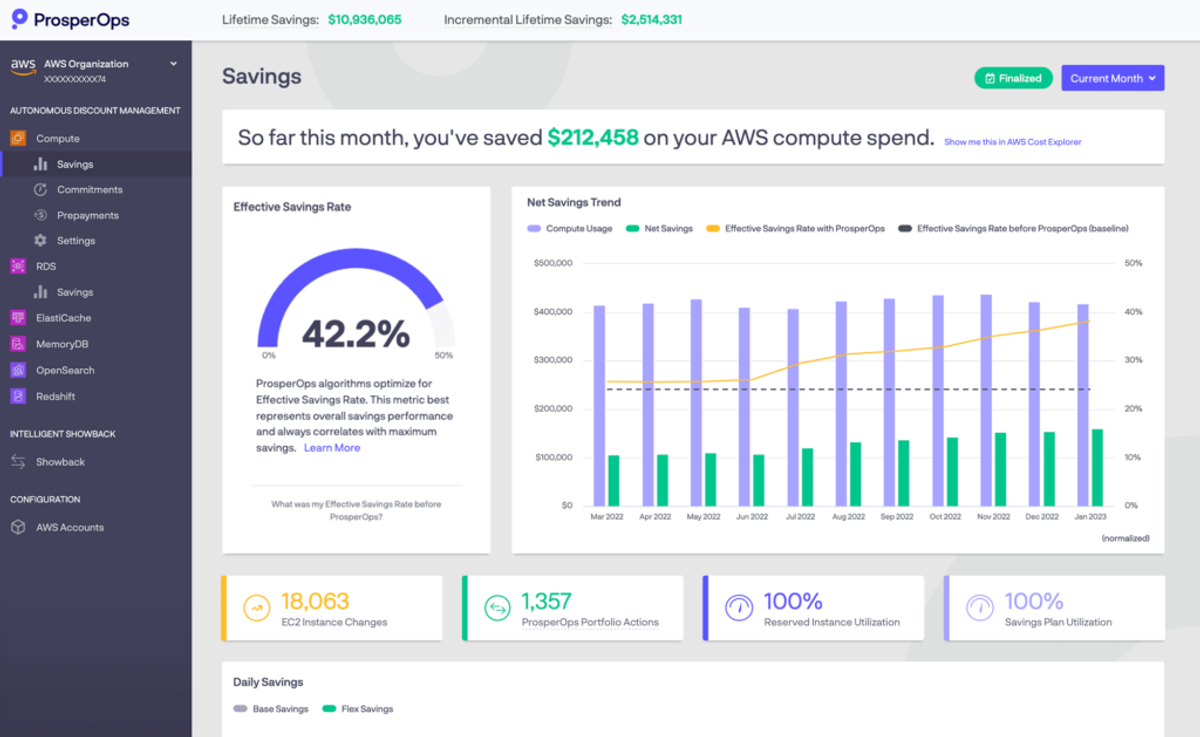
ProsperOps (recently acquired by Flexera) automates RI and Savings Plan purchasing across AWS, Azure, and GCP. The platform continuously adjusts discount portfolios based on usage patterns.
Key Capabilities
- Multi-cloud discount management across AWS, Azure, and GCP
- Autonomous portfolio adjustments without manual intervention
- Resource scheduling that syncs with discount coverage
- Performance-based pricing
Automation Depth
Moderate to high. ProsperOps automatically purchases and manages commitments, but comparison analyses note that customers must manually submit claims within 10 days to receive refunds for unused commitments—adding operational overhead. The platform adjusts commitments periodically but doesn't offer the hourly rebalancing or Convertible RI exchange strategies that platforms like nOps use.
Multi-Cloud Support
AWS, Azure, and GCP, with varying depth across providers. Strongest on AWS.
Best For
Teams that want hands-off commitment management and are comfortable with the Flexera ecosystem for broader IT financial management.
Pros
- Proven autonomous purchasing model
- Multi-cloud coverage
- Part of Flexera's broader IT management suite
Cons
- Stops at commitment management—no compute rightsizing, storage optimization, or GenAI workload management
- Lacks broader visibility features like budgeting, anomaly detection, and cost allocation
- Flexera acquisition can mean longer onboarding cycles and heavier enterprise processes
- Manual claims process for unused commitment refunds
- May deliver less savings compared to platforms with hourly rebalancing
Pricing
Percentage of savings model with baseline definitions controlled by ProsperOps. Compare what counts as "savings generated" before signing—the denominator matters.
3. CloudZero — Best for Cost Intelligence and Unit Economics
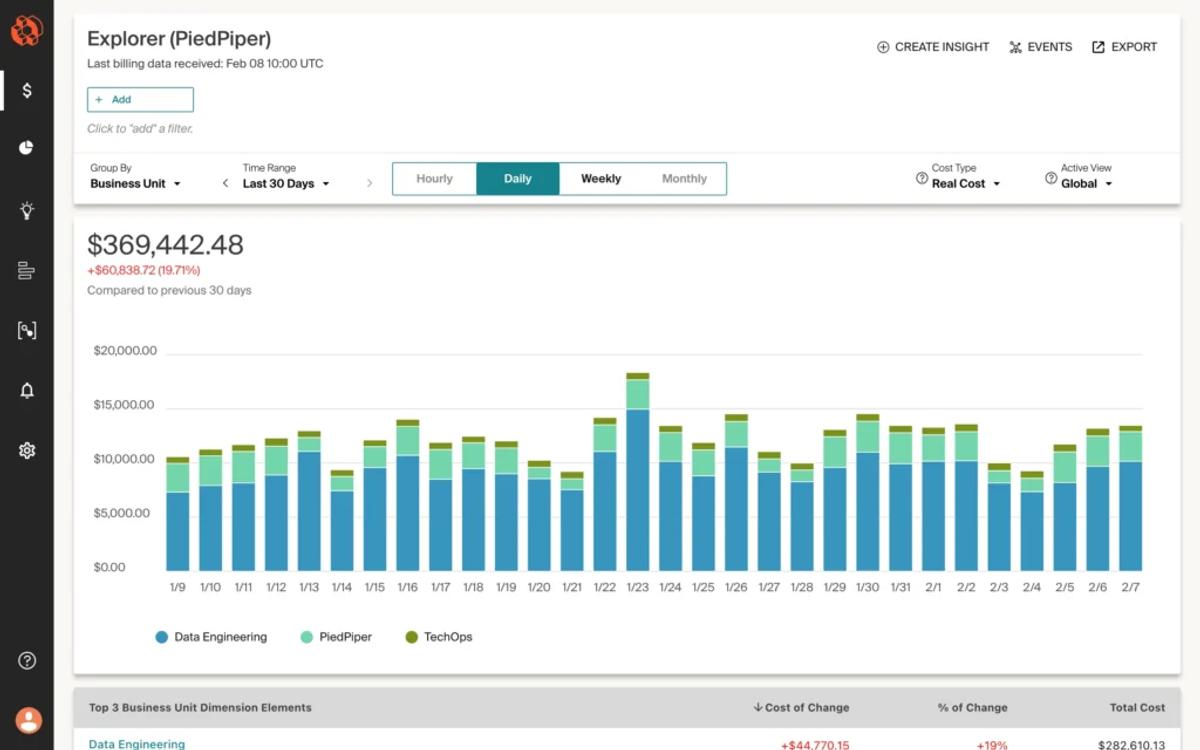
CloudZero positions itself as a cloud cost intelligence platform, emphasizing cost allocation by product, feature, and team rather than by infrastructure resource.
Key Capabilities
- Granular cost allocation by business dimensions (product, feature, customer, team)
- Anomaly detection with root cause analysis
- Unit economics tracking (cost per customer, cost per transaction)
- Kubernetes cost visibility
- Budget alerts and forecasting
Automation Depth
Limited. CloudZero focuses on intelligence and allocation rather than automated optimization. You'll see where money is going with precision, but the platform won't purchase commitments or rightsize resources for you.
Multi-Cloud Support
AWS, Azure, and GCP with varying depth. Strongest on AWS.
Best For
Engineering-led organizations that need precise cost attribution by business dimension—especially SaaS companies tracking unit economics across products or customers.
Pros
- Exceptional cost allocation granularity
- Strong unit economics and per-customer cost tracking
- Clean interface designed for engineering teams
Cons
- No automated commitment management or purchasing
- No automated resource optimization
- Pricing can scale quickly based on monitored spend
Pricing
Tiered pricing based on cloud spend under management.
4. Cloudability (Apptio/IBM) — Best for Enterprise FinOps Reporting
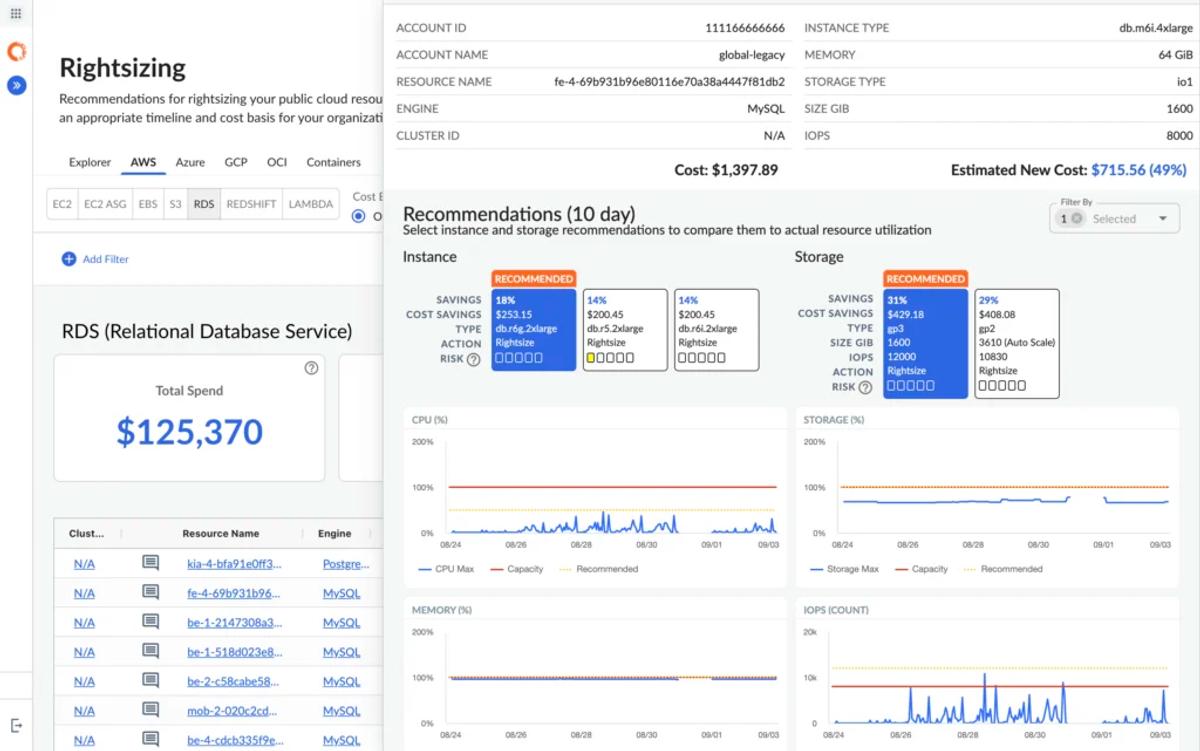
Cloudability is an enterprise-grade FinOps platform with deep cost allocation, showback/chargeback, and governance capabilities.
Key Capabilities
- Multi-cloud cost visibility across AWS, Azure, and GCP
- Advanced showback and chargeback with business mapping
- Commitment automation add-on (RI and Savings Plan) through acquisition of Cloudwiry
- Forecasting and budgeting
- Kubernetes cost visibility via Kubecost integration (IBM acquired Kubecost in 2024)
Automation Depth
Moderate. Cloudability provides commitment recommendations and some automated purchasing through Cloudwiry, but execution frequency and scope trail platforms purpose-built for continuous optimization.
Multi-Cloud Support
Strong across AWS, Azure, and GCP. IBM ecosystem integration adds depth for large enterprises already using Apptio for IT financial management.
Best For
Large enterprises needing mature showback/chargeback workflows, governance policies, and integration with broader IT financial management tooling.
Pros
- Mature enterprise FinOps capabilities
- Strong cost allocation and chargeback
- Good multi-cloud coverage
- Part of IBM's broader IT management suite
Cons
- Steeper learning curve
- Limited automation depth for resource optimization
- Enterprise pricing with higher minimums (estimated $30K+/year)
- Can feel heavyweight for mid-market teams
Pricing
Percentage of monitored spend, tiered pricing. Starts around $30K/year for mid-market. Commitment management may carry additional fees.
5. CloudHealth by VMware (Broadcom) — Best for Multi-Cloud Governance
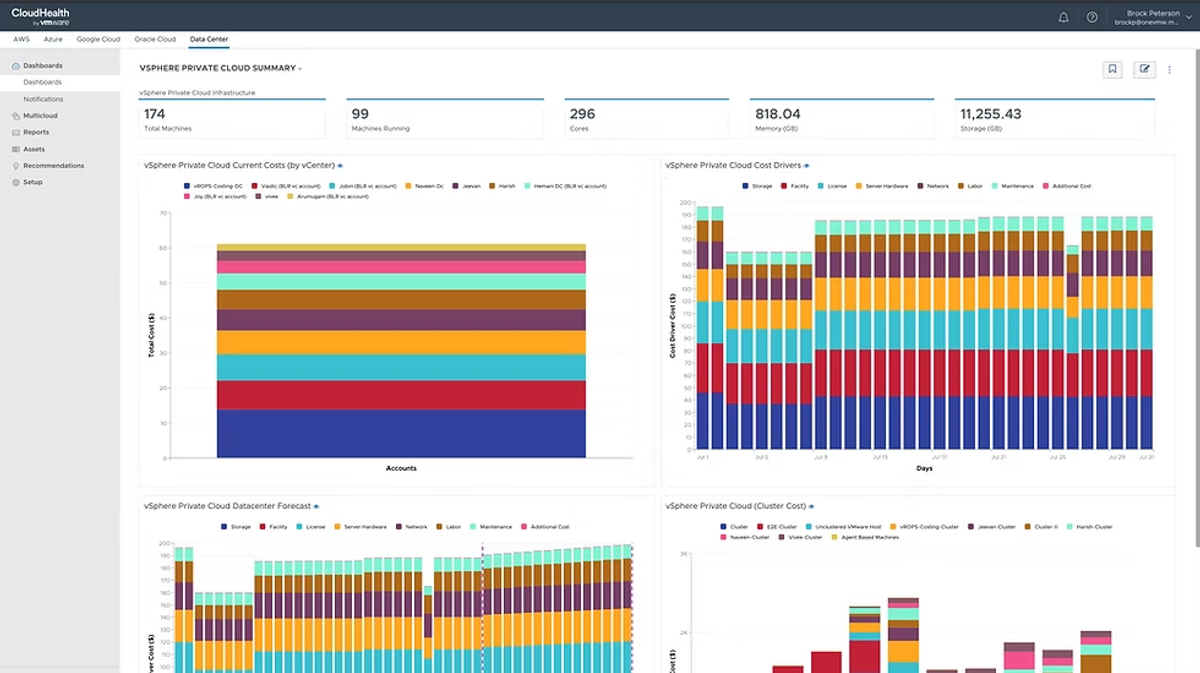
CloudHealth has been a FinOps mainstay since 2012, offering multi-cloud cost management, governance, and security posture. Following VMware's acquisition by Broadcom in 2023, product direction has introduced some uncertainty.
Key Capabilities
- Multi-cloud dashboards across AWS, Azure, GCP, OCI, and Alibaba Cloud
- Policy-based governance and automated actions
- RI and Savings Plan tracking with recommendations
- Tag-based allocation with retroactive tagging
- Security and compliance posture management
Automation Depth
Policy-based governance allows automated actions (shutting down tagged resources, enforcing instance types), but commitment management is primarily advisory—recommendations, not autonomous purchasing.
Multi-Cloud Support
Widest multi-cloud coverage for visibility: AWS, Azure, GCP, Oracle Cloud, and Alibaba Cloud.
Best For
Enterprises needing broad multi-cloud governance and security posture alongside cost management—particularly those already in the Broadcom/VMware ecosystem.
Pros
- Widest multi-cloud coverage (5 providers)
- Combined cost + governance + security platform
- Mature, well-established product
- Policy-based automation for governance
Cons
- Broadcom acquisition creates product roadmap uncertainty
- Enterprise complexity—typically requires dedicated FinOps resources
- Limited Kubernetes-native support
- Commitment management is advisory, not autonomous
Pricing
Enterprise licensing, custom pricing. Typically starts at $50K+ annually for mid-market organizations.
6. Harness Cloud Cost Management — Best for CI/CD Integration
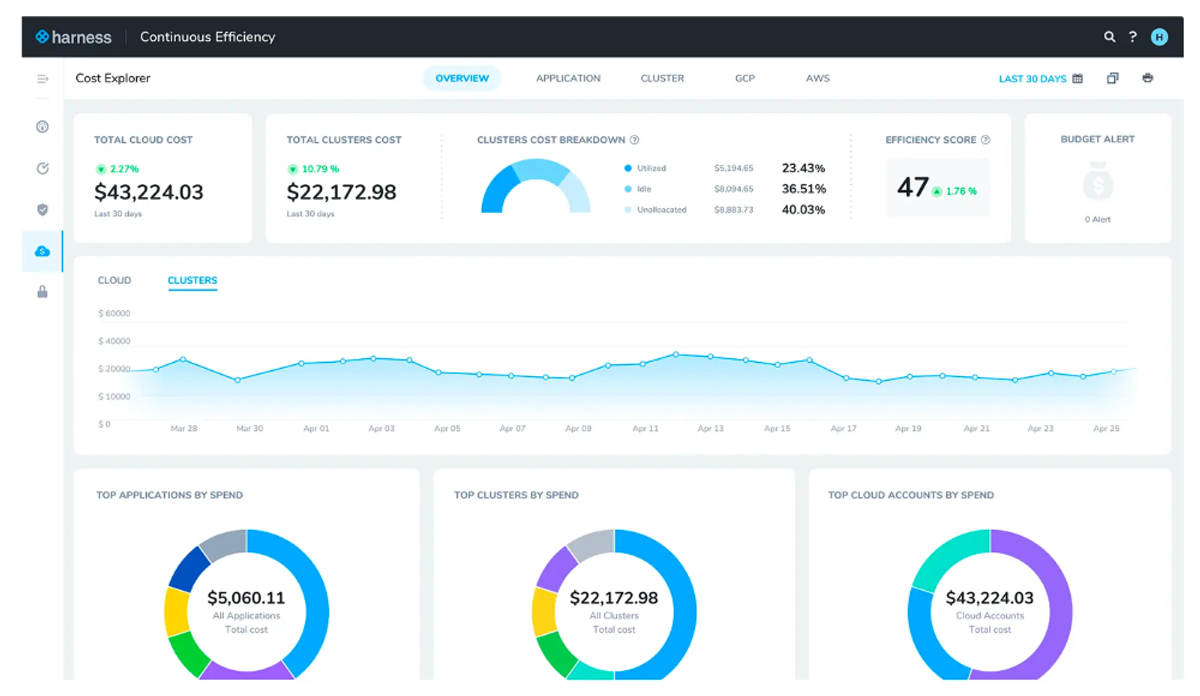
Harness Cloud Cost Management is part of the broader Harness software delivery platform, offering cost visibility, governance, and some automation.
Key Capabilities
- Cloud cost visibility and allocation across AWS, Azure, and GCP
- Auto-stopping rules for non-production workloads
- Commitment recommendations (RI and Savings Plan)
- Kubernetes cost management with cluster-level recommendations
- Budget tracking and alerts
Automation Depth
Moderate, with a specific strength in auto-stopping non-production environments. Commitment management provides recommendations but automation is limited compared to purpose-built optimization platforms.
Multi-Cloud Support
AWS, Azure, and GCP with consistent coverage across the three major providers.
Best For
Organizations already using the Harness platform for software delivery that want integrated cost management without adding another vendor.
Pros
- Integrated with Harness CI/CD for dev team adoption
- Auto-stopping for non-production environments saves immediately
- Solid Kubernetes cost visibility
- Multi-cloud coverage
Cons
- Less depth than standalone FinOps platforms
- Commitment automation is limited
- Full value requires adoption of the broader Harness platform
Pricing
Part of the Harness platform; pricing varies based on modules adopted. Free tier available for smaller teams. Enterprise pricing is custom.
7. Spot by NetApp — Best for Kubernetes and Spot Instance Optimization
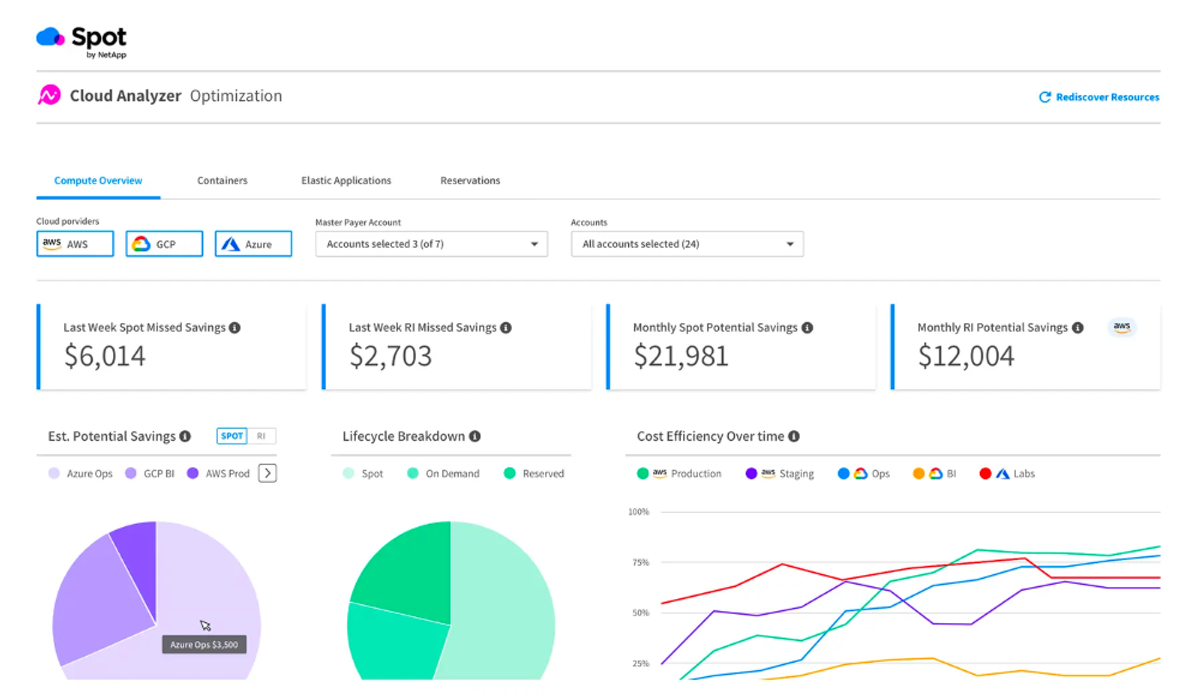
Spot by NetApp combines commitment management with Spot instance orchestration and container optimization for highly dynamic workloads.
Key Capabilities
- Integrated Spot instance management alongside commitment purchasing
- Ocean for Kubernetes—automated infrastructure for containerized workloads
- Elastigroup for intelligent instance replacement
- AWS, Azure, and GCP support for Spot optimization
Automation Depth
High for Spot instances and Kubernetes workloads. Commitment management is secondary to Spot/container orchestration.
Multi-Cloud Support
AWS, Azure, and GCP for Spot optimization and container management.
Best For
Organizations with significant Spot instance usage or Kubernetes-heavy architectures needing coordinated compute optimization and commitment management.
Pros
- Strong Spot instance orchestration
- Deep Kubernetes optimization via Ocean
- Multi-cloud Spot support
Cons
- Commitment management is secondary focus
- Less depth in RI/SP lifecycle management compared to specialized tools
- Part of broader NetApp portfolio, adding complexity
Pricing
Custom pricing through NetApp sales engagement.
When Not to Switch from Pump
Pump may still be the right fit if:
- You're comfortable with the group buying model and its dependencies
- Your workloads are relatively stable and predictable, without the need for advanced risk-reducing strategies like CRIs and adaptive layering
- You only need basic cost visibility (forecasting, anomaly alerts, project-level allocation) without deep commitment performance analytics or unit economics tracking
If your environment matches these criteria, Pump's simple model handles the basics. The alternatives above become necessary when you outgrow these constraints.
Any questions about how much you can save compared to Pump? Book a free savings analysis for some concrete numbers.
nOps manages $5B+ in cloud spend and was recently ranked #1 in G2’s Cloud Cost Management category.
Demo
AI-Powered Cost Management Platform
Discover how much you can save in just 10 minutes!
Book a Demo
FAQ
Is Pump a good cloud cost tool?
Pump is effective for startups with simple compute workloads that want fast savings without upfront cost. The group buying model delivers immediate discounts, and setup takes minutes. Where it falls short is on the sustainability and risk side—Pump's model depends on collective pool health and operates in a gray area regarding AWS discount sharing policies. Teams that need multi-cloud depth, Convertible RI strategies, or granular visibility typically outgrow Pump once they move past the simplicity stage.
Are there free alternatives to Pump?
Pump's Base plan is free and includes cost visibility (Pump View) with forecasting, anomaly detection, and scheduled reports. The Plus plan ($599/month) adds automated commitment management ("Autopilot"), deeper automation features, and dedicated support. nOps and ProsperOps both operate on a percentage-of-savings model—you only pay when they deliver measurable cost reductions, though ProsperOps may charge for managing existing commitments. True free tools include AWS Cost Explorer (basic AWS cost reporting), Infracost (open-source Terraform cost estimates), and OpenCost (Kubernetes cost allocation).
What are the risks of Pump's group buying model?
The primary risks are AWS policy compliance and dependency on collective pool dynamics. Cloud Capital notes that "Pump markets group buying to unlock discounts, using collective commitment structures AWS has clarified are limited to the purchasing customer and affiliates." If AWS enforces restrictions on discount sharing across unaffiliated customers, Pump's model faces uncertainty. Additionally, your savings depend on the health of Pump's customer pool—if usage patterns shift across the collective or customers churn, rebalancing effectiveness could change.
Why do companies look for Pump alternatives?
The most common reasons: (1) Commitment flexibility—without Convertible RI support, teams with evolving workloads face lock-in risk. (2) Advanced visibility requirements—while Pump View offers forecasting, anomaly detection, and project-level cost allocation, it lacks deep commitment performance KPIs (effective savings rate, lock-in risk analysis, utilization vs. coverage tracking), unit economics, and Kubernetes-native cost monitoring. (3) Risk management—organizations want 100% utilization guarantees and direct control over commitments without group buying dependencies. (4) Long-term sustainability—questions about AWS policy compliance and the viability of group buying models make some teams seek platforms with more traditional, proven approaches.
What are the best Pump alternatives?
The top alternatives depend on what gap you're filling. nOps is best for teams that want full automated optimization and visibility with guaranteed savings, hourly rebalancing, and no group buying dependencies. CloudHealth suits enterprises needing governance and policy enforcement across large multi-cloud estates. Cloudability focuses on FinOps reporting and unit economics for mature teams with dedicated analysts. ProsperOps offers autonomous commitment management across AWS, Azure, and GCP as part of Flexera. For mid-market teams spending $50K–$2M/month on cloud who want savings without hiring a FinOps team or relying on collective pools, nOps consistently delivers the highest ROI with the least operational burden.