
Technology Business Management (TBM Framework): A Complete Guide (2026)
Technology business management (TBM) emerged from efforts by enterprise CIOs to better understand IT spending and connect technology investments to business value. Developed through an industry initiative led by Apptio and now standardized by the TBM Council, TBM is particularly associated with IT finance, cost modeling, and enterprise technology governance.
This guide covers the TBM framework and taxonomy, its benefits and challenges, and how it relates to FinOps, ITFM, and ITIL.
Technology Business Management Defined
Technology business management (TBM) is a discipline for translating technology spending into business value. It gives finance, business and technology leaders one standard way to classify costs, assign them to the services that consume them, and compare results over time and against peers. In practice, that means being able to say what each technology service costs, who consumes it, and what happens to cost if usage or vendors change.
The TBM Council, a nonprofit founded in 2012 out of Apptio's TBM Summits, maintains the standards. Three terms come up constantly and are often used loosely.
- The TBM framework is the overall structure of foundations, model, outcomes, and value drivers.
- A TBM model is the cost and consumption data model an organization builds to that structure.
- The TBM taxonomy is the standard classification the model uses, currently version 5.0.1.
The TBM Framework
The framework has four layers, stacked from the bottom up: foundations, the model, outcomes, and value drivers. Each layer depends on the ones below it.
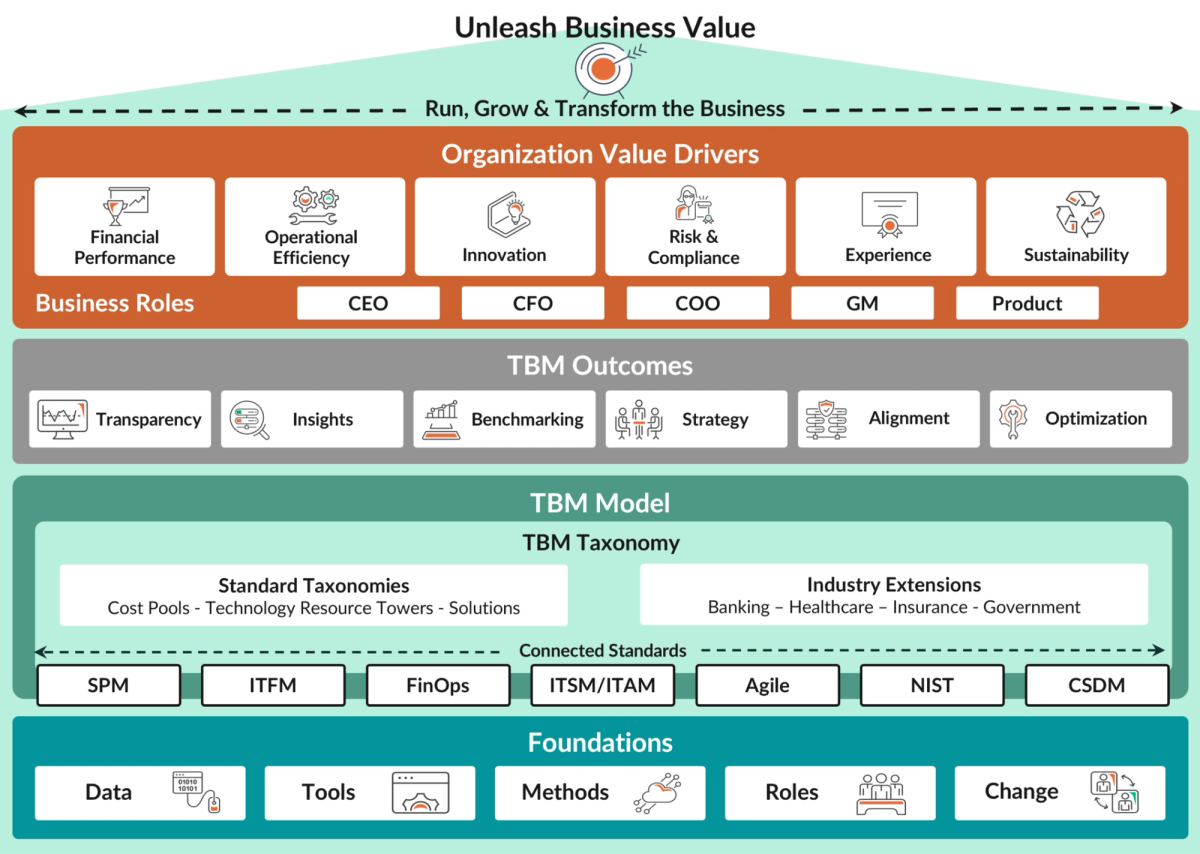
Source: TMB Council
Foundations
Foundations are the five components needed to build a model and run a TBM practice.
- Data is the financial, operational, and contextual information the model is built from.
- Tools are the platforms that collect, model, and report that data.
- Methods are the standard approaches for allocation, service modeling, chargeback and showback, benchmarking, and scenario planning.
- Roles are the people accountable for the practice, including an executive sponsor, practice lead, analysts, administrators, and change managers.
- Change is the change management that gets the model used in budgeting and planning decisions.
The TBM Model
The model is the data engine at the center of the framework. It maps financial and operational data through the taxonomy's layers so a dollar on the general ledger can be traced to the business unit that benefits, and it is rebuilt on a recurring cycle rather than built once. It supports four uses.
- Cost allocation and service modeling
- Chargeback and showback
- Benchmarking against peers
- Scenario planning
Three components support the model: the taxonomy, industry-specific taxonomy extensions such as banking and the public sector, and connected standards including FinOps, Agile, ITFM, and sustainability frameworks.
Outcomes
Outcomes are what a mature practice does with the model. The Council separates them from value drivers: outcomes are internal capabilities, while value drivers are external business results.
- Financial transparency into spend, consumption, and performance
- Insights into how technology contributes to business value
- Benchmarking against peers and standards
- Strategy that links technology initiatives to company objectives
- Alignment among IT, finance, and business leaders
- Optimization of investments and resources over time
Value Drivers
Value drivers are the business results technology leaders are expected to deliver, and they sit at the top of the framework. The Council expects each organization to customize this layer to its own strategy rather than adopt every driver.
- Financial performance through profitability and growth
- Operational efficiency through less waste and simpler processes
- Innovation by freeing funds for new capabilities
- Risk and compliance through governance of technology spend
- Experience for customers, employees, and partners
- Sustainability, including the environmental impact of technology use
The TBM Council
The TBM Council is a nonprofit that sets the standards for TBM.
- A board of CIO executive directors governs it, and a Standards Committee oversees the taxonomy and its extensions.
- It publishes the TBM framework, the taxonomy, business-value KPIs, and playbooks.
- It reports more than 20,000 members from over 4,000 organizations in 110+ countries, including 92 Fortune 100 companies.
The TBM Taxonomy
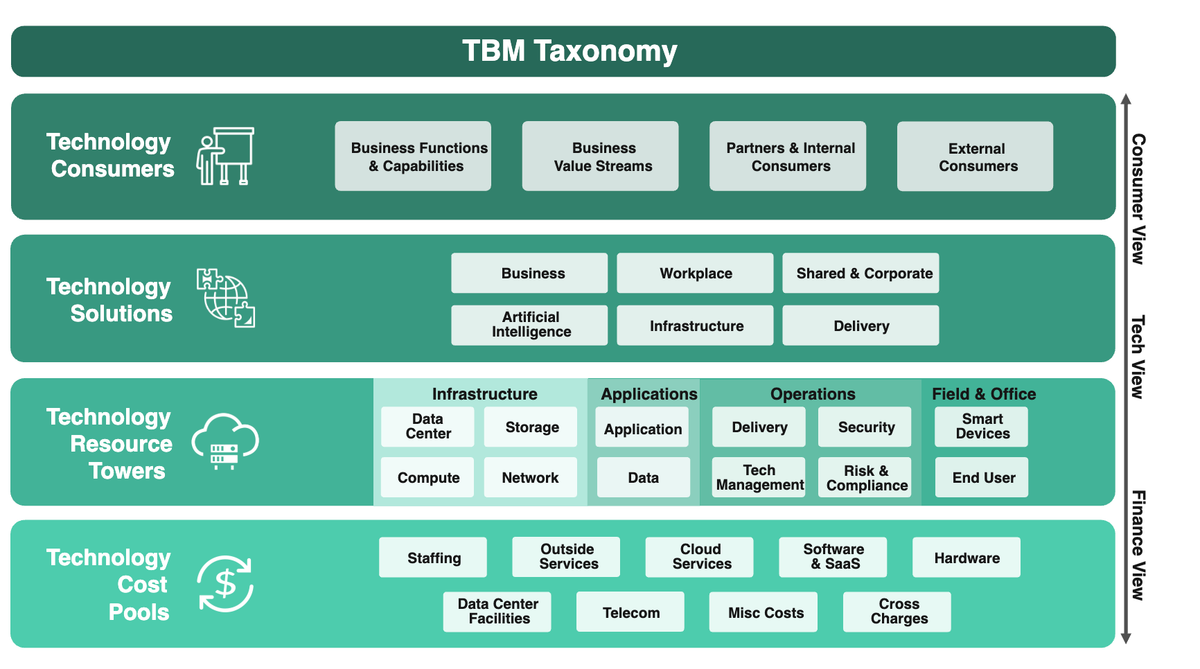
The TBM taxonomy is the standard classification a TBM model uses to trace spend. Version 5.0.1 organizes it into four layers, and each layer answers a different question about the same dollars.
Cost Pools
Cost pools sort spend by what was purchased and connect directly to the general ledger, so a TBM model starts from a baseline finance already trusts.
- Typical pools include labor, software, hardware, facilities, and outside services, plus cloud services.
- Each pool separates operating from capital expenditure.
- Pooling shows how much technology spend is fixed versus variable and helps expose shadow IT.
- A dedicated cloud services pool lets finance compare on-premises and cloud scenarios and links TBM to FinOps.
Technology Resource Towers
Resource towers group technology by function so costs can be compared with peers regardless of how an organization is structured. Version 5.0 renamed "towers" to "technology resource towers."
- The four domains are infrastructure, application, operations, and field and office, with towers such as compute, storage, network, and security inside them.
- A data tower was added to capture the growing cost of data platforms.
- Towers are the layer used to benchmark labor intensity and infrastructure ratios against peers.
- Costs mapped to cost pools do not flow into towers automatically. They need an allocation method.
The Council lists five allocation methods, matched to how mature the model is.
Method | How it works | Typical maturity |
|---|---|---|
Direct | Assigns cost straight to a consumer based on measurable usage | Early |
Fixed | Spreads fixed cost by predetermined percentages, such as headcount | Early to moderate |
Shared services | Splits centralized service cost by each unit's share of actual usage | Moderate to high |
Weighted | Distributes cost using weighting factors, such as revenue contribution | Moderate to high |
Activity-based | Assigns cost by the activities that consume resources | Moderate to high |
Solutions
Solutions are the products and services technology delivers to the business, with every supporting cost rolled up into a fully burdened total cost of ownership.
- Categories include business, workplace, shared and corporate, infrastructure, delivery, and artificial intelligence.
- Version 5.0.1 supports AI across layers, so AI compute, AI models, and generative AI solutions can be modeled as their own cost lines.
- Without a service catalog, spend lands in unmapped buckets, which the Council lists as a common cause of model fallout at this layer.
Consumers
Consumers identify who uses each solution: business functions, value streams, and partners. This layer makes showback and chargeback possible because it ties a solution's cost to the group that consumes it.
- Showback reports each consumer's share of spending for cost transparency. Chargeback transfers that cost to the consumer's budget.
- The consumer view shows whether technology operates mainly as an infrastructure provider or a product engine, and it exposes heavy outsourcing and disproportionate overhead.
- Consumer hierarchies have to follow the current org chart. When they drift, spend falls into miscellaneous buckets.
Finance, Technology, and Business Views
Views are lenses on one shared taxonomy rather than separate taxonomies. Each view uses the layers its audience cares about most.
View | Layers used | Audience | Supports |
|---|---|---|---|
Finance | Cost pools, resource towers | CFO | Budgeting, planning, variance tracking, chargeback |
Technology | Resource towers, solutions | CIO and IT leaders | Technology management, architectural optimization, capability rationalization |
Business | Solutions, consumers | Business leaders | Evaluating value delivery |
Benefits of TBM
TBM emphasizes a standard taxonomy, full cost scope, and a link to business outcomes.
- Every team sorts services, resources, and applications into the same categories instead of using its own financial terms.
- Costs can be compared across business units and against peers, because everyone uses the same taxonomy.
- Cost per application or service is fully loaded, including labor and facilities that narrower spend views miss.
- TBM enables data-driven decisions across IT and business functions.
- TBM aligns technology investments with organizational goals and priorities. Costs connect to business growth and business operations, not only to spend categories.
- Organizations use TBM to identify and eliminate redundant applications or inefficiencies.
- Budget conversations use terms business partners understand, which moves IT from order taker to service broker.
Challenges of TBM
Most TBM difficulty comes from mapping spend to the taxonomy, not from the framework itself.
- Leaders who do not see TBM tied to business value have no reason to give it attention and resources.
- Positioning TBM as a cost reduction tool can make other teams treat it as a threat.
- People push back when TBM arrives as new tools, new processes, and a new view of IT without anyone explaining how it helps them. Incremental taxonomy adoption reduces complexity during TBM implementation.
- TBM needs more data, analysis, and reporting than spreadsheets can handle, plus people with finance, data, and strategy skills.
- Labor is hard to allocate when teams do not track time by service.
- Building trust in cost data is essential for effective TBM practices
- Business units dispute allocation methods once cost moves onto their budgets.
The unmapped share is called model fallout and is measured as a coverage ratio at each layer. The Council cites under 1% unmapped as a common target, and its sample dashboard turns red above 3%.
TBM Compared to Related Disciplines
TBM overlaps with FinOps, ITFM, and ITIL, and the three are often mistaken for substitutes. The differences come down to scope, who runs each one, and the question each is built to answer.
TBM vs. FinOps
TBM models all technology spend, including labor, hardware, software, and facilities, in one structure, while FinOps works at the resource level to manage usage-based spend. FinOps supplies the granular data, and TBM places it in the context of everything else IT spends.
Dimension | TBM | FinOps |
|---|---|---|
Scope | All technology spend, including labor, on-premises, SaaS, cloud, and AI | Technology usage spend, with public cloud at the core and SaaS, data center, and AI added in the 2025 framework |
Core question | What does technology cost, and what does it deliver for the business? | How do we get the most value from variable, usage-based spend? |
Owners | TBM office or IT finance, with IT, finance, and business leaders | A cross-functional team of finance, engineering, procurement, and executives |
Data | General ledger, on-premises operational data, and monthly cloud bills | Resource-level usage and billing data |
Emphasis | Taxonomy-based modeling, allocation, and benchmarking | Usage visibility, optimization, and accountability |
FinOps feeds resource-level cloud data into TBM, and the FinOps Foundation has widened its framework beyond public cloud toward the same technology spend TBM models. In practice the two teams agree on who is accountable for cloud cost and share a common data format through the FOCUS billing schema.
ITFM vs. TBM
IT financial management (ITFM) is the older discipline and covers budgeting, forecasting, cost allocation, and expense tracking. TBM was developed by the TBM Council on top of ITFM and adds a standard taxonomy and a focus on business value and financial systems.
ITFM | TBM | |
|---|---|---|
What it is | Discipline for planning, tracking, allocating, and optimizing IT spend | Standardized framework and taxonomy for modeling IT department spend in business terms |
Approach | Flexible, shaped to each organization | Prescriptive, based on the Council's taxonomy and practices |
Question it answers | How much does IT cost, and is the financial data accurate | What does that spend deliver to the business |
TBM vs. ITIL
ITIL is a framework for IT service management and covers how services are delivered and improved, while TBM manages what technology solutions cost and what value they return. ITIL's financial management covers budgeting, accounting, and charging for IT services, and TBM extends cost modeling across the whole technology estate and ties it to business consumers. Organizations usually run both, with TBM adding the cost view to the service catalog ITIL maintains and with ServiceNow CSDM and CMDB data supplying the resources behind towers.
TBM Tools and Software
A TBM model can be run four ways, and the Council's provider list has examples of each.
Approach | Strength | Tradeoff | Examples |
|---|---|---|---|
Dedicated TBM and ITFM platforms | Built-in taxonomy, allocation, and reporting | Integration effort and staffing | Apptio, Nicus, Serviceware, CostPerform |
Cloud cost and FinOps platforms | Resource-level cloud, SaaS, and AI data and allocation, such as nOps allocating 100% of cost even with messy tags and shared resources | Cover cloud, SaaS, and AI rather than labor, facilities, or on-premises | nOps, Apptio Cloudability, Finout |
Services partners | Faster start and established methods | Ongoing dependency on the partner | It's Value, Deloitte, KPMG, REI Systems, Rego Consulting |
Spreadsheets, databases, or Python | No license cost | Needs internal expertise to maintain the data model, integrations, allocation logic, and reporting | Built in-house |
Where the spend lives decides the mix. A dedicated platform fits when labor, on-premises, and cloud costs all need modeling, and cloud-heavy organizations pair it with a cloud cost platform that supplies resource-level data.
How nOps Supports TBM
The hardest part of a TBM model is the variable spend: cloud, Kubernetes, SaaS, and AI costs that change by the hour, span several providers, and rarely carry clean tags. Until that spend is allocated, it cannot be mapped to towers, solutions, and consumers, and the model's numbers are not trusted.
nOps gives TBM teams the cloud side of the model in one platform.
- Unified visibility across all major cloud providers, Kubernetes, SaaS, and AI spend, so the cloud services cost pool draws from a single source.
- 100% cost allocation, even with messy tags and shared resources, so every dollar has an owner when it enters the model.
- Automated commitment management that optimizes the pricing layer, including Savings Plans and Reserved Instances, so the costs the model reports are already lower.
Book a demo to see how nOps feeds cloud, SaaS, and AI costs into your TBM model.
nOps manages $5 billion in AI and cloud spend and was recently ranked #1 in G2's Cloud Cost Management category.
FAQ
Short answers on what TBM is and how it differs from business management technology.
What is technology business management?
Technology business management (TBM) is a discipline for managing technology spend in business terms. A standard taxonomy of cost pools, resource towers, solutions, and consumers traces each technology dollar from the general ledger to the group that uses it, so IT, finance, and business stakeholders work from the same numbers.
What is business management technology?
Business management technology is a general term for the software used to run a business, such as project management, CRM, accounting, HR, and reporting tools. It is different from technology business management, which is the specific discipline for managing the cost and value of technology itself.
What are the benefits of the TBM framework?
The TBM framework can help improve cost transparency, business alignment, portfolio management and business outcomes, ultimately helping you get more out of every dollar you spend on IT to better meet your business needs while improving customer satisfaction.