Skip to content


- Blog
- Commitment Management
- Top Cloud Commitment Management Tools in 2026
Top Cloud Commitment Management Tools in 2026
Cloud commitments — Reserved Instances, Savings Plans, Committed Use Discounts — can slash your bill 30–60% vs. on-demand. But they’re also bets. Overcommit and you’re paying for capacity nobody uses. Undercommit and you’re leaving money on the table every single month.
One CIO we spoke with recently put it bluntly: “I can’t start signing one-year or two- or three-year commitment contracts because if I don’t hit those minimums, I’ll be paying for air.” That fear keeps a lot of teams from committing at all.
This is exactly what these tools are designed to solve. In this article, we’ll discuss the state of cloud commitment management in 2026 and compare the nine tools that can help.
What Is Cloud Commitment Management?
At its core, cloud commitment management means buying, watching, adjusting, and renewing discount instruments — AWS Savings Plans, Reserved Instances, Azure Reserved VM Instances, Google Cloud CUDs — so you save as much as possible without getting stuck paying for stuff you’re not using.
The lifecycle looks like this: planning (sizing commitments based on real usage), purchasing (across compute and non-compute services), monitoring (checking utilization and coverage gaps in real time), adjusting (exchanging convertible RIs or rebalancing when things shift), and renewing (deciding what to extend vs. let expire). Tools that do this continuously — not once a quarter — tend to outperform the rest by a wide margin.
Why Commitment Management Matters in 2026
Rising Cloud Costs Meet Tightening Budgets
Organizations waste roughly 27% of cloud spend — that’s over $100 billion globally in 2026. And 84% of organizations say they struggle to manage cloud spend at a time of global turmoil, uncertain economic conditions, and pressure to cut costs. Commitment-based discounts remain the single biggest lever for reducing waste.
GenAI Causes Underutilization Risks
Choosing Commitment Types Amid Multicloud Complexity
How We Evaluated These Cloud Commitment Management Tools
Commitment Lifecycle Automation
Does the tool automate the full lifecycle — purchasing, exchanging, rebalancing, and renewing commitments to maximize effective savings rates — or does it stop at recommendations that require manual execution?
Forecasting Accuracy
Risk Mitigation Capabilities
Does the tool quantify and reduce commitment lock-in risk? This includes features like short-term commitment laddering, automatic rebalancing, insurance mechanisms, and the ability to unlock three-year discount rates without requiring a full three-year lock-in.
Multi-Cloud Support
Integration with Cost Data
FinOps Reporting and Governance
Top Cloud Commitment Management Tools in 2026
nOps (Best Overall)
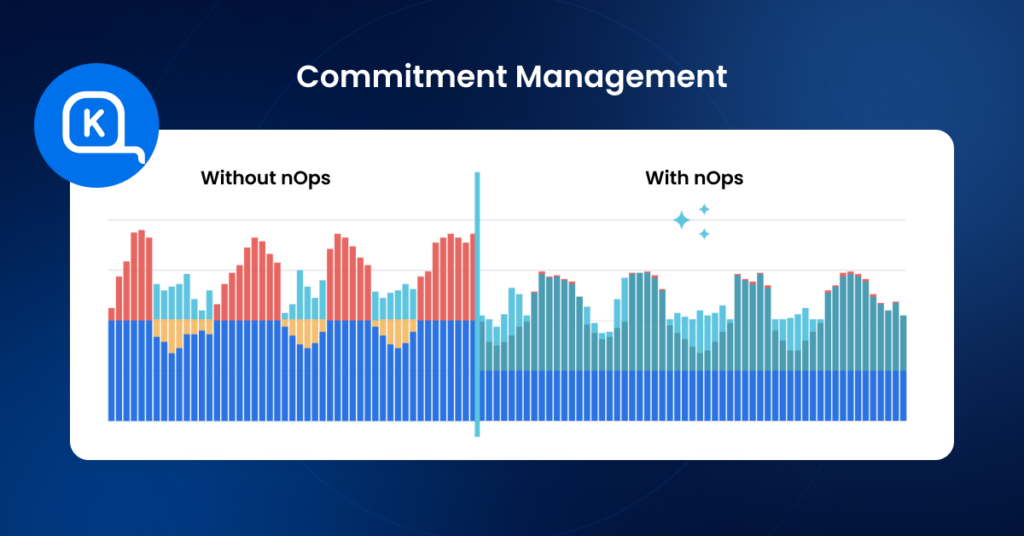
nOps is a FinOps platform that manages over $4 billion in annual cloud spend. Its commitment management capabilities are designed for full automation — purchasing, rebalancing, and renewing commitments continuously without manual intervention. nOps covers compute and non-compute services across AWS, Azure and GCP.
Commitment Management Capabilities
nOps automates the full commitment lifecycle, continuously rebalancing commitment portfolios on an hourly basis in response to actual usage trends. It focuses on maximizing your effective savings while lowering your lock-in risk, with a savings-first pricing model that ensure you’re paying only for results.
Automation Depth
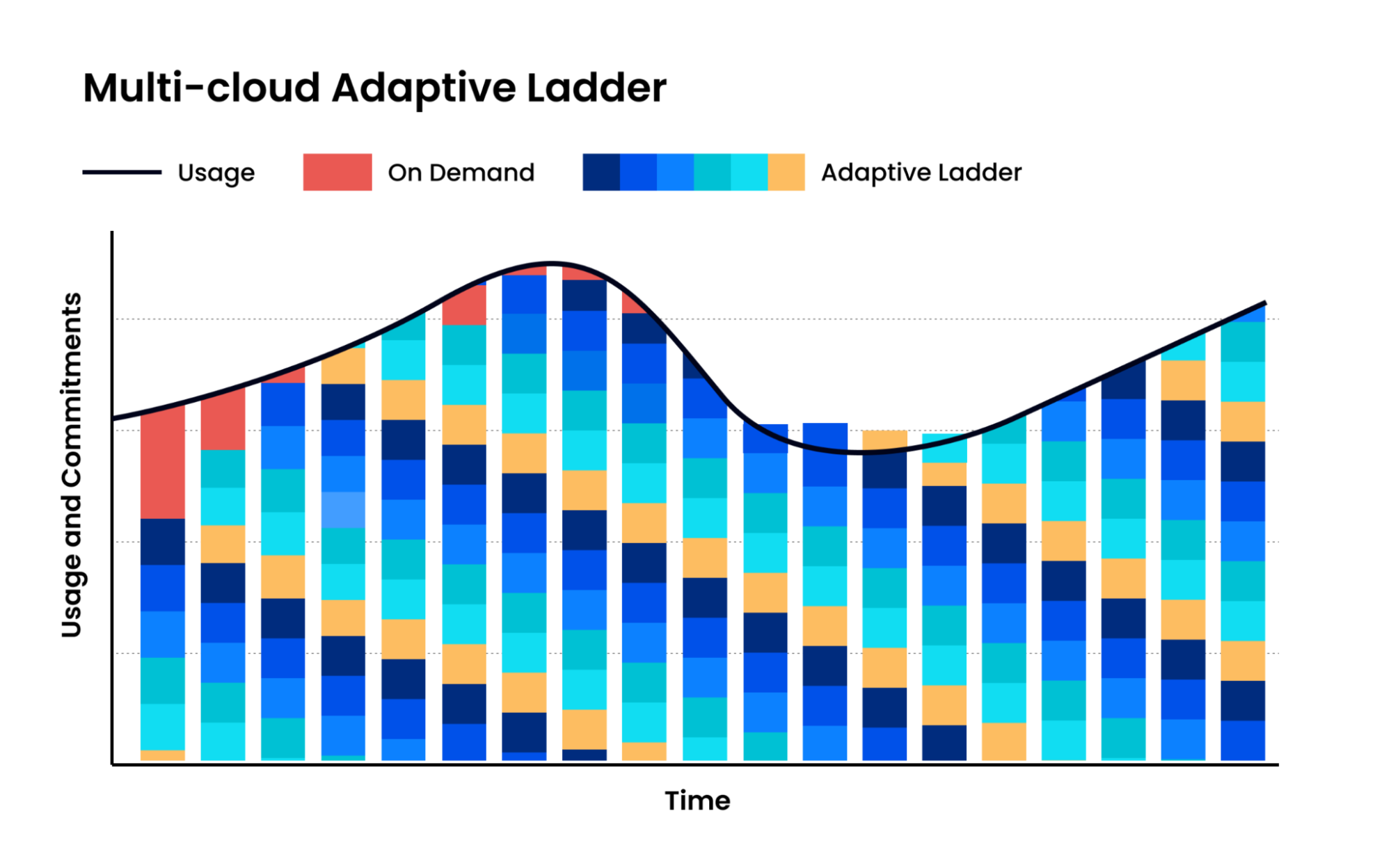
nOps operates on full autopilot. Commitments are purchased, exchanged, and renewed automatically based on real-time usage data. It leverages adaptive laddering and seeding/squishing to eke out often 20%+ more incremental savings than competitors, while reducing the risk of committing (even for volatile workloads). Setup takes less than five minutes with no infrastructure changes required.
Multi-Cloud Support
nOps supports commitment management and deep cost visibility for AWS, Azure, GCP, AI and Kubernetes.
Ideal For
Organizations that want hands-off commitment optimization with a savings guarantee. Particularly strong for teams running volatile or rapidly changing workloads — nOps manages the risky commitments you don’t want to touch, while your team gets credit for the increased savings.
Pros:
- Industry-leading savings rates that often reach 20% higher than competitors
- Adaptive laddering shrinks commitment windows down, reducing risk without sacrificing savings
- No work required — nOps manages your commitments end-to-end
- Full visibility features covering all key areas — from reporting to anomaly detection to FinOps AI agent
Cons:
- Doesn’t focus on workload optimization, though it is compatible with it
Pricing Model
nOps charges a percentage of the savings it generates. You pay only when you save. You can book a free savings analysis to see if your team can benefit.
Archera

Archera is a cloud commitment management platform built around a unique insurance model. Archera adds the concept of “insured commitments” to the standard commitment management workflow — allowing organizations to purchase commitments with a financial safety net against underutilization.
Commitment Management Capabilities
Archera provides commitment recommendations based on observed usage patterns, risk quantification for potential commitments using scenario modeling, and optional insurance that reimburses organizations for underutilized commitments. The platform supports AWS, Azure, and GCP, with a free tier that includes core commitment management features.
Limitations:
Archera’s core platform provides recommendations and analysis, but actual commitment purchases are user-executed — automation requires a separate fee. The insurance model adds a premium cost per insured commitment that reduces net savings compared to tools achieving similar risk mitigation through continuous rebalancing. Insurance terms (30-day and 1-year) vary by risk profile, making total cost harder to predict.
Ideal For
Risk-averse finance teams that want a formal insurance mechanism rather than algorithmic risk mitigation.
Pricing Model
Free tier with core features. Insurance premiums are charged per insured commitment. Advanced Reporting is a separate flat-rate tier.
ProsperOps

ProsperOps (recently acquired by Flexera) delivers what it calls Autonomous Discount Management (ADM) — an automated system that continuously optimizes commitment portfolios across AWS, Azure, and Google Cloud. ProsperOps is one of the more mature multi-cloud commitment automation platforms.
Commitment Management Capabilities
ProsperOps automates the purchasing, exchanging, rebalancing, and renewal of commitments. The platform determines the right mix of commitment type-term combinations (one-year and three-year) and rebalances the portfolio as business needs change. For Google Cloud, it automates strategies that purchase, merge, split, upgrade, and extend CUDs to provide vertical flexibility.
Limitations:
ProsperOps requires granting commitment purchasing permissions, which some enterprises with strict governance find challenging. Pricing is not publicly disclosed. ProsperOps focuses specifically on rate optimization — it does not include compute management features like spot orchestration or rightsizing, so organizations needing holistic optimization must pair it with other tools.
Ideal For
Multi-cloud organizations (AWS, Azure, GCP) that want automated commitment management specifically for rate optimization and are comfortable delegating purchasing authority.
Pricing Model
Not publicly disclosed. Requires sales engagement for pricing details.
CloudFix

CloudFix is an AWS cost optimization tool that focuses on automated, low-risk fixes — rightsizing, deprecating unused instances, optimizing storage configurations, and implementing AWS best practices. CloudFix runs regular scans to identify optimization opportunities and implements fixes without service disruptions.
Commitment Management Capabilities
CloudFix’s strength is in infrastructure optimization. The platform identifies and implements resource-level fixes (such as switching to Graviton instances, optimizing EBS volumes, or cleaning up unused resources). In addition to rightsizing, storage cleanup, and other automated fixes, CloudFix now offers RightSpend, which manages AWS discount coverage across Savings Plans and Reserved Instances.
Limitations:
CloudFix is AWS-only with no Azure or GCP support.
Ideal For
AWS-only teams that prioritize automated infrastructure optimization (rightsizing, storage, waste removal).
Pricing Model
Percentage of savings generated from implemented fixes, plus commitment management as an added fee.
CloudHealth (Broadcom Tanzu CloudHealth)

CloudHealth (now Tanzu CloudHealth by Broadcom) is one of the longest-standing cloud management platforms, offering cost visibility, governance, and optimization across AWS, Azure, and GCP. It is widely deployed in enterprises for financial reporting and policy enforcement.
Commitment Management Capabilities
CloudHealth provides commitment discount recommendations for AWS Savings Plans and Reserved Instances, as well as Azure Reservations. The platform surfaces spend-based recommendations, tracks utilization of existing commitments, and provides portfolio-level reporting across multiple accounts.
Limitations:
CloudHealth generates recommendations but does not automate execution. FinOps teams must manually implement commitment decisions through the provider’s console. Optimization frequency depends entirely on the team’s bandwidth. The Broadcom acquisition has also introduced pricing uncertainty.
Ideal For
Large enterprises already using CloudHealth for multi-cloud governance, with dedicated FinOps teams to act on recommendations manually.
Pricing Model
Enterprise licensing; pricing is not publicly listed and requires direct engagement.
Apptio Cloudability

Apptio Cloudability (now part of IBM after the 2023 acquisition) is a cloud financial management platform known for its detailed cost allocation, business mapping, and commitment management capabilities. The Cloudability Commitment Manager provides a unified view of Reserved Instances and Savings Plans normalized to a common dollar-based metric.
Commitment Management Capabilities
Cloudability offers automated commitment optimization, including purchasing and maintaining Savings Plans and Convertible Reserved Instances (CRIs) to achieve and maintain over 90% commitment coverage. The platform can access three-year discount rates through automated lifecycle management. It also provides commitment burn-down tracking and coverage reporting.
Limitations:
Enterprise pricing makes it less accessible for mid-market organizations. Some Reddit users have noted Cloudability can be “too big” for organizations below a certain spend threshold.
Ideal For
Large enterprises with significant AWS spend needing deep financial reporting alongside commitment automation, particularly within the IBM/Apptio ecosystem.
Pricing Model
Enterprise licensing based on cloud spend managed. Requires direct engagement for pricing.
Harness Cloud Cost Management

Harness CCM is a cloud cost management module within the broader Harness software delivery platform. It combines AI-powered cost analysis, recommendations, AutoStopping rules, and commitment orchestration across AWS, Azure, and GCP.
Commitment Management Capabilities
Harness provides commitment recommendations and some orchestration capabilities, alongside its core strengths in idle resource detection and AutoStopping for dev/test environments. The platform uses AI to identify over-provisioned and idle resources and can generate right-sizing plans.
Limitations:
Harness CCM’s commitment management is secondary within a broader DevOps platform rather than a dedicated optimization engine. Commitment orchestration is less mature than purpose-built tools — Harness focuses more on resource-level optimization (AutoStopping, rightsizing) than commitment portfolio management.
Ideal For
DevOps-oriented organizations already using Harness for CI/CD that want integrated cost management with basic commitment visibility.
Pricing Model
Free tier for organizations under $250K/month cloud spend. Paid plans based on cloud spend managed.
Spot by NetApp (Now Flexera)
Spot by NetApp (acquired by Flexera in 2025) was known for its Spot Instance management capabilities and Spot Eco — an automated commitment management feature for Reserved Instances and Savings Plans. Following the Flexera acquisition, the Spot FinOps portfolio is being integrated into Flexera’s broader cloud financial management suite.
Commitment Management Capabilities
Spot Eco automates the management of Reserved Instances and Savings Plans, optimizing cloud commitments for maximum savings and flexibility. The platform analyzed usage patterns to recommend and purchase commitments, and could rebalance portfolios as workloads changed.
Limitations:
The Flexera acquisition creates transition uncertainty. As Spot’s features merge into Flexera One, existing customers face potential migration requirements and a product roadmap dependent on Flexera’s priorities. The original Spot platform was primarily AWS-focused, and expanded multi-cloud capabilities are part of the combined offering.
Ideal For
Organizations already in the Flexera ecosystem wanting commitment management bundled with broader IT asset and cloud financial management.
Pricing Model
Now part of Flexera One enterprise pricing. Requires direct engagement.
Densify (Now Called Kubex)
Densify or Kubex is a cloud optimization platform that uses machine learning to analyze workload patterns and provide rightsizing recommendations across AWS, Azure, and GCP. Densify’s core strength is in matching resources to actual workload requirements.
Commitment Management Capabilities
Densify provides RI recommendations based on rightsized workload configurations — meaning it first determines what resources you actually need, then recommends commitments based on that optimized footprint. This approach ensures commitment purchases align with right-sized infrastructure rather than current (potentially over-provisioned) usage.
Limitations:
Densify generates commitment recommendations but does not automate purchasing, exchanging, or renewal. It is a recommendation engine requiring human action. Commitment optimization is only as timely as the team executing the recommendations.
Ideal For
Enterprises focused on rightsizing-first optimization that want commitment recommendations aligned with actual workload requirements, with operational bandwidth to execute manually.
Pricing Model
Enterprise licensing; pricing not publicly listed.
Cloud Commitment Management Feature Comparison
| Tool | Commitment Automation | Forecasting | Risk Mitigation | Multi-Cloud | Real-Time Tracking |
|---|---|---|---|---|---|
| nOps | Full autopilot (purchase, exchange, renew) | ML-driven, hourly adjustments | Portfolio rebalancing across commitment types | AWS, Azure, GCP | Yes — hourly rebalancing |
| Archera | Recommendations + user-executed purchases | Scenario modeling with risk quantification | Insurance on underutilized commitments | AWS, Azure, GCP | Yes — dashboard-based |
| ProsperOps | Full automation (ADM) | Cyclicality detection + optimal coverage algorithms | Yes, automated management | AWS, Azure, GCP | Yes — portfolio tracking |
| CloudFix | Automation available | N/A for commitments | N/A for commitments | AWS only | N/A for commitments |
| CloudHealth | Recommendations only (manual execution) | Usage-based recommendations | Utilization reporting and alerts | AWS, Azure, GCP | Dashboard-based |
| Cloudability | Automated purchasing + rebalancing | Usage analytics with coverage modeling | Automated management | AWS (primary), Azure/GCP (evolving) | Yes — portfolio tracking |
| Harness CCM | Basic orchestration + recommendations | AI-powered analysis | AutoStopping for idle resources | AWS, Azure, GCP | Dashboard-based |
| Spot (Flexera) | Spot Eco automates RI/SP management | Usage pattern analysis | Portfolio rebalancing | AWS (primary), expanding via Flexera | Yes — automated |
| Densify/Kubex | Recommendations only (manual execution) | ML-based workload analysis | Right-sized commitment recommendations | AWS, Azure, GCP | Dashboard-based |
How to Choose the Right Cloud Commitment Management Tool
We built our cloud commitment management platform to optimize for all of the criteria discussed in this article:
- Eliminate commitment risk: nOps shortens commitment windows from years to a fraction of the time, leveraging advanced strategies like dynamic seeding, laddering, and squishing.
- Maximize savings on autopilot: nOps continuously adjusts commitments every hour to match real usage, helping customers capture incremental savings that slower optimization approaches can miss. Savings are often 20% higher than competitors — customers have described switching to nOps as “picking $20 bills off the ground”.
- Savings-first pricing model: You don’t pay us until we’ve delivered measurable cost savings. No upfront platform fees, no percentage-of-spend charges, no premiums.
nOps offers a free savings assessment, so you can see exactly how much you can save while eliminating commitment risk.
nOps was recently ranked #1 in G2’s Cloud Cost Management category and manages $4 billion in multicloud spending.
Frequently Asked Questions
What are cloud commitment management tools?
Why are cloud commitments difficult to manage?
Can commitment management tools reduce cloud costs?
Do cloud providers offer native commitment management tools?

Last Updated: April 10, 2026, Commitment Management
Last Updated: April 10, 2026, Commitment Management