
AI Agent Governance: FinOps & Cost Control for Agentic AI (2026)
AI agent governance is the set of budgets, limits, ownership rules, and monitoring that keeps autonomous AI agents inside an agreed cost and risk boundary. It applies FinOps practice to systems that decide for themselves how many model calls to make, which tools to use, and when to stop. That makes spend a product of the agent's behavior at runtime, which finance cannot forecast the way it forecasts headcount or reserved capacity.
This guide covers why agents break ordinary cost controls, the governance layer that addresses it, the guardrails that apply inside a single run, how to track cost per agent, team, and task, and a framework for assigning policy and ownership. It closes with how nOps handles AI agent spend.
1. Cost governance issue with AI agents
A chat request has one input and one output, so its cost is easier to bound than an autonomous agent run. An agent turns one request into a sequence of model calls and tool calls, and the agent decides how long that sequence runs. Cost governance has to account for that.
Autonomous, multi-step loops = runaway spend
An agent works in a loop: it plans, calls a tool, reads the result, and decides what to do next. The stopping condition is the model's own judgment that the task is done, so anything that keeps the agent from reaching that judgment keeps it spending. Common causes are a tool that returns an error the agent keeps retrying, a goal vague enough that it never reads as finished, and several agents handing work back and forth.
Each pass can also cost more than the last. Unless context is trimmed or cached, each call carries the system prompt, the tool definitions, and the conversation so far, so input tends to grow with every step and a long run can cost more than the same number of separate calls. Output tokens add to this: on Claude's current Sonnet 5.5 and Opus 5.5 models, output is priced at five times input, per Anthropic's pricing.
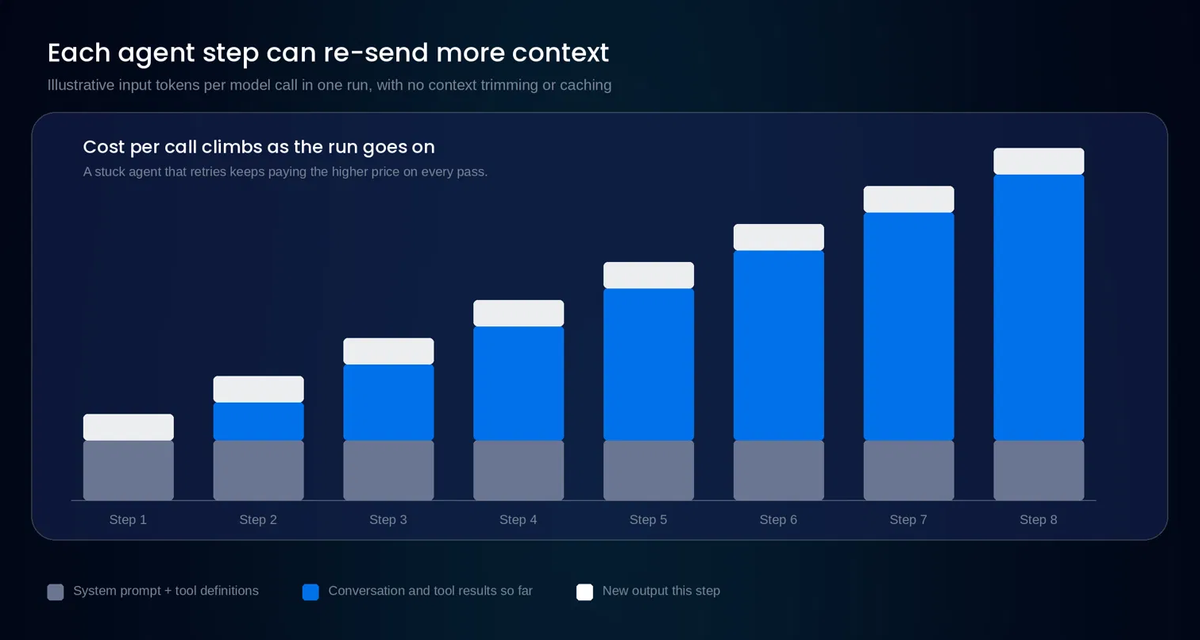
A monthly budget or an end-of-day report catches none of this in time. By the time a dashboard shows the loop, it has already finished or hit the provider's rate limit, which is why the controls in the next section act during the run.
Cost + security + compliance converge
Cost is one of three reasons to govern agents, and the controls overlap. Gartner predicts that over 40% of agentic AI projects will be canceled by the end of 2027, citing escalating costs, unclear business value, or inadequate risk controls.
An agent's API key, the tools it can call, and the data it can read determine how much it can spend and how much damage it can do. The same scoped credentials, logs, and approval steps therefore serve finance, security, and compliance. Running them as one program avoids three teams building separate controls on the same agents, and gives audit a single record of what each agent did and what it cost.
2. The Cost Governance Layer
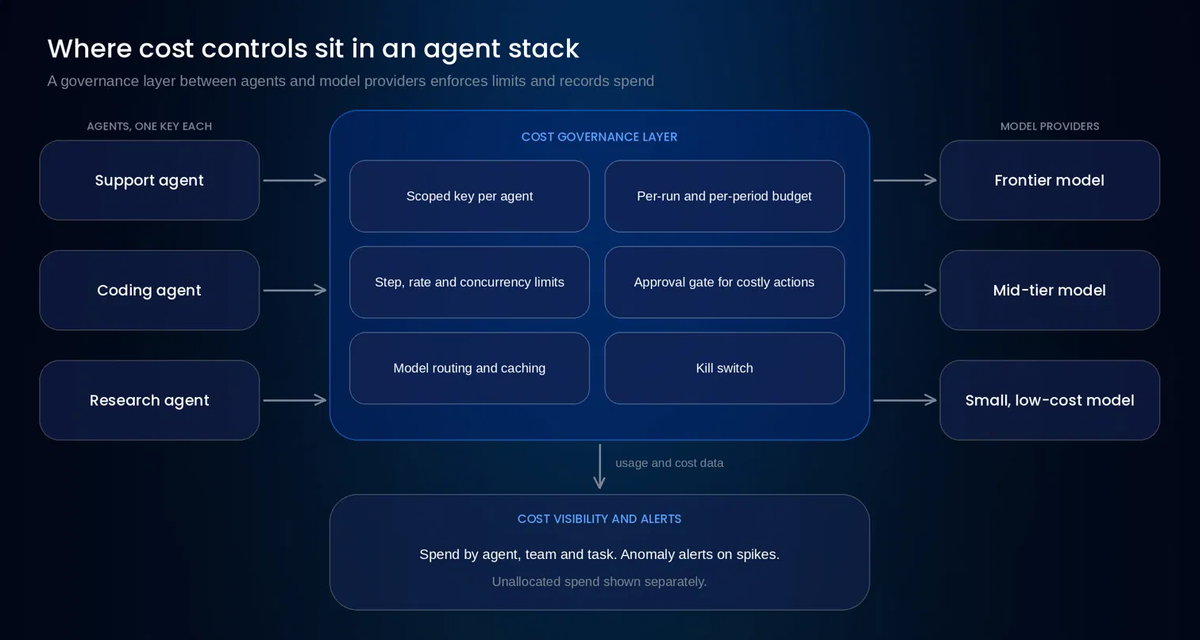
The cost governance layer is the set of controls between your agents and the model provider that decide what each agent may spend. It works at three levels, the run, the agent, and the team, and it differs from reporting in that it can stop spend as well as describe it.
Budgets, iteration limits & kill-switches
A budget sets the most an agent, team, or feature may spend over a period, in dollars or tokens. Per-period budgets catch sustained growth, but a loop can use a month's allowance in an afternoon, so each agent also needs a per-run ceiling: a maximum number of steps, tool calls, tokens, or minutes of wall-clock time for any single run. Enforce iteration limits in the agent runtime or a gateway in front of it, where the agent cannot reason its way around them. Per-period budgets are easier to set when they come from a forecast, as covered in AI spend forecasting.
Thresholds work best in tiers. A soft threshold alerts the agent's owner, a harder one throttles the agent or routes new runs to a cheaper model, and the ceiling stops it. A kill switch is the last tier: a way for a person or an automated rule to halt an agent and revoke its credentials immediately, without a deploy. Test it before it is needed, including who is authorized to use it.
Scoped keys & per-agent attribution
Give every agent its own API key, with separate keys for production and non-production. A shared key turns the invoice into one line item nobody can split, and revoking it to stop one agent takes down all of them. Scope each key to the models and tools that agent actually needs.
The key is also the join for attribution. One allocation framework points out that AI providers do not expose tag-based cost attribution comparable to cloud resource tagging, so ownership has to be applied afterward by mapping each key, seat, or organization to a team in the FinOps system. Keeping that mapping current as agents and teams change is what turns an invoice into a per-agent view.
3. Guardrails for Agentic Workloads
Guardrails constrain what an agent does inside a run. They are cheaper to apply up front than to clean up after the fact, and most come down to limiting how much an agent may do on its own and how expensive each step is.
Rate/step limits & approval gates
Rate limits cap requests and tokens per minute for an agent, which turns a runaway loop into a slow one that someone has time to notice. Step limits cap tool calls and sub-agent spawns per run. Concurrency limits matter for agents that fan out, because ten parallel sub-agents each running their own loop multiply the cost of a single bad instruction.
Approval gates pause a run at defined points and wait for a person. Good candidates are the actions where cost or consequences jump: escalating to the most expensive model, starting a long-context job, spawning sub-agents past a set count, or spending money outside the model bill. Gating everything defeats the purpose of an agent, so set gates by cost and reversibility and let routine steps run.
Model routing & caching for agents
Routing sends each step to the cheapest model that handles it well. Planning and hard reasoning justify a stronger model, while classification, extraction, and summarizing tool output often do not. Route by step type, measure quality on a sample, and keep the stronger model as the fallback when the cheaper one fails a check.
Caching fits agents unusually well because every step resends the same system prompt and tool definitions. On Claude's Sonnet 5.5 and Opus 5.5 models, cache reads are priced at 5% of the base input price, and at 10% on most other current models, while a five-minute cache write costs 1.25 times base input, according to Anthropic's documentation. The default cache lifetime is five minutes and is refreshed each time the entry is used, so a tight loop keeps hitting the cache and an agent that idles between steps loses it. Put stable content first and keep timestamps and other per-request values out of the cached prefix. The Claude API costs guide covers the mechanics in more depth.
4. Visibility & Accountability
Controls need an owner and a number to enforce against, and visibility supplies both. The State of FinOps 2026 report found that 98% of respondents now manage AI spend, up from 63% the year before, so tracking has to reach the agents inside that spend, with alerts that go to the person responsible while the spend is still running.
Per-agent, per-team, per-task cost tracking
Each level answers a different question. Per-agent cost shows which workload is spending and whether a new version changed its cost per run. Per-team cost shows who owns the budget and who receives the alert. Per-task cost, such as cost per resolved ticket or per completed code review, connects spend to value and shows whether an agent is worth running at its current price.
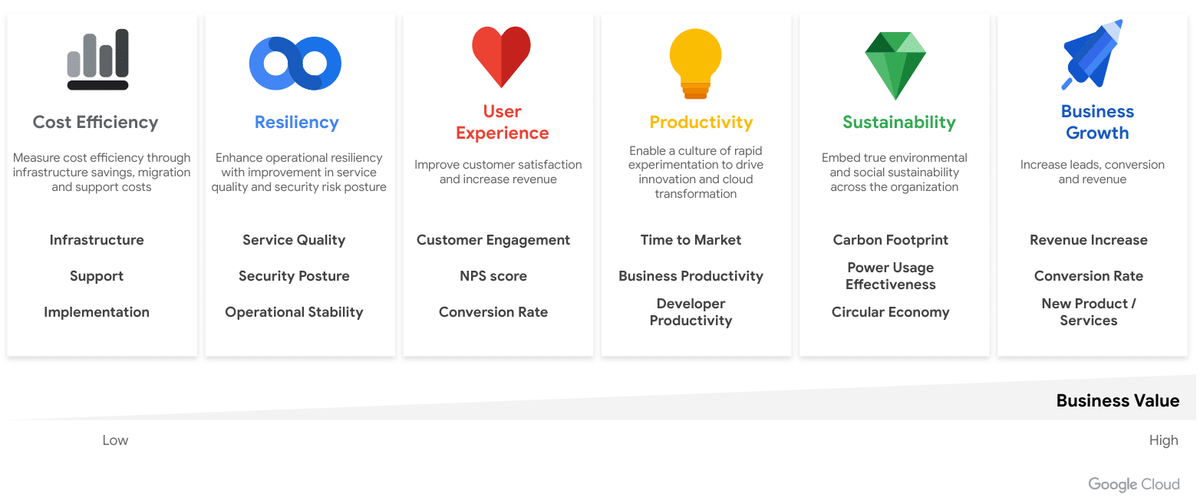
The six value areas the FinOps Foundation uses to tie AI spend to business outcomes. Source: FinOps Foundation, FinOps for AI Overview, licensed CC BY 4.0.
Within each view, break tokens into input, output, and cache reads and writes, since the mix explains a change in cost faster than the total does. Aim for every dollar to have an owner, with an explicit unallocated bucket, because unowned agent spend is the part that grows unnoticed.
Anomaly alerts on agent spend spikes
Alert on the rate of spend, not on month-end totals. A common method compares each hour with the same hour in the prior week, which accounts for daily and weekly rhythms, and flags hours well above that baseline once they clear a minimum dollar amount so small agents do not create noise. Add structural alerts for patterns that are suspicious at any size: a new model appearing in an account, an agent running outside its normal hours, or spend landing in an account the agent should not use.
Send each alert to the agent's owner with the agent, model, key, and run that caused it, and agree in advance on the first response. Usually that is pausing the key and inspecting the run's trace.
5. An AI Agent Governance Framework
A governance framework records who decides what, in writing, so controls survive staff changes and new agents. It has three parts: policies, ownership, and a maturity path.
Policies, ownership & maturity model
Policies state the rules the controls enforce. A usable set covers which models each class of agent may call, the default per-run and per-period budgets by agent class, the thresholds that trigger an approval gate, what must be logged for each run, and how long an agent may run unattended.
Ownership assigns each control to a role:
- Agent owner: accountable for the agent's budget and for responding to its alerts.
- FinOps: runs attribution, budgets, anomaly detection, and reporting.
- Platform or security: issues and revokes keys and operates enforcement in the gateway.
- Finance: sets period budgets and reviews cost per task.
Most teams build up in stages, following the Crawl, Walk, Run approach of the FinOps Foundation. The table shows what each stage adds.
| Stage | Controls | Ownership |
| Crawl | A separate key for each agent; budget alerts on each key; monthly review of cost by agent | Agent owners named; FinOps reviews invoices |
| Walk | Per-run limits; attribution by team and task; hourly anomaly alerts; tiered budget thresholds | Budgets owned by agent owners; alerts routed to them |
| Run | Gateway-enforced budgets and kill switches; model routing; approval gates; cost per task in planning | Governance policy reviewed on a schedule; finance uses agent cost in forecasts |
How nOps Governs AI Agent Spend
nOps manages $5 billion in AI and cloud spend and was recently ranked #1 in G2's Cloud Cost Management category.
- Attribution: nOps Inform maps AI spend hour by hour to the model, account, team, and product behind it, using virtual tag rules built without code, with an unallocated bucket for anything still without an owner.
- Limits: AI Wallets set spend limits at the group or seat level, with predictive alerts before a seat hits its limit and approve, partially fund, or reject decisions on each request.
- Anomaly alerts: hourly anomaly detection flags anything running 3x over the same hour in the prior week, plus structural anomalies such as a new model or an overnight workload, each tied to the model, account, and department behind it.
- Optimization: recommendations for the infrastructure your agents run on, including model substitution, cache tuning, and provisioned throughput, plus automated commitment management that optimizes pricing automatically.
Book an AI cost governance demo to see your AI spend attributed to the model, team, and product behind it, with budgets and anomaly alerts set up on your own data.
FAQs
What is AI agent governance?
AI agent governance is the combination of budgets, limits, ownership rules, and monitoring that keeps autonomous AI agents within a defined cost and risk boundary. It covers what each agent may spend, which models and tools it may use, who is accountable for it, and how overspend is detected and stopped.
How do you control AI agent costs?
Give each agent its own API key, set a per-run ceiling and a per-period budget, and cap steps, rate, and concurrency. Route routine steps to cheaper models and cache the stable prompt prefix. Track cost by agent, team, and task, and send hourly spend alerts to the agent's owner so a loop is caught while it is running.
What are guardrails for agentic AI?
Guardrails are the limits and checkpoints applied inside an agent's run. They include rate, step, and concurrency limits, approval gates for costly or irreversible actions, allowed-model lists, scoped tool access, and logging of each run. Cost guardrails and security guardrails often share the same mechanisms.
How do you budget for AI agents?
Measure cost per task in a pilot, multiply by expected task volume, and add headroom for retries. Set the per-run ceiling above normal cost per run, review actuals against the budget monthly, and revise as models, prompts, and volumes change. See AI spend forecasting for the forecasting method.