
How to Reduce Claude API Costs (2026): 8 Proven Strategies
The FinOps Foundation’s State of FinOps 2026 survey found that 98% of respondents now manage AI spend, up from 31% in 2024. For teams building on Claude, controlling that spend comes down to a handful of decisions about tokens, model choice and batching, plus enough visibility to see which team or feature is driving the bill.
This guide covers eight ways to reduce Claude API costs and how to track spend by team and feature so the savings can be measured.
What Drives Your Claude API Bill
Claude bills per token, and two things set the price of each one: whether it is input or output, and which model processes it. Output tokens, the text Claude writes back, cost five times as much as input tokens on every current model, so a long answer costs more than a long prompt of the same length. The model sets the scale: input prices run from $0.10 per million tokens on Claude Haiku 5.5 (for prompts up to 100,000 tokens) to $10 on Claude Fable 5.1, a 100x spread, with Opus and Sonnet in between.
The other driver is how much text goes into each call. Requests are stateless, so every call re-sends the system prompt, tool definitions and conversation history as input tokens, and in a long agent session that repeated context grows faster than the request count suggests. Upgrades can move the bill too: Claude 4.7 and later models use a tokenizer that produces about 30% more tokens for the same text, so the token count behind an unchanged prompt can rise after a model change.
For an explanation of per-model rates, cache and batch pricing, and the fees that sit outside token charges, see our AI pricing guide.
Cut Token Usage
A request's token count has four parts you can influence: the prompt you send, how much of that prompt is billed at full price, the text that comes back, and the reasoning Claude does before answering. The first two are input costs. Reasoning is billed as output, so it is handled together with the response text in the last two subsections.
1. Prompt trimming & system-prompt reuse
Every request is billed for its entire prompt, so a token in a system prompt or tool definition is paid for again on every call. That makes prompt size a multiplier: removing 500 tokens from a prompt that runs a million times a month takes 500 million input tokens off the bill, while the same edit to a prompt that runs a hundred times is not worth the testing time.
What to cut is whatever rides along on every call without changing the output: instructions that repeat each other, examples that no longer affect the result, whole documents where an excerpt would answer the question, and conversation history from earlier tasks. Tool definitions deserve a separate look, because they are billed as input on every request and tool use adds its own fixed system prompt on top. Anthropic's built-in toolsets are large: declaring the computer use toolset adds about 4,500 input tokens to a request before any of your own text. An agent that carries many tools it rarely calls pays that overhead on every step.
Trim against a measurement rather than by feel. The token counting endpoint reports how many tokens a prompt will use before it is sent, so each edit can be priced, and running a sample of real requests through an eval shows whether quality held. The common failure is cutting an instruction that was quietly doing work, which appears as lower quality rather than as an error.
Reuse matters for the same reason. A system prompt that is identical across requests can be cached, while one assembled per request, with a timestamp or user details near the top, cannot. Keep the stable instructions first and put anything that varies after them; the next subsection covers what that is worth.
2. Prompt caching & context management
Prompt caching lets Anthropic store a prompt prefix and reuse it on later requests, so repeated content is billed at a fraction of the normal input price. The cached prefix covers tools, then the system prompt, then messages, in that order, up to a breakpoint set with the cache_control field. A cache read costs 10% of the base input price on most models and as little as 2.5% on some current ones, while writing the prefix the first time costs 1.25x the base price for the default 5-minute lifetime or 2x for a 1-hour lifetime.
The cache refreshes at no charge each time it is read, so a prefix used more often than every five minutes stays cached at the read price. A 5-minute write pays for itself after one read and a 1-hour write after two, which makes the test whether the same prefix will be sent again before the cache expires. A long, fixed system prompt on a high-traffic endpoint passes that test easily; a one-off job never earns back its write. The 1-hour lifetime fits prefixes that are reused less often than every five minutes but more often than hourly, where its higher write price is cheaper than rewriting the 5-minute cache repeatedly.
Automatic caching is the simplest way to start: one top-level cache_control field, and the breakpoint moves forward as a conversation grows. Explicit breakpoints on individual blocks suit prompts whose parts change at different rates, with up to four per request. Caching fails silently, so check the usage fields in each response. If cache_read_input_tokens stays at zero, the prefix is not being reused, and the usual causes are:
- A breakpoint on content that changes. A timestamp or the incoming user message inside the cached block gives every request a different prefix, so each request pays for a write and none gets a read. The breakpoint belongs at the end of the static part.
- A prompt below the minimum length. Prefixes shorter than the model's minimum cacheable length, which varies by model, are processed without caching and without an error.
- A changed prefix. Editing tool definitions invalidates the whole cache, and changing tool_choice, adding or removing images, or changing the thinking or effort settings invalidates the message portion.
- Parallel first requests. A cache entry only becomes available once the first response begins, so requests sent at the same moment all miss.
Caching makes repeated tokens cheaper; context management reduces how many there are. In a long conversation or agent run each turn re-sends all earlier turns, so input grows with every step even when each step adds little. Anthropic offers two server-side tools for this. Compaction replaces older turns with a summary that Claude writes, and is in beta. Context editing clears old tool results once the prompt passes a threshold, 100,000 input tokens by default, and can also clear old thinking blocks, which suits agents whose earlier file reads and search results are no longer needed.
The two techniques interact with caching, because clearing content changes the prefix and forces the cache to be rewritten. The clear_at_least setting stops clearing from running unless it removes enough tokens to justify that write. Keeping the active context small also helps beyond cost, since Anthropic notes that response quality degrades as a conversation grows. Neither is worth setting up for short conversations, where history never grows large enough to matter.
3. Limit output length
Output is the part of a response that the model decides rather than you, which makes it the hardest part of the bill to predict. Four controls apply, and each does a different job.
max_tokens is a hard ceiling on output for a request, and Claude never generates past it. It protects against runaway responses but does not make answers shorter: a response that reaches the ceiling is cut off mid-answer and still billed in full, so the cap should be sized to the longest legitimate answer rather than to the length you hope for. On models that think, the cap also covers the reasoning.
Instructions in the prompt are what actually shorten answers. State the length and format you want and what to leave out, such as asking Claude to keep responses concise and skip non-essential context. Anthropic's guidance on Claude Opus 5 is to prompt for length for this reason, since changing effort does not reliably shorten visible responses on that model.
Output format matters as much as length. A task whose downstream use needs a label or a single field should ask for exactly that, because every sentence of explanation around it is billed output that no one reads.
Effort lowers token use across the whole response, including text, tool calls and thinking, with fewer and terser tool calls at lower levels. It governs how much work Claude does rather than how long the visible answer is, and the next subsection covers it in detail. For all four controls, check quality on a sample before shipping, since a shorter answer only saves money where the detail removed was not being used.
4. Cap extended thinking budgets
Thinking tokens are billed as output tokens, and the bill covers all the thinking Claude generates even when the response shows only a summary of it. The billed output count can therefore be much larger than the text you see. Each response reports how many output tokens were reasoning in usage.output_tokens_details.thinking_tokens.
Current models do not take a thinking token budget. The older budget_tokens setting is deprecated on some models and rejected on the newest, and thinking is instead adaptive: Claude decides for each request whether to think and how much. Two controls bound the cost. max_tokens caps thinking and answer text combined, so it must leave room for both or answers get cut off. Effort is soft guidance on how much of that output Claude spends on thinking.
Effort runs from low to max. Lower levels skip thinking on simple requests and think less on hard ones, and higher levels think on most requests. Defaults differ by model, medium on some and high on most, so a request that omits effort does not run at the same level everywhere. Anthropic's advice is to run a sweep on your evals: send the same sample of real requests at several levels and keep the lowest that holds quality, since levels are recalibrated between models and a setting carried over from an older model can behave differently.
Two behaviors change the bill without any code change. Adaptive thinking is on by default on some models, so a request that never mentioned thinking can start producing billed reasoning after a model upgrade. And changing effort between requests in the same conversation invalidates the prompt cache, so pick a level per workload and hold it; models that support per-message effort, which is in beta, can change levels without losing the cache. Lowering effort on tasks that need multistep reasoning shows up as shallow answers, so apply it first to the high-volume, simple traffic.
Smarter Model & Routing Choices
Model choice sets the rate on every token in a request, and the Batch API halves that rate for work that can wait. Neither changes the prompt, so both can be applied after the token-level work above.
5. Route simple tasks to cheaper models
Routing means choosing the model per request instead of sending everything to one. Anthropic positions its tiers by workload: Haiku 5.5 for high-volume, latency-sensitive work such as classification, extraction and routing, Sonnet 5.5 as the balance of speed and intelligence, Opus 5.5 for long-running agentic coding and knowledge work, and Fable 5.1 for the most demanding reasoning. Whatever share of traffic moves to a cheaper tier is billed at that tier's rate, so the saving scales with how much of the workload does not need the largest model.
There are three ways to do it. Static routing assigns a model by task type in code, so classification goes to the smallest model and drafting to a larger one; it adds no overhead and is predictable, but it cannot adapt when a hard request arrives on an easy path. Classifier routing has a cheap model rate each request's difficulty first and forwards it accordingly; it handles mixed traffic better but adds a call to every request and misroutes some of them. Escalation starts every request on the cheap model and moves up when a check fails, such as malformed output or low confidence; it keeps most traffic cheap, but the requests that escalate pay for both attempts.
Judge a model by cost per successful task, not price per token. A cheaper model that needs retries, longer outputs or a second pass can cost more than a larger one that gets it right the first time, so each task type needs its own eval set. Two details shift the math. Haiku 5.5 prices prompts over 100,000 tokens at five times its base rate, which narrows its advantage on long-document work, and effort levels are not equivalent across models, so settings need re-testing after a switch.
6. Batching
The Message Batches API processes requests asynchronously at 50% off both input and output tokens. A batch holds up to 100,000 requests or 256 MB, most batches finish within an hour, and any request still unfinished after 24 hours expires. Results stay available for 29 days. Models and features match standard requests except that streaming is not supported, so the only thing traded for the discount is when the answer arrives.
The test for whether work is batchable is whether anyone is waiting for the result. Output that will not be read until later qualifies; anything inside a user-facing request does not.
The discount stacks with caching, because the cache multipliers apply on top of batch prices. A batch can take longer than five minutes to work through, so use the 1-hour cache lifetime when its requests share a long prefix.
Batches are scoped to a workspace, are subject to their own rate limits, and can slightly exceed a workspace spend limit because they are processed concurrently.
Monitor & Attribute Claude Spend
Each lever above needs a way to confirm it worked, and each saving needs an owner. Anthropic's built-in reporting covers the first part at the level of keys and workspaces. Getting down to teams and features takes a deliberate setup. Dedicated FinOps tools for AI cover this ground, and our AI cost observability guide compares the main approaches.
7. Scoped keys, tags & per-team/per-feature tracking
Anthropic attributes spend through workspaces and API keys. A workspace groups keys, members and limits, and each API key is scoped to one workspace, so separate workspaces for development, staging and production, or for each team or product, give usage reporting an owner by construction. The Usage and Cost API returns token usage and dollar cost grouped by workspace, API key and model, with uncached input, cached input, cache writes and output reported separately, and it requires an Admin API key.
The granularity stops at the key. If one service calls Claude for several features, or serves several customers through one key, the API reports a single line. There are two fixes. Give each feature its own key or workspace, which is simple to set up. Or log the usage block returned with every response alongside a feature or customer ID and price it yourself, which is the only way to split a shared key and the only way to get cost per request.
Splitting workspaces has one cost: prompt caches are isolated per workspace, so identical prompts sent from different workspaces do not share cache entries. Keep services that send the same long prefix in the same workspace.
Buying Claude through a cloud marketplace adds a layer. Claude Platform on AWS and Claude in Microsoft Foundry bill in Claude Consumption Units, and the cloud bill shows only the aggregated total, so the breakdown by workspace stays in the Claude Console and in your own request logs.
8. Budgets & anomaly alerts
Anthropic enforces spend limits at two levels. Each usage tier has a monthly spend cap, you can set your own limit below it, and workspaces can carry lower limits of their own with alerts at spending thresholds. When a limit is reached, requests return an HTTP 400 error until it resets, so a limit is a hard stop, not a warning.
That makes limits a design decision. A tight cap on a development workspace is harmless, but the same cap on a production workspace turns a spending problem into an outage. For production, set alerts well below the limit, and set the limit where an overrun would be worse than downtime.
A limit also only catches the total. It does not catch a spike that stays under it, and by the time a cap trips the money is spent. Anomaly detection compares each source of spend against its own recent baseline, so one user's usage doubling, a new model entering the mix, or an agent looping overnight surfaces within days instead of at invoice time. Anthropic's Cost API reports in daily buckets, so daily is the fastest cadence the cost data gives you, and faster detection needs the Usage API, which reports at the minute or hour level.
When an alert fires, the useful question is what changed: which key, which model, which day. The grouping dimensions from the previous subsection are what make that answerable.
How nOps Helps Control Claude/LLM Spend
Workspaces, keys and spend limits show where Claude spend lands, but they leave gaps: attribution below the key level, budgets that stop work instead of steering it, and alerts that do not explain what changed. nOps fills those gaps and puts Claude spend in the same platform as your other AI, multicloud, Kubernetes and SaaS costs, so AI spend is managed with the same allocation, budgeting and optimization as the rest of the bill.
- Attribution by team and feature. Automatically allocate 100% of Anthropic spend across teams, business units and initiatives, so every dollar has an owner.
- Budget governance that keeps teams working. Approvers set budgets by group, define thresholds at the seat level, and handle limit increases through an approval workflow, with the option to rebalance individual limits inside the group budget instead of blocking users.
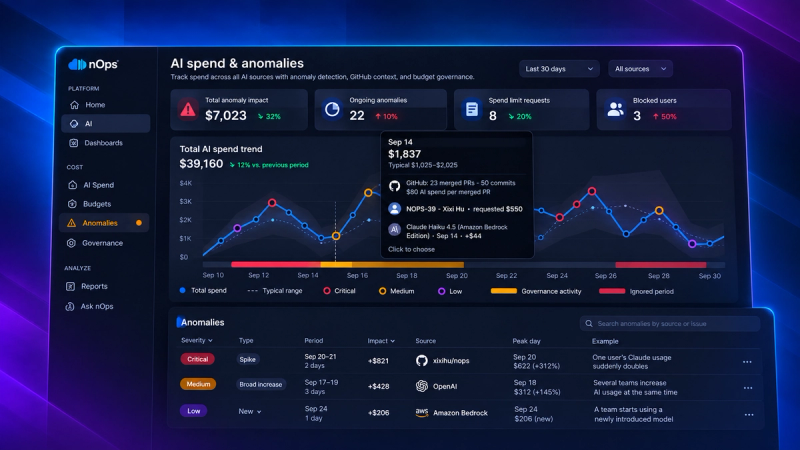
- Anomaly detection with engineering context. Each anomaly is classified as a spike, broad increase, new model or service, or deviation from baseline, rated by severity, and traced to the user, model and day behind it. Comparing spend with engineering activity such as merged pull requests shows whether a spike was waste or a productive week. You can also ask Clara, the nOps FinOps AI agent, about any anomaly.
- Recommendations. nOps recommends changes such as model substitution and cache tuning, which are the levers covered earlier in this guide.
- Unit economics. Cost per request and cost per feature connect Claude spend to what it produces, which is how a bill becomes a pricing and margin decision.
To try it out with your Claude costs, you can book a free savings analysis with a free trial.
nOps manages $5 billion in AI and cloud spend and was recently ranked #1 in G2’s cloud cost management category.
FAQs
Why is the Claude API expensive?
Claude API cost is driven by volume more than by price: every request re-bills its full prompt, output tokens cost five times as much as input, and reasoning is billed as output. Bills grow fastest when long prompts are re-sent on every call, when responses run longer than the task needs, or when a larger model than necessary handles routine work.
How do I reduce Anthropic API costs?
Measure first, then work through the levers in this guide: cut prompt tokens, cache repeated prefixes, cap output and thinking, send each task to the cheapest model that handles it, batch work no one is waiting for, and put limits and alerts on every workspace. Trimming and output limits reduce the token count, while caching, routing and batching reduce the rate paid per token. For the wider set of LLM cost levers, see our LLM cost optimization tips.
Does prompt caching lower Claude costs?
Yes, on repeated prefixes. A cache read costs 10% of the base input price on most models and as little as 2.5% on some current ones, against a one-time write of 1.25x for the 5-minute lifetime or 2x for the 1-hour lifetime. It saves nothing on a prompt that runs once, on a prefix below the minimum length, or when the prefix changes between requests.
Which Claude model is cheapest?
Claude Haiku 5.5 is the cheapest current model, at $0.10 per million input tokens and $0.50 per million output tokens for prompts up to 100,000 tokens, and $0.50 and $2.50 above that. Cheapest per token is not always cheapest per task, so compare cost per successful result on your own evals.