
GenAI Cost Attribution: Complete Guide to Track AI Spend (2026)
Enterprise GenAI spending tripled to $37 billion in 2025, and the generative AI market is projected to reach $91.57 billion in 2026. Yet more than 80% of organizations report no measurable EBIT impact from their GenAI investments. The disconnect is clear: organizations are spending aggressively on generative AI but struggling to understand where that money actually goes.
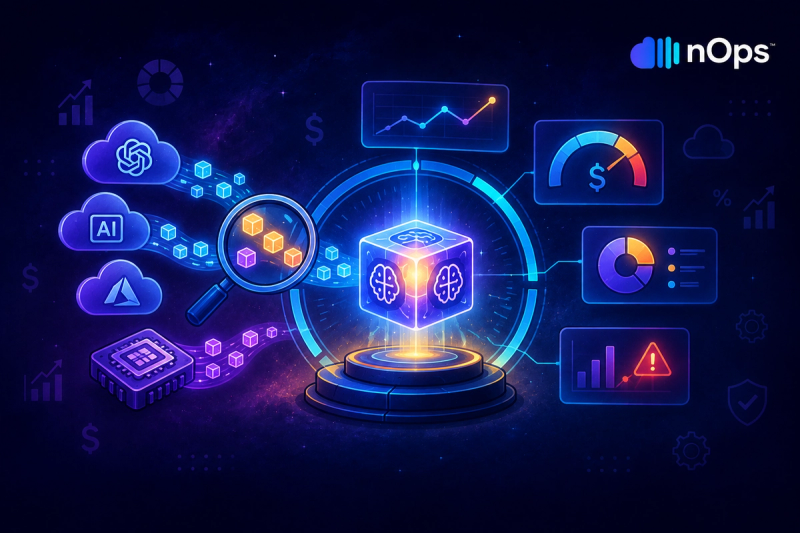
GenAI cost attribution solves this problem. It connects every dollar of GenAI spend back to the teams, features, and customers that generated it — giving finance, engineering, and leadership the visibility they need to make informed decisions about AI investments.
In this guide, we break down what GenAI cost attribution is, why it matters, how to implement it across AWS, Azure, and GCP, and compare the top automation tools that can help.
What Is GenAI Cost Attribution?
GenAI cost attribution is the practice of tracing generative AI costs back to the specific teams, features, products, or customers that incurred them. Unlike traditional cloud cost allocation, which relies on tagging static resources like EC2 instances or S3 buckets, GenAI cost attribution must account for dynamic, usage-based spending patterns: token consumption, model inference calls, GPU time, and API requests that shift constantly based on workload behavior.
Traditional cloud billing tells you how much a service cost. GenAI cost attribution tells you *why* it cost that much — and who should be accountable for it.
Why GenAI Cost Attribution Matters
GenAI costs behave differently than traditional cloud infrastructure. Inference alone can account for 80–90% of total GenAI spend according to the FinOps Foundation, and those costs scale unpredictably as usage grows. Without attribution, organizations face three compounding problems:
Financial blind spots. When multiple teams share the same model endpoints, it becomes impossible to determine which team or feature drove a cost spike. A 33% of IT executives cite excessive GenAI adoption costs as a significant barrier, and 22% highlight ineffective cost management specifically. Attribution eliminates the guesswork by mapping every API call, every token, and every GPU hour to the business context that generated it.
Scaling without accountability. GenAI costs exhibit non-linear growth. A chatbot that costs hundreds per month during pilot can reach tens of thousands in production. Without attribution, there is no way to calculate unit economics or identify which use cases deliver ROI.
Budget governance failures. GenAI costs can quickly rise to 25%+ of COGS for organizations deploying AI-native applications. When costs are spread across shared endpoints with no attribution model, finance teams cannot enforce budgets and leadership has no clarity on return.
GenAI Cost Attribution vs Cost Optimization
Understanding how Google Cloud prices its services is the first step to optimize spending. GCP uses a combination of pricing models, each with different implications for your monitoring strategy.
Pay-as-You-Go Pricing
These terms are related but address fundamentally different problems. Confusing them leads to organizations trying to cut costs before they understand where those costs come from.
| GenAI Cost Attribution | GenAI Cost Optimization | |
|---|---|---|
| Primary question | Who or what caused this cost? | How do we reduce this cost? |
| Focus | Visibility, allocation, and accountability | Efficiency, waste reduction, and savings |
| Key activities | Token tracking, cost mapping, chargeback/showback | Model selection, prompt compression, caching, GPU rightsizing |
| When it matters | Before optimization — you cannot optimize what you cannot measure | After attribution — once you know where costs originate, you can target reductions |
| Output | Cost dashboards by team, feature, or customer; unit economics | Lower inference costs, reduced GPU underutilization, better commitment coverage |
| Example | “The fraud detection feature consumed $12,000 in GPT-4o tokens last month across 2.3M requests.” | “Switching fraud detection from GPT-4o to GPT-4o-mini reduced token costs by 60% with no accuracy loss.” |
Key Components of GenAI Cost Attribution
Effective GenAI cost attribution requires capturing data across four dimensions. Each dimension addresses a different layer of the cost stack, and all four are necessary for complete visibility.
Token Usage Tracking
Tokens are the atomic unit of GenAI cost. Every API call to a language model consumes input tokens (your prompt) and output tokens (the model’s response), each priced differently. For example, GPT-4o charges $2.50 per million input tokens and $10.00 per million output tokens as of April 2026 — a 4x difference that makes the input/output split critical for accurate attribution.
Token tracking means logging the exact token count for every request, tagged with metadata: which team sent the request, which feature triggered it, and which customer it served.
Model-Level Cost Tracking
Most organizations use multiple models simultaneously — a frontier model like Claude Opus for complex reasoning, a mid-tier model for general tasks, and a smaller model for high-volume, low-complexity requests. Each has different per-token pricing, latency, and quality tradeoffs.
Model-level cost tracking captures which models are used by which teams and features, revealing opportunities like routing low-priority traffic to cheaper models.
API Usage Tracking
Beyond tokens, GenAI workloads incur costs through API calls to embedding models, vector databases, and retrieval pipelines. A single RAG pipeline might involve an embedding call, a vector search, a reranking step, and a final generation call — each with its own cost structure.
API usage tracking captures request counts, latency, and costs across the entire inference pipeline, not just the final model call.
Infrastructure Cost Allocation
Self-hosted models on GPU instances introduce infrastructure costs where GPU utilization is frequently as low as 15–30%. Infrastructure cost allocation distributes these GPU, storage, and networking costs across workloads using proportional allocation based on actual utilization metrics.
How GenAI Costs Are Structured
Understanding the cost structure is essential for building an attribution model. GenAI costs fall into three categories:
Consumption-based costs are the most visible. These include per-token charges from API providers (OpenAI, Anthropic, Google), per-request fees, and per-image or per-minute charges for multimodal models. These costs scale linearly with usage and are directly attributable when proper tagging is in place.
Infrastructure costs include GPU instance hours, storage for model weights and vector databases, networking for data transfer between services, and orchestration overhead. With approximately $450 billion of projected 2026 cloud spend tied directly to AI infrastructure, these costs are substantial but harder to attribute because infrastructure is often shared across multiple workloads.
Platform and tooling costs include fees for MLOps platforms, observability tools, and fine-tuning compute. These indirect costs are often overlooked but can represent a meaningful portion of total GenAI spend.
The key insight: consumption-based costs are easy to attribute (each API call has a clear cost), while infrastructure and platform costs require allocation rules based on utilization percentage or request volume.
Attribution Layers in GenAI Workloads
GenAI cost attribution operates at multiple layers, each answering a different business question.
Model-Level Attribution
Model-level attribution answers: “How much are we spending on each model?” This is the starting point for most organizations. It reveals the cost distribution across models (e.g., 60% on GPT-4o, 25% on Claude Sonnet, 15% on embedding models) and identifies whether expensive models are being used for tasks that could be handled by cheaper alternatives.
This layer requires tagging or routing every API call through a gateway that logs the model, tokens consumed, and cost. Tools like Portkey, LiteLLM, and AWS Bedrock’s Application Inference Profiles provide this capability.
Feature-Level Attribution
Feature-level attribution answers: “How much does each product feature cost to power with AI?” This is where attribution becomes actionable for product teams. A SaaS company might discover that its AI-powered search feature costs $0.02 per query while its document summarization feature costs $0.35 per request — a 17x difference that directly impacts pricing and margin decisions.
This layer requires application-level instrumentation. Every GenAI API call must carry metadata identifying which feature triggered it. This cannot be done purely at the infrastructure layer — it requires integration at the application code level.
Customer-Level Attribution
Customer-level attribution answers: “How much GenAI cost does each customer generate?” This is critical for SaaS companies with usage-based pricing models. Without customer-level attribution, it is impossible to identify which customers are profitable, which are consuming disproportionate resources, and how to price AI features sustainably.
Customer-level attribution requires passing a customer identifier with every API call and aggregating costs per customer over billing periods.
How to Implement GenAI Cost Attribution: A Framework
Implementation follows a five-step process, from defining the model to building dashboards. Each step builds on the previous one.
Monitor Costs Daily (Not Monthly)
Implementation follows a five-step process, from defining the model to building dashboards. Each step builds on the previous one.
Step 1: Define Your Attribution Model
Before instrumenting anything, decide what you want to attribute costs to. Common attribution dimensions include:
- Team/department: Engineering, marketing, data science, customer support
- Product/feature: AI search, document summarization, code generation, chatbot
- Customer/tenant: Individual customers or customer tiers (enterprise, mid-market, SMB)
- Environment: Production, staging, development, experimentation
- Project/initiative: Specific AI projects or POCs
Most organizations start with team + feature attribution, then add customer-level attribution as they mature.
Step 2: Track Usage — Tokens and Requests
Implement per-request logging that captures:
- Timestamp
- Model used
- Input token count and output token count
- Request latency
- Team, feature, and customer tags
- Environment
- Cost (calculated from token counts × model pricing)
For API-based models (Bedrock, Azure OpenAI, Vertex AI), use the provider’s built-in logging plus application-level tagging. For self-hosted models, instrument the inference server to emit these metrics.
Step 3: Map Costs to Features
Connect the usage logs to your product architecture. This requires a mapping that links each API endpoint or service to the product feature it supports. For example:
`/api/search` → AI Search feature
`/api/summarize` → Document Summarization feature
`/api/chat` → Customer Support Chatbot feature
Automate this mapping by requiring feature tags in every API call.
Step 4: Allocate Shared Infrastructure
For self-hosted models and shared GPU clusters, define allocation rules: proportional allocation (distribute based on GPU utilization or request volume), reserved allocation (dedicated capacity per team), or hybrid (reserve baseline, allocate burst proportionally).
The FinOps Foundation recommends providing granular, actionable metrics that define the tradeoff between cost, performance, and business impact to engineers and product owners.
Step 5: Build Dashboards and Alerts
Create dashboards that answer the questions each stakeholder cares about:
Finance: Total GenAI spend by department, month-over-month trends, budget vs. actual
Engineering: Cost per model, cost per feature, cost anomaly detection
Product: Unit economics (cost per customer, cost per feature usage), margin analysis
Leadership: GenAI ROI, cost as percentage of revenue, trend forecasting
Set up alerts for budget thresholds and anomalous spending spikes.
Multi-Cloud GenAI Cost Attribution
Most enterprises run GenAI workloads across multiple cloud providers. Each provider handles cost attribution differently, which creates fragmentation for multi-cloud organizations.
AWS (Amazon Bedrock)
AWS offers the most mature native attribution tooling through Application Inference Profiles in Amazon Bedrock. You create a profile per application or team, assign cost allocation tags, and every API call through that profile appears with those tags in the Cost and Usage Report (CUR). This gives you billing-level attribution without custom instrumentation. AWS also recently added CSV download support for Cost Optimization Hub, making it easier to export and analyze recommendations.
Strengths: Native CUR integration, tag-based attribution compatible with existing FinOps workflows, SageMaker endpoint tagging.
Gaps: No input vs. output token breakdown in CUR, no per-user visibility, no automatic cross-model cost comparison
Customer-Level Attribution
Azure lacks an equivalent to Inference Profiles. Attribution requires creating separate Azure OpenAI resources for each team or use case, then tagging those resources. Azure Cost Management aggregates by resource tags, with tag inheritance from subscriptions providing some scalability.
Strengths: Tag inheritance across resource hierarchy, Azure Cost Management integration.
Gaps: No call-level tagging, shared endpoints cannot be split by consumer, requires architectural segmentation.
GCP (Vertex AI)
Google Cloud uses resource labels and BigQuery billing export. Label Vertex AI endpoints, then query billing exports to calculate costs per label. For workload-level attribution, GCP recommends separate projects per team.
Strengths: BigQuery enables custom analytics, flexible label support, per-project isolation.
Gaps: No request-level attribution, shared deployments cannot be split, no native token-level cost breakdown.
Multi-Cloud Summary
| Capability | AWS Bedrock | Azure OpenAI | GCP Vertex AI |
|---|---|---|---|
| Native call-level attribution | Yes — Inference Profiles | No | No |
| Tag/label-based cost grouping | Yes — CUR tags | Yes — resource tags | Yes — labels + BigQuery |
| Token-level cost breakdown | Partial | Partial | Partial |
| Shared endpoint attribution | Via Inference Profiles | Requires separate resources | Requires separate projects |
| Multi-model cost comparison | Manual | Manual | Manual |
For organizations operating across two or more providers, a third-party attribution tool is typically necessary to unify cost data and provide consistent attribution across environments.
Tools for GenAI Cost Attribution
The tooling landscape for GenAI cost attribution spans cloud-native options and specialized third-party platforms. Here is how the leading options compare.
nOps
nOps is a FinOps platform that helps organizations track, allocate and optimize their GenAI costs. For AI spending visibility, nOps helps teams connect AI-related AWS costs — including GPU instances, SageMaker spend, and Bedrock usage — to the teams, workloads, features, and business units that generated them.
nOps stands out because it pairs attribution with automated optimization. The platform uses ML to monitor hourly compute usage and automatically commit in small increments as workload patterns change. This helps reduce costs and increase flexibility across dynamic EC2, EKS, Fargate, Lambda, SageMaker, and GPU-heavy workloads.
Best for: AWS-focused organizations that want GenAI cost attribution, tagging governance, and automated optimization in a single platform.
Finout
Finout focuses on multi-cloud cost attribution with strong support for virtual tagging — the ability to assign cost allocation labels to resources that were not tagged at creation. For GenAI workloads, Finout can combine CUR data from AWS, billing exports from Azure and GCP, and usage data from SaaS tools like Snowflake and Datadog into a unified cost view.
Good fit for: Multi-cloud organizations that need virtual tagging and SaaS cost unification alongside GenAI attribution.
CloudZero
CloudZero specializes in unit economics — connecting cloud costs to business metrics like cost per customer, cost per transaction, or cost per feature. For GenAI attribution, CloudZero ingests cloud billing data and telemetry from Kubernetes, then maps costs to business dimensions without requiring extensive tagging upfront. As noted in a CloudZero FinOps tools comparison, the platform focuses on unit economics and AI cost visibility.
Good fit for: SaaS companies that need customer-level and feature-level unit economics for AI-powered products.
Native Cloud Tools
Each cloud provider offers built-in cost management tools that can be stretched for GenAI attribution:
AWS Cost Explorer + CUR: Tag-based cost grouping, Bedrock Inference Profiles, Athena queries for custom analysis
Azure Cost Management: Resource-tag-based attribution, budget alerts, cost anomaly detection
GCP Billing Export + BigQuery: Label-based cost analysis, custom SQL queries, Looker dashboards
Native tools work for single-cloud organizations with disciplined tagging but lack cross-model comparison and virtual tagging.
Tool Comparison Summary
| Capability | nOps | Finout | CloudZero | Native Cloud Tools |
|---|---|---|---|---|
| Cloud support | AWS, Azure, and GCP | AWS, Azure, and GCP | AWS, Azure, and GCP | Single cloud |
| GenAI cost visibility | Yes | Yes | Yes | Basic |
| Virtual tagging | Yes | Yes | Yes | No |
| Unit economics | Yes | Yes | Yes | Manual |
| Automated optimization | Yes | No | No | Limited |
| Kubernetes attribution | Yes | Yes | Yes | Varies |
| SaaS cost integration | Yes | Yes | Yes | No |
Take Control of Your GenAI Costs with nOps
nOps makes AI cost attribution easy with automated tagging enforcement and real-time visibility. For AI workloads, it breaks down GPU instance costs, SageMaker spend, and Bedrock invocations by business dimension.
The real differentiator is how nOps combines cost visibility with automated optimization. For GPU reserved capacity and savings plans, nOps’s commitment management automatically rightsizes commitments — increasingly important as AI infrastructure costs grow.
nOps only gets paid if we save you money — meaning there’s no upfront cost or financial risk. See if you can reduce costs on AI with a free savings analysis.
nOps is entrusted with $5 billion in cloud spending and was recently rated #1 in G2’s Cloud Cost Management category.
Demo
AI-Powered Cost Management Platform
Discover how much you can save in just 10 minutes!
Book a Demo
Frequently Asked Questions
Why is GenAI cost attribution important?
GenAI cost attribution matters because generative AI costs scale unpredictably and can become a significant portion of cloud spend. With enterprise GenAI spending tripling to $37 billion and inference accounting for 80–90% of total GenAI spend, organizations need per-team and per-feature visibility to maintain budget control.
How is GenAI cost attribution different from cost optimization?
Attribution answers “who caused this cost?” while optimization answers “how do we reduce it?” Attribution maps costs to teams, features, and customers. Optimization uses that data to take action: switching models, caching responses, rightsizing GPUs. Attribution must come first.
Can GenAI cost attribution be automated?
Yes. AWS Bedrock’s Application Inference Profiles automate attribution at the API level. Third-party platforms like nOps, Finout, and CloudZero further automate by ingesting billing data, applying virtual tags, and generating dashboards. The prerequisite is consistent metadata tagging at the application layer.
How do SaaS companies use GenAI cost attribution?
SaaS companies use it for customer-level unit economics — calculating cost-to-serve, identifying unprofitable accounts, and pricing AI features sustainably. For example, attributing costs per customer reveals that enterprise accounts consuming AI search cost $0.03 per query, informing whether to include it in base pricing or charge per usage.
What tools help with GenAI cost attribution?
The top tools include nOps (AWS-focused with automated optimization), Finout (multi-cloud with virtual tagging), and CloudZero (unit economics focus). Native tools — AWS Cost Explorer, Azure Cost Management, GCP BigQuery billing — provide basic attribution for single-cloud environments.