
Agentic FinOps: The Complete Guide (2026)
AI agents are beginning to change how organizations manage cloud costs. Rather than simply reporting on spending, emerging agentic FinOps tools can investigate anomalies, analyze optimization opportunities, and, in some cases, take action with limited human intervention.
It's a promising development, but the technology is still evolving. How much autonomy should agents have? Which FinOps tasks are best suited to automation? And what safeguards are needed before organizations can trust agents to make financial decisions?
This guide explains what agentic FinOps is, how it works, the levels of autonomy agents can be given, the FinOps tasks they handle, the risks involved, and how to choose a platform.
What Is Agentic FinOps?
Agentic FinOps is the use of AI agents to carry out FinOps work without waiting to be asked. Instead of a person opening a dashboard, spotting a problem, and investigating it, this work is delegated to agent(s). What this might look like is a FinOps agent watches cost and usage data continuously, works through each issue it finds, and delivers a finished result: an explanation, a recommendation, or, within limits people set, a completed change. The practice sits within the existing FinOps framework, and human FinOps practitioners still set policy and own decisions.
How It Differs from Traditional FinOps
Traditional FinOps already uses automation extensively, from anomaly detection and forecasting to rightsizing recommendations and commitment management. However, traditional FinOps tools generally perform specific, predefined functions. When an anomaly is detected, for example, a practitioner may still need to investigate the cause, correlate data across systems, and determine the appropriate response. Agentic FinOps aims to automate more of that work. Rather than executing only predefined rules, AI agents can use available data and tools to investigate problems, follow different lines of inquiry, and determine next steps based on what they find.
AI Assistants vs. AI Agents
An AI assistant answers when someone asks it a question, such as what a team spent last month. An AI agent works toward a goal on its own. Given a standing task, such as reviewing each day's spend for problems, it runs on a schedule, decides which queries to make, follows up on what it finds, and reports back or acts. Agent designs such as ReAct describe this loop of reasoning, calling a tool, and choosing the next step.
Agentic FinOps vs. FinOps for AI Agents
The two terms sound alike but describe opposite relationships. Agentic FinOps uses AI agents to manage cloud and AI spend. FinOps for AI agents manages the cost of the agents themselves, through per-agent budgets, run limits, and spend tracking, which is the subject of AI agent governance.
Why FinOps Teams Are Turning to Agents
Most FinOps teams have more data and more recommendations than people to act on them. Several shifts keep widening that gap, and others have made agents practical to use:
- Cost data has outgrown manual review. AWS's Cost and Usage Report alone can run to millions of line items a month, and every additional cloud, SaaS tool, and AI provider adds another dataset in its own format.
- AI spend changes faster than monthly reporting. Because it is billed per token or request, a prompt change, a new model, or an agent stuck in a loop can raise costs within hours.
- Recommendations go unactioned. Each one needs someone to verify it, find the owner, and follow up, and the FinOps Foundation notes that most practices lack the authority to move from reporting a cost issue to fixing it.
- Commitment portfolios involve more decisions than a team can make by hand. Choosing coverage means weighing combinations of instance family, region, term, and payment option across every cloud, and most teams rebalance monthly at best, even with dedicated staff.
- Cost ownership has moved to engineering. Engineers now own much of the spend they create but rarely open FinOps dashboards, so findings have to reach them in the tools they already use, which agents can do directly.
- The building blocks now exist. Models that reliably call tools, the Model Context Protocol, and official billing MCP servers from AWS, Microsoft, and Google make it practical to connect agents to cost data, and practitioners presented working FinOps agents at FinOps X 2026.
How Agentic FinOps Works
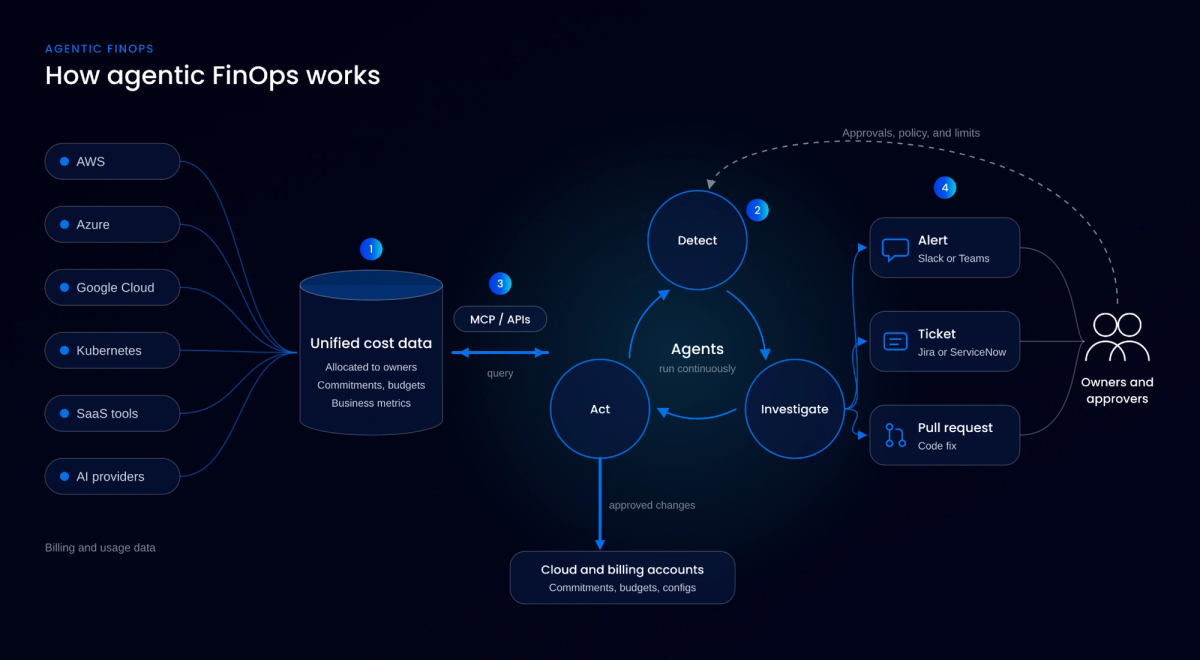
An agentic FinOps system has four parts: the cost data agents work from, the agents themselves, the tools they use to query data and take action, and the integrations that deliver their results to people.
A Unified Cost Data Layer
Agents can only reason about the data they can reach. This is increasingly important as the FinOps Foundation has expanded its framework beyond public cloud to encompass SaaS, data centers, data cloud scopes, and AI. A useful data layer combines billing from every cloud, Kubernetes cluster, SaaS tool, data platform and AI provider, and adds what billing files lack on their own: allocation of untagged and shared spend, commitment coverage, budgets, and business metrics. With raw billing data, an agent can say which account spent more. With allocated data, it can say which team, product, or customer did.
Specialized Agents
Most AI systems split the work among several narrow intelligent agents rather than one general one:
- A detection agent scans continuously for anomalies, waste, and budget drift.
- An investigation agent traces each finding to its cause and owner.
- An action agent opens tickets, generates code, or carries out approved changes.
- In some systems, a planning agent breaks a broad request into steps for the others.
Narrow agents are easier to test and need fewer permissions. A prototype FinOps agent from IBM Research used the same design, with separate planning, data retrieval, and analysis agents.
Tool Access Through MCP and APIs
Agents act by calling tools, such as running a query, updating a budget, or purchasing a commitment. Platforms expose these through APIs and, increasingly, the Model Context Protocol (MCP), an open standard that lets any compatible AI application use a server's tools without custom integration work. MCP also lets an organization's own agents and coding assistants reach a FinOps platform's data, and AWS, Microsoft, and Google each publish billing MCP servers. FinOps MCP compares the options.
Workflow Integrations
Agents deliver results where people already work: a Slack or Microsoft Teams message for an anomaly, a Jira or ServiceNow ticket for a recommendation, a pull request for a code change. Approvals go through the same tools, so the record of who approved each change stays in a system the organization already audits.
Levels of Agent Autonomy
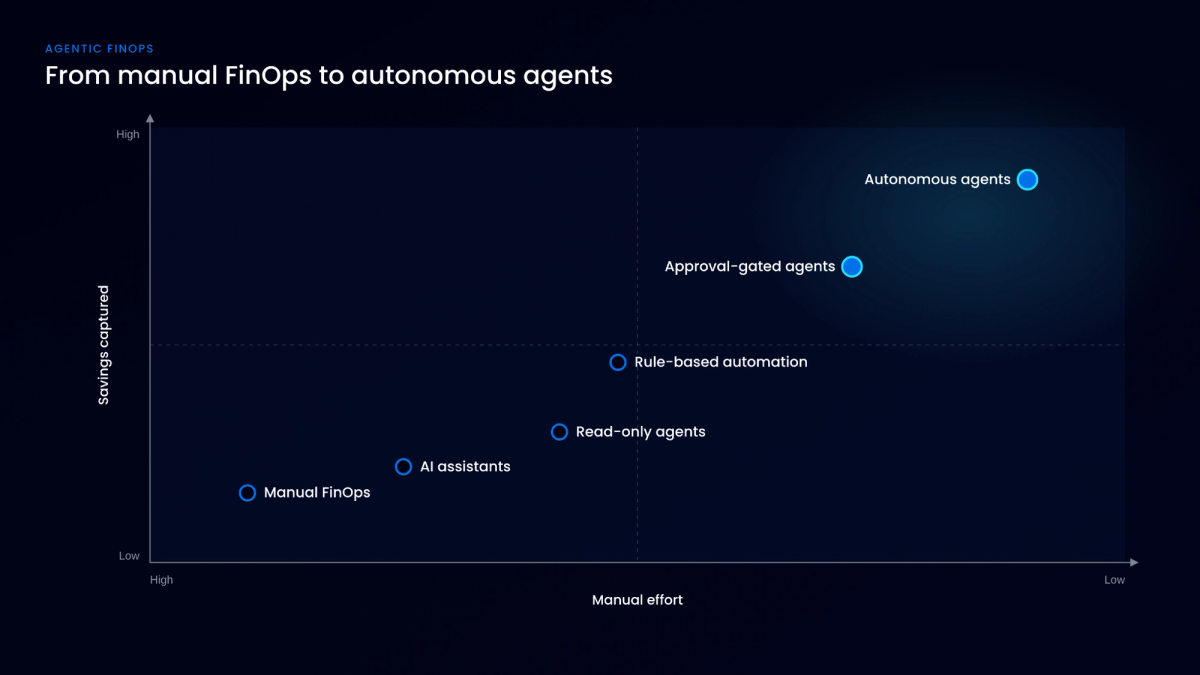
Agentic FinOps tools differ most in how much an agent may do without a person. The FinOps Foundation ranks agent autonomy by who decides what happens next, from fixed automation to agents that act within delegated limits. Platforms generally fall into one of three levels, and some let an organization set a different level for each type of action.
Level | What the agent does | Who makes the change | Example |
|---|---|---|---|
Read-only | Investigates and reports | A person | Amnic's FinOps agents; Clara's scheduled agents in nOps |
Approval-gated | Prepares a specific change and waits for sign-off | The agent, after a person approves | Vantage's FinOps Agent, with human approval turned on |
Autonomous within guardrails | Acts within limits set by policy | The agent, with people reviewing results | nOps automated commitment management |
Read-Only Agents
Read-only agents are the easiest to approve, since their credentials cannot change production infrastructure or commit spend, and most organizations start with them. They take over the investigation, but every fix still waits for a person to make it.
Approval-Gated Actions
Approval gates keep a person accountable for each change while the agent does the analysis and the execution. The cost is delay: each action waits as long as its approver does, which suits occasional, high-impact changes better than decisions that come up many times a day.
Autonomous Execution Within Guardrails
Autonomous agents act without per-action approval, inside limits set by policy, such as which accounts are in scope, how much may be committed, and what conditions stop the agent. Every action is logged, and people review results rather than individual decisions. Autonomy fits work that recurs constantly and follows clear rules, which is why commitment management is its most established use. nOps, for example, manages Savings Plans, Reserved Instances, and committed use discounts autonomously, adding, expanding, or shrinking small layers of commitments as usage changes.
Matching Autonomy to Risk
The right level depends on the action, not the tool. Four questions decide it:
- Can the action be reversed?
- How often does it recur?
- How much damage can a wrong decision do?
- How much value is lost while it waits for approval?
Changes to running resources, such as rightsizing or deleting an instance, can affect performance, so they usually stay gated or with the teams that own the workload. Commitment purchases change only the rate paid for usage that is already running, lose savings for every hour they wait, and can be bought in small increments that limit how much is committed at once. That makes the pricing layer the place where autonomous action carries the most value for the least risk.
Agentic FinOps Use Cases
Agents now take on work across the FinOps lifecycle. In each case the change is the same: a task that used to start when someone noticed a problem now runs continuously and arrives as a finished result.
Anomaly Detection and Root Cause Analysis
Cloud providers have offered anomaly detection for years. AWS Cost Anomaly Detection, for example, uses machine learning to flag unusual spend by service, account, or cost category and sends an alert. Everything after that is manual: someone has to notice the alert, pull the cost data, work out what changed, and decide who should fix it. Agentic tools run that whole sequence without being asked. They watch spend continuously, detect cost anomalies, investigate each spike as it appears, and deliver a written summary of what happened, what likely caused it, and what to do about it.
Cost Allocation and Tagging
Cost allocation assigns every dollar of spend to the team, product, or customer behind it. Done by hand, it means finding untagged resources, working out who owns them, writing rules to split shared costs, and chasing teams to fix their tags, usually as a periodic cleanup. Agents do this continuously, flagging untagged resources as they appear, suggesting likely owners from account structure and naming, and proposing allocation rules tested against past data. Because a rule change alters every report built on it, teams generally still approve rule changes themselves.
Unit Economics
Unit economics measures cost against a business metric, such as cost per customer or per transaction. Keeping it current means repeatedly joining allocated cost with business data from other systems and recalculating as products and teams change. Agents maintain that join, update unit costs as new data arrives, and explain each movement, such as whether cost per customer rose because spend went up or because the customer count went down. For AI products, the same approach tracks AI unit economics such as cost per task.
Commitment Management
Commitment discounts, such as AWS Savings Plans and Reserved Instances, Azure reservations, and Google Cloud committed use discounts, lower rates in exchange for committing to a level of usage. Choosing them is a large optimization problem: AWS alone has more than 4 million SKUs, and every commitment involves a choice of instance family, region, term, and payment option. Managed by hand, the portfolio is usually reviewed monthly or quarterly through a few large purchases, and between reviews usage drifts away from what was bought, leaving some commitments unused and new usage at on-demand rates.
Automated commitment management changes both the timing and the structure. Instead of a few large purchases, it layers many small commitments, which creates a decision point every hour where coverage can grow or shrink with usage. nOps, for example, evaluates more than 20 decision variables across 3 to 6 months of usage history and unlocks 3-year rates with 1-year terms. Because this changes only the price of existing usage and never touches infrastructure, it is the most established form of autonomous action in FinOps.
Forecasting and Budget Tracking
Most cost tools already produce statistical forecasts and budget alerts, but they stop at the number. When spend drifts from plan, someone still has to explain why and decide whether to change the forecast or the spending. Agents check each budget on a schedule, explain variances by naming the services, teams, or models responsible, and adjust forecasts for known events such as a migration or product launch. AI spend forecasting covers the extra difficulty of usage-based AI costs.
On-Demand Cost Questions and Reporting
Questions such as what a team spent last quarter or why a service got more expensive used to mean building a filtered report for each one. Agents answer them directly from a plain-language request, with the breakdown behind the answer. Run on a schedule, the same prompts produce recurring reports for finance, engineering, and leadership that adjust as the environment changes.
Waste and Usage Optimization
Finding waste has traditionally meant periodic reviews of utilization reports. Agents instead scan every account continuously for idle resources, unattached volumes, oversized instances, and environments left running after hours, and put a cost on each. Because fixing waste changes running systems, agents usually route each finding to the owning team as a ticket or proposed change. Autonomous optimization is mostly limited to low-risk cases such as stopping tagged non-production resources overnight.
Remediation Code Generation
Once a fix is agreed, someone still has to write it as a Terraform change, CLI command, or storage policy. Agents built on code-capable models write it from the finding, using resource details already in the cost data, so a recommendation to move a rarely accessed S3 bucket to S3 Intelligent-Tiering can arrive with the lifecycle policy attached. The infrastructure as code goes through the same review and deployment process as any other change.
AI and Token Spend
AI spend is spread across model providers, cloud AI services, and AI coding tools, each billed differently. This is where traditional attribution models break: usage may be billed through shared API keys or model endpoints rather than clearly tagged resources, making it harder to attribute costs to individual teams, features, or agents. Agents can help:
- Allocate spend by model, API key, team, and feature, mapping keys and seats to owners because AI providers lack cloud-style tags.
- Flag new or unapproved models and sudden changes in usage.
- Compare cost per task across models.
- Recommend fixes such as routing simple requests to cheaper models, caching repeated prompts, and reclaiming unused AI coding seats.
AI cost observability covers the monitoring side in more detail.
Risks and Guardrails
Agents add risks that dashboards do not have: they can be wrong with confidence and act on the mistake before anyone notices. Each risk has a matching guardrail.
Bad Data Produces Confident Wrong Answers
An agent presents an answer built on incomplete data with the same confidence as one built on complete data. If a quarter of spend is unallocated, an agent asked which team drives costs will answer from the other three quarters without necessarily saying so, and language models can also produce plausible output that is wrong. Model choice affects reliability too: in IBM Research's tests, the same FinOps agent carried out its plan correctly in 76% of runs with one model and 22% with another. The guardrails are a well-maintained data layer, agents that show their sources and what they could not see, and a check of important figures against a saved report.
Write Access and Security Review
An agent that can change infrastructure or commit spend holds real authority, so security teams review exactly which actions its credentials allow. Reviews also cover where those credentials are stored, how often they rotate, and whether each action is logged under the agent's own identity rather than a shared account. The principle of least privilege applies: an agent that reads data should not hold write access, and an agent that buys commitments should not be able to modify running resources. Scoping permissions by action is what lets an organization automate one kind of change while keeping others gated.
Audit Trails and Rollback
An audit trail records what each agent did, when, why, and under whose authority, so FinOps can review decisions, finance can reconcile savings, and security can investigate surprises. The FinOps Foundation is clear that accountability for an agent's actions stays with the people operating it. Reversible actions, such as stopping a resource or merging a pull request, can be rolled back. Commitment purchases mostly cannot, so their guardrails apply beforehand through purchase limits, small increments, and rules on term length.
The Cost of the Agents Themselves
FinOps agents run on language models and consume tokens like any other AI workload, and billing API calls can add charges of their own, such as $0.01 per AWS Cost Explorer API request. An agent running hourly across many accounts adds up, so its spend belongs in the same allocation, budgets, and run limits as every other AI agent. Limits on steps and tool calls per run also stop a misbehaving agent from repeating expensive queries.
How to Choose an Agentic FinOps Platform
Agentic features are now common in FinOps platforms, and the label covers everything from a chat box to autonomous purchasing. Four criteria show what a platform's agents will actually do.
Autonomy and Access Model
Ask which actions are read-only, which can be approval-gated, and which can run autonomously, and whether the level can be set separately for each type of action. Check where approvals happen (in Slack, in a ticketing system, or only in the vendor's console), what credentials each level requires, and whether every agent action is logged with its reasoning. A read-only platform is easier to approve but leaves execution to your team. A platform that acts should let you limit autonomy to where it pays off, such as commitment purchases, while infrastructure changes stay with the teams that own them.
Coverage Across Cloud, SaaS, and AI
Agents only see the spend a platform ingests. Check every source you need, including each cloud, Kubernetes, AI model providers, AI coding tools such as Cursor and Claude Code, and SaaS such as Snowflake or Datadog. Granularity matters as much as breadth: hourly, resource-level data lets an agent catch a spike the same day, while daily or account-level data delays the alert and hides its cause. Missing coverage is easy to overlook because the agent's answers still look complete.
Data Foundation
Ask what the platform does to the data before an agent sees it:
- Does it allocate untagged and shared spend, or only report what tags already cover?
- Does it normalize data across providers, for example to the FOCUS specification?
- Does it track commitments, their utilization, and their expiration dates?
- Can it join cost with business metrics for unit economics?
The most reliable test is to run the platform's agents on your own data during evaluation and check their answers against reports you already trust.
Pricing Model
Platforms charge a fee based on spend under management, a share of realized savings, per-request or per-token fees for agent use, or a mix. Savings-based pricing ties the vendor's revenue to results, which suits optimization work such as commitment management, though it is worth asking exactly how the vendor calculates savings. Per-request pricing is harder to predict when agents run on schedules, so ask how background runs are billed and whether agent usage counts against a monthly allowance.
How nOps Puts Agentic FinOps to Work
Most teams have cost data scattered across several clouds, Kubernetes, SaaS tools, and AI providers, and a backlog of recommendations nobody has time to act on. That's where nOps comes in. nOps brings that spend into one allocated view across all major providers and puts agents to work on it.
- Clara, the nOps FinOps agent, answers cost questions in plain language and runs scheduled agents for anomaly detection, waste discovery, trends, budget check-ins, and reporting, delivering results to the teams responsible and turning findings into code you can review and apply.
- nOps MCP gives your own AI tools and agents access to the same allocated data.
- Commitment management acts on its own where autonomy pays off most, using models trained on the spend nOps manages to analyze usage hourly and buy the best mix of Reserved Instances, Savings Plans, and committed use discounts in small increments that preserve flexibility. You pay only for results.
Book a demo to see Clara and automated commitment management working on your own data.
nOps manages $5 billion in AI and cloud spend and was recently ranked #1 in G2's Cloud Cost Management category.
Demo
AI-Powered Cost Management Platform
Discover how much you can save in just 10 minutes!
Book a Demo
FAQ
Let's dive into sone frequently asked questions about how agentic AI can help you manage cloud spend, optimize your cloud environment, and implement FinOps practices.
Do you need to replace your existing FinOps tools to adopt agentic FinOps?
Not necessarily. AI agents can work with existing cloud cost management tools through APIs and integrations such as the Model Context Protocol (MCP). Organizations can add AI capabilities to their current workflows without replacing their entire FinOps stack. The key requirement is access to reliable, sufficiently detailed cost and usage data.
Should you build your own FinOps agents or use a platform?
Building custom FinOps agents offers flexibility but requires significant work to connect data sources, maintain integrations, manage permissions, and ensure reliability.
nOps offers both approaches. Clara provides built-in FinOps agents for anomaly investigation, waste discovery, and automated reporting through natural language interfaces, while nOps MCP lets organizations connect their own AI agents to the same unified, allocated cost data. Teams can build custom agentic workflows without having to build the underlying FinOps data infrastructure themselves.
How do you measure the ROI of agentic FinOps?
The ROI of agentic FinOps includes both cost savings from cloud financial management and operational efficiency. Key metrics include hours saved on reporting and investigations, time to identify and resolve cost issues, recommendations successfully implemented to improve business outcomes, and verified cloud cost reductions. Organizations should compare these benefits against platform fees, AI inference costs, and the effort required to maintain and oversee agents.
What is augmented FinOps?
Augmented FinOps refers to using AI and automation to support FinOps practitioners in improving cost visibility, analyzing cloud cost insights, identifying opportunities, and making financial decisions. While augmented FinOps typically emphasizes helping people work more effectively, agentic FinOps goes a step further by delegating tasks to AI agents that can independently pursue goals and complete multi-step workflows to improve cloud efficiency.
How can an AI agent help with cloud cost optimization?
An AI agent for cloud optimization can analyze usage and billing data to identify idle cloud resource usage, inefficient configurations, unexpected spending, and potential savings. Beyond identifying opportunities, agents can investigate root causes, estimate financial impact, and prepare remediation steps for finance teams. Depending on their permissions, they may also execute approved changes or create tickets and pull requests for engineering teams.
How can an AI agent optimize BigQuery costs?
An AI agent for BigQuery FinOps optimization can examine query history, bytes processed, execution patterns, and slot utilization to identify expensive workloads. It can suggest SQL improvements, partitioning or clustering strategies, and changes to capacity configurations. Agents can also monitor cloud spending trends and generate recommendations based on actual workload behavior, helping teams reduce BigQuery compute costs without compromising query performance.
What is agent tokenization in AI?
In the context of AI agents, tokenization refers to breaking text into smaller units called tokens that language models process. Agentic workflows consume tokens when processing instructions, analyzing information, calling tools, and generating responses. Because agents may perform multiple steps to complete a single task, token consumption can accumulate quickly. Tracking token usage, limiting unnecessary tool calls, and managing execution budgets are important parts of controlling AI agent costs.