
FinOps for AI: The Complete Guide to Managing AI Costs (2026)
Three in four enterprises can't confidently connect their AI spend to an outcome their CFO would accept, according to the Tokenomics Foundation's September 2026 State of Tokenomics survey of 472 companies. Proving value was the most common challenge respondents named, at 43%, ahead of visibility and attribution of the spend itself.
This guide covers how to manage AI spend: what the practice is and how it differs from cloud FinOps, where AI costs come from, the levers that reduce them, and a maturity model for building it in stages. Using AI to automate FinOps work is a separate topic, which the FinOps Foundation's FinOps for AI overview also treats separately.
What FinOps for AI Is
FinOps for AI, sometimes called AI FinOps, is the practice of managing what AI workloads cost and tying that cost to the teams, products and customers that drive it. It exists as its own discipline because an AI bill is driven by prompts, model choices and agent behavior rather than by provisioned capacity, so the practices cloud teams built around instances and reservations need adapting.
Applying visibility, allocation & optimization to AI/ML
A FinOps for AI framework applies the same three disciplines as cloud FinOps, adapted to where AI costs actually show up.
- Visibility. AI spend is billed in several places at once: cloud AI services that land on the cloud bill, direct contracts with model providers such as OpenAI and Anthropic, and AI tools and SaaS that bill separately. Visibility means bringing all of it into one view.
- Allocation. Each cost needs an owner, whether a team, product, feature or customer. This is harder for AI than for most cloud resources, because one model or API key often serves several features, and many AI SKUs can't be tagged natively.
- Optimization. The basic cost equation still applies: price times quantity. Teams lower the rate they pay, the amount they consume, or both.
The people generating AI spend are also different. The FinOps Foundation notes that product, marketing, sales and leadership teams now contribute to AI costs directly, not only engineers, which is a large part of why allocation and shared visibility matter.
How it differs from traditional cloud FinOps
Most of what a cloud FinOps team already does carries over. AI services that run on a cloud provider appear in the same billing data as everything else, and many AI components qualify for commitment discounts. What changes is the mechanics, as the table shows.
Traditional cloud FinOps | FinOps for AI | |
Billing unit | Instance hours, storage, requests | Input and output tokens, API calls, GPU hours |
Pricing | Published rates that change infrequently | New models and SKUs ship regularly, and prices can move sharply in either direction |
Capacity | Rarely a constraint | GPU capacity can be scarce, which affects both price and availability |
Allocation | Native tags on most resources | Many AI SKUs can't be tagged natively, and one model often serves multiple features |
Who spends | Mostly engineering and infrastructure teams | Engineering plus product, marketing, sales and leadership |
Discounts | Reservations and savings plans | GPU reservations, provisioned throughput units, and provider commit tiers |
Why AI Breaks Traditional FinOps
Cloud FinOps methods assume that rates change slowly, that capacity is available when you ask for it, and that last quarter's usage is a reasonable guide to the next. AI workloads weaken all three.
Token pricing volatility & GPU scarcity
Model providers release new models often and price each one separately, and the FinOps Foundation describes AI pricing as inconsistent, with prices that can swing sharply in either direction. A forecast or commitment built on today's rate card can be out of date within a quarter, and an engineer who switches models changes the cost of a feature without changing its usage. In cloud FinOps, cost follows what was provisioned. Here it also follows decisions made in code.
GPU scarcity adds a second problem. The Foundation notes that scarce AI infrastructure calls for capacity management through contracts, orchestration and purchasing, which cloud teams rarely need for general-purpose compute. Autoscaling doesn't help when the instances aren't available, so capacity becomes something finance and engineering plan together, ahead of time.
Usage is the third. Spend depends on prompt length, which model is called, and how many calls an agent makes, so it doesn't track provisioned capacity and can change overnight when one team ships a feature. The Foundation's guidance is to revise AI forecasts and budgets more often than cloud teams usually do, and AI spend forecasting covers the methods.
New unit economics (cost per inference/token)
Instance hours and storage volume describe what was bought, not what an AI feature costs to deliver. Unit metrics fill that gap, and the FinOps Foundation's list of AI KPIs starts with these.
Metric | Calculation | What it shows |
Cost per inference | Total inference cost divided by inference requests | The efficiency of a deployed model or feature |
Total cost divided by tokens used | Which prompts and use cases drive spend. Track input and output separately, since providers price them differently | |
Training cost efficiency | Training cost divided by a performance measure such as accuracy | Whether a training run was worth its cost |
GPU utilization | Actual use divided by provisioned capacity | Idle or oversized hardware |
These roll up into business-level measures such as cost per customer, cost per task and AI gross margin, which is where finance and product teams pick the numbers up. AI unit economics covers how to calculate each one.
The AI Cost Lifecycle
AI spend arrives in four stages, each with its own cost driver and its own owner. They need to be tracked separately, because a number that is a useful signal in one stage says little in another.
Training, tuning, inference, orchestration
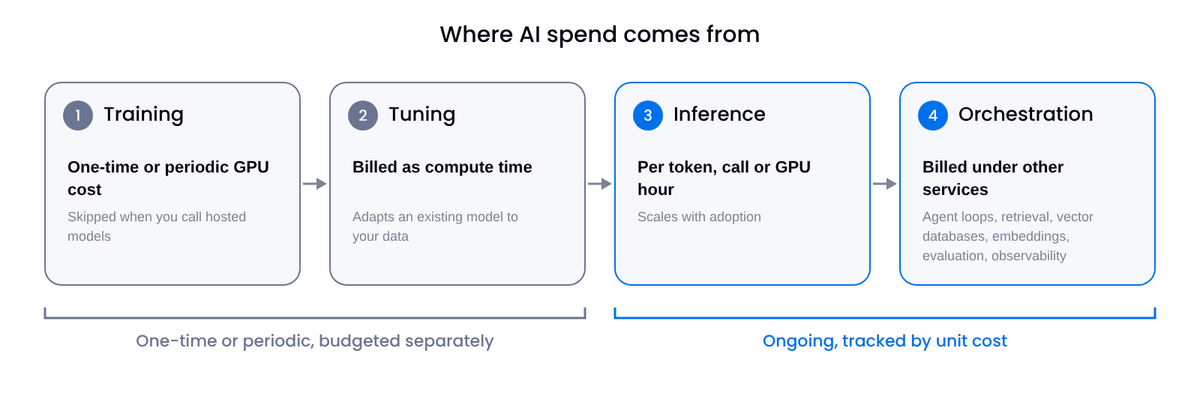
Training. Building a model from scratch is a one-time or periodic GPU cost. Organizations that call hosted models skip this stage entirely.
Tuning. Fine-tuning adapts an existing model to your data and is billed as compute time. The FinOps Foundation separates one-time training costs from ongoing inference costs, since they are budgeted differently. It also recommends retraining when data drift or degraded performance justifies it, rather than on a fixed schedule.
Inference. Running the model for real users is billed per token, per call or per GPU hour. It scales with adoption, which makes it the stage where cost per unit matters most.
Orchestration. Agent loops, retrieval, vector databases, embeddings, evaluation and observability all sit around the model call. They bill under other services, so they are easy to leave out of an AI cost estimate.
Optimization Levers
Optimization for AI works on the same two terms as any other cost: the price paid per unit and the quantity consumed. The levers below are grouped by where they apply. The guides to reducing Claude API costs and OpenAI API costs go deeper on the API-specific ones.
Model selection, caching, RAG, quantization
- Model selection. The FinOps Foundation advises against using the most capable model for every task. A classification or extraction step rarely needs a frontier model, so route by task and check quality on a sample.
- Caching and batching. Anthropic prices cache reads at 10% of the base input price on most models, and lower on its newest ones, which makes repeated system prompts and tool definitions much cheaper. For work that can wait, OpenAI's Batch API takes 50% off in exchange for a 24-hour completion window.
- RAG. Retrieval-augmented generation supplies relevant documents at request time, so a smaller model or a shorter prompt can do the job without fine-tuning. It adds embedding, vector storage and retrieval costs, which should be weighed against the tokens it saves.
- Quantization. Lowering the numeric precision of model weights reduces compute and memory for self-hosted models. The Foundation groups it with pruning and distillation as ways to cut compute without significant loss of accuracy. It does not apply to hosted APIs.
GPU commitments, spot & rightsizing
Self-hosted and managed GPU workloads have the usual compute levers, with limits specific to GPUs. Reservations and savings plans suit steady GPU demand, and commitment management works best when it commits only to the floor of usage that has held across recent periods. Where capacity is scarce, AWS Capacity Blocks for ML reserve GPU instances for a future date for up to six months, at prices that move with supply and demand.
For fault-tolerant work such as batch inference and retraining, Spot Instances run at up to 90% below on-demand prices, with the trade-off that capacity can be interrupted. Rightsizing starts from GPU utilization. The Foundation suggests smaller GPUs for inference that doesn't need the largest ones, and CPUs for lightweight models.
Agent guardrails & proxy/metadata routing
Agents decide for themselves how many model calls to make, so cost controls have to act during a run instead of after the bill. The usual guardrails are per-run ceilings on steps, tokens and time, per-period budgets, rate and concurrency limits, and the usage limits, throttling and anomaly detection the FinOps Foundation recommends.
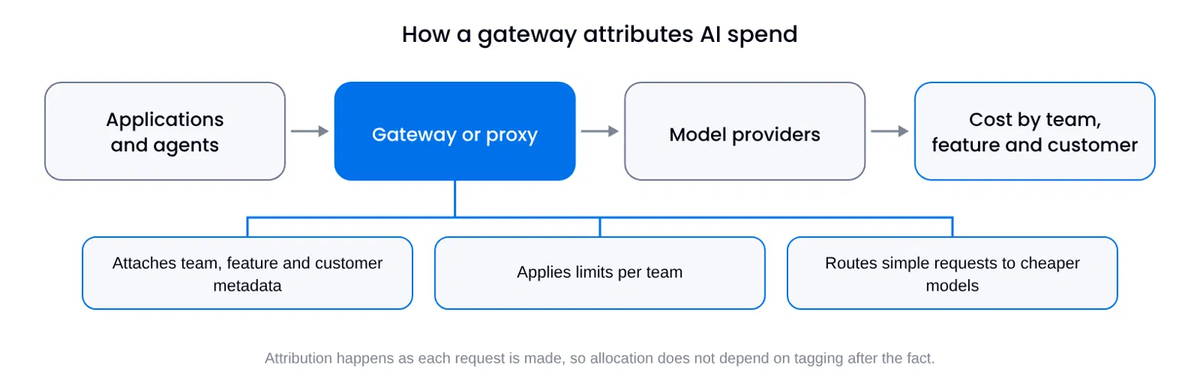
A gateway or proxy between applications and model providers makes these easier to enforce. It can attach team, feature and customer metadata to every request, apply limits per team, and route simple requests to cheaper models. Because the attribution happens as each request is made, it also closes much of the allocation gap described earlier. AI agent governance covers budgets, kill switches and ownership in detail.
A FinOps for AI Maturity Model
The FinOps Foundation applies its crawl, walk, run model to AI, with each phase reflecting a different attitude toward cost. The early phases tolerate rougher numbers because the goal is learning.
Crawl / walk / run
Phase | Where AI is | How cost is managed |
Crawl | Prototypes, pilots and MVPs | Minimal spend with limits set in advance for cost and time, and a fail-fast approach. Calculations are manual, budgets are revised often, and non-financial indicators carry weight |
Walk | The solution is integrated into business processes | Costs above what daily use requires are minimized. Cost tracking and basic anomaly analysis are automated, and financial metrics become more important |
Run | AI powers core business processes | Constant monitoring and optimization, with the quality and availability the business depends on protected. Anomaly tracking is advanced, ROI-style metrics are used, and budgets are relatively stable |
In practice, progress follows the same order as this guide. Spend has to be visible across providers before it can be allocated, and allocated before unit metrics mean anything.
How nOps Delivers FinOps for AI
nOps manages $5 billion in AI and cloud spend and was recently ranked #1 in G2's Cloud Cost Management category. For AI, the platform covers each step in this guide in one place.
- One view across AI and cloud spend. AI costs from all major providers sit next to multicloud, SaaS and Kubernetes costs in the same platform, so you can understand and allocate your costs in one place. AI cost visibility and optimization is built around this.
- Anomaly detection and budget governance. Hourly anomaly detection compares each hour with the same hour the prior week and ties each alert to the model, account and department behind it. AI Wallets set spend limits at the group or seat level.
- Optimization. Recommendations for model substitution, cache tuning and provisioned throughput appear next to the spend they affect. Automated commitment management handles the pricing layer, and it works alongside whatever GPU and Kubernetes tooling a team already runs.
To see your own AI spend attributed and governed, book a demo.
Demo
AI-Powered Cost Management Platform
Discover how much you can save in just 10 minutes!
Book a Demo
FAQ
Let’s dive into some frequently asked questions about FinOps for AI capabilities.
What is FinOps for AI?
FinOps for AI is the practice of applying FinOps visibility, allocation and optimization to AI spend: tokens, GPU compute, managed AI services and AI tools. It is distinct from AI for FinOps, which uses AI to automate cost management work.
How is it different from cloud FinOps?
The principles are the same. The differences are in the mechanics: AI is billed in tokens, prices change often, GPU capacity can be scarce, many AI SKUs can't be tagged natively, and spend comes from teams well beyond engineering.
How do you manage AI costs?
Start with visibility across every place AI is billed, then allocate spend to teams and features and set budgets and alerts. Optimization follows, through model choice, caching and GPU purchasing. Unit metrics such as cost per inference or cost per customer tie the spend back to value.
What are the AI cost lifecycle phases?
Training, tuning, inference and orchestration. Training and tuning are one-time or periodic costs, while inference and orchestration are ongoing and scale with usage.