
Cloud Cost Platform Comparisons: nOps vs the Alternatives
The market for cloud cost optimization software has consolidated quickly. Flexera bought Spot and CloudCheckr from NetApp in 2025 and ProsperOps in January 2026, IBM owns both Apptio Cloudability and Kubecost, and CloudHealth now sits inside Broadcom after its acquisition of VMware. Comparing platforms now means checking who owns a product as well as what it does.
Whether you're replacing a tool or choosing your first, this page shows how the main vendor categories differ and where nOps fits, with links to detailed head-to-head comparisons.
How to Compare Cloud Cost Platforms
Feature lists overlap heavily, so the useful comparisons are the ones that separate platforms in practice:
Evaluation criterion | What to ask | Why it matters |
|---|---|---|
Coverage | Which clouds, Kubernetes clusters, SaaS and AI services appear in one view? | Separate tools for each produce separate numbers that never quite reconcile |
Action | Does the platform make changes itself, or hand engineers a list? | Recommendations waiting in a backlog save nothing |
Commitment risk | Who pays for commitments that go unused, and how quickly is coverage adjusted? | Unused commitments are billed until they expire, and vendors range from no protection to automatic credits |
Pricing model | Is it a share of spend, a share of savings, per CPU or a flat fee, and how does it change as spend grows? | Spend-based fees rise with the bill whether or not savings do |
Ownership | Who owns the product, and has it changed hands recently? | Acquisitions can bring repricing, support changes and a different roadmap |
Time to value | What access does it need, and how long until the first savings? | Read-only billing access connects in minutes; agents and professional services take weeks |
nOps is built around these differences: unified visibility across AI, multicloud, SaaS and Kubernetes; commitment management that adjusts every hour; a 100% utilization guarantee on the commitments it buys; and pricing tied to the savings it delivers. nOps alternatives compares it with each major competitor, and the vendor evaluation guide walks through a full evaluation.
Commitment Management Vendors
Commitment managers differ less in what they buy than in how often they adjust and who absorbs the cost when usage drops. Four approaches are common:
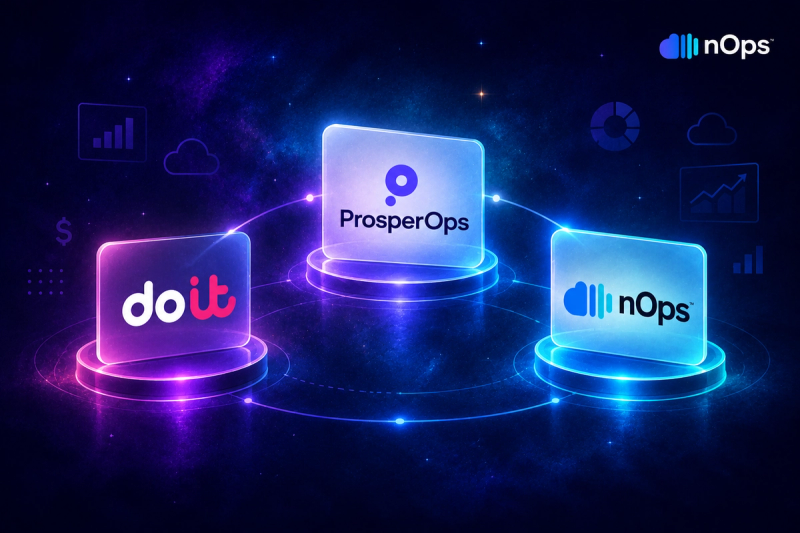
- Advisory. DoiT monitors commitments and recommends purchases but leaves buying and rebalancing to the customer (DoiT vs ProsperOps vs nOps).
- Automated purchasing. ProsperOps, now owned by Flexera, buys and adjusts Savings Plans and Reserved Instances automatically and charges a share of the savings (nOps vs ProsperOps).
- Insured commitments. Archera charges a risk-based premium to cover usage swings, with terms as short as 30 days, and Usage.ai pays cashback when commitments it bought go underused, refreshing its recommendations every 24 hours (ProsperOps vs Archera vs nOps, Usage.ai alternatives).
- Partial protection. Zesty focuses on EC2 Reserved Instances and refunds part of its management fee for unused commitments (Zesty vs ProsperOps vs nOps).
nOps addresses the same risk at the source. It adjusts commitments every hour in small increments, so coverage tracks actual usage instead of insuring against forecasts that miss, and it guarantees 100% utilization, crediting any unused commitment automatically. Pricing is a share of the savings delivered, with no upfront cost or minimum contract.
Kubernetes & Container Cost Vendors
Kubernetes vendors split by the layer of the cluster they work on:
- Visibility. Kubecost, now owned by IBM and built on the open-source OpenCost project, breaks cluster costs down by namespace, deployment and pod, with paid tiers priced by the CPUs it monitors (Kubecost pricing, Kubecost alternatives).
- Pods. ScaleOps adjusts container CPU and memory requests in real time and runs alongside the existing autoscaler (ScaleOps vs Cast AI vs nOps).
- Nodes. Cast AI replaces Cluster Autoscaler with its own engine by default and manages Spot capacity, priced per CPU, while Spot by Flexera's Ocean also replaces the autoscaler and requires a 12- to 36-month contract (Cast AI vs Spot.io vs nOps, Kubecost vs Cast AI vs nOps).
None of these manage the pricing layer: Cast AI can use existing commitments but doesn't buy them, and Kubecost doesn't track them at all. nOps works there, managing Savings Plans and Reserved Instances for cluster capacity and allocating the full bill down to the container, including shared costs, while leaving Karpenter, Cluster Autoscaler or Cast AI in place. nOps vs Kubecost compares the two directly.
Visibility & Reporting Vendors
Visibility platforms are judged on how clearly they explain spend and how much they leave for someone else to act on. Vantage focuses on self-serve dashboards and infrastructure-level reporting across clouds, Kubernetes and third-party services, and automates Savings Plan purchases but not Reserved Instances. CloudZero ties costs to business dimensions such as features, customers and teams, and leaves its recommendations to engineers or a third party to carry out.
nOps pairs comparable visibility with automated management of both Savings Plans and Reserved Instances. Vantage vs nOps vs CloudZero sets the three side by side, and Vantage alternatives covers the wider field.
Enterprise FinOps Suites
Enterprise suites cover the most ground, and most of them have been bought at least once:
- CloudHealth, part of Broadcom since its acquisition of VMware, is strongest on policy-based governance across five clouds but reports each cloud in its own dashboard and stops at recommendations for commitments. Pricing runs around 2.5% of tracked spend (CloudHealth vs Flexera vs nOps, CloudHealth alternatives).
- IBM Apptio Cloudability is built for finance-led showback, chargeback and reporting. It charges a percentage of managed spend, roughly $30,000 a year for the first $1 million, and sells commitment management as an add-on (Flexera One vs Cloudability vs nOps, nOps vs ProsperOps vs Cloudability, Cloudability alternatives).
- Flexera One grew out of IT asset and software license management and now spans cloud, SaaS and on-premises assets. It typically costs about 5% of managed cloud spend with annual minimums above $50,000 (Flexera alternatives).
- CloudCheckr has changed hands three times in four years and now sits within Flexera. Teams moving off it usually want faster container visibility and automation rather than governance reports (CloudCheckr alternatives).
nOps competes with these suites on cloud cost rather than IT asset management. It connects through read-only access without an implementation project and automates commitments instead of recommending them. Organizations whose main need is license compliance or broad IT asset governance are better served by a suite such as Flexera.
How nOps Helps
Cloud spending is now spread across several providers, Kubernetes clusters, SaaS tools and AI services, each with its own bill, its own discounts and its own owners. The biggest savings depend on seeing all of it in one place and buying the right commitments at the right time, which is hard to do by hand.
nOps brings that spend into one allocated view across all major providers and automates the pricing layer, so teams can see exactly where money goes and pay less for it without adding manual work:
- Unified visibility across AI, multicloud, SaaS and Kubernetes costs, allocated to the teams, products and customers that own them
- Hourly anomaly detection, with each alert tied to the responsible account, team or model, plus budgets and spend limits
- Automated commitment management that analyzes usage every hour and buys Savings Plans, Reserved Instances and committed use discounts in small increments, so coverage follows real usage
- Pricing based on the savings delivered, with read-only access and setup in minutes
Book a demo to see your cloud and AI spend in one place.
nOps manages $5 billion in AI and cloud spend and was recently ranked #1 in G2's Cloud Cost Management category.
Demo
AI-Powered Cost Management Platform
Discover how much you can save in just 10 minutes!
Book a Demo
FAQ
What is the best alternative to Kubecost?
It depends on why you're leaving. If the issue is cost, OpenCost provides the same open-source allocation engine for free, and flat-fee platforms such as nOps avoid per-CPU pricing that grows with cluster size. If you need automated pod or node tuning, ScaleOps and Cast AI do that work. If you need commitments managed and Kubernetes costs shown alongside the rest of the bill, nOps covers both.
How does nOps pricing compare to ProsperOps?
Both charge a share of the savings they generate, and neither requires an upfront payment. The difference is what the fee covers: ProsperOps manages commitments only, while nOps includes cost allocation, budgets, forecasting and anomaly detection across clouds, Kubernetes, SaaS and AI. nOps also offers a free savings analysis and a two-week trial.
What is the difference between a commitment manager and a FinOps suite?
A commitment manager does one job, buying and adjusting discounts, and does it automatically. A FinOps suite does many jobs, from allocation to governance, but mostly by reporting and recommending. Many organizations have run one of each; platforms like nOps combine automated commitments with suite-level visibility.
Which tools handle Kubernetes cost allocation?
Kubecost and OpenCost were built for it. Vantage and CloudZero break costs down by Kubernetes constructs within broader cloud reporting, CloudHealth offers basic Kubernetes views, and nOps allocates costs to the container level, including shared costs such as load balancers and data transfer.
Can one platform cover AWS, Azure, GCP and AI spend?
For visibility, yes: several platforms, nOps among them, combine all three clouds with Kubernetes, SaaS and AI providers in one view. Optimization coverage varies more, so check which clouds and services a vendor actually automates, not only which it reports on.
What should I ask a cloud cost vendor in a demo?
Ask to see your own data rather than a sample account, which most read-only platforms can connect within the call. Ask for a savings estimate on your actual bill, what happens to any commitments the vendor bought if you cancel, and for a reference customer at your level of spend.