Skip to content


72% of companies reported reducing waste as a top priority, according to the State of FinOps (FinOps Foundation). But before your team can implement FinOps effectively, you need a clear grasp of what FinOps is, how the FinOps Framework works, which personas own which responsibilities, and how to build a culture where engineering, finance, and business teams collaborate on cost and value—not blame.
One of the most reliable ways to build that shared foundation (and keep pace as FinOps expands into AI, containers, and SaaS) is through structured certification and training. The FinOps Foundation offers a range of intermediate-to-advanced courses and certifications for engineering, finance, business, and technology roles, and the major cloud providers add platform-specific training to help teams apply FinOps practices using native tools.
Below is a curated list of the most important FinOps certifications and training paths to support your journey.
Benefits of FinOps Certifications
Before diving into the list of FinOps certifications, let’s take a quick look at how FinOps certifications can help.
Improves cloud cost management skills
The “why” is concrete: there’s real money on the table. Estimates from companies like Datadog and Flexera indicate that 27-30%+ of public cloud spend (IaaS/PaaS) is wasted, which is exactly the type of waste FinOps practices (and certification-backed skills) are built to find and reduce.
Enhances career opportunities
FinOps sits at the intersection of cloud + finance + optimization — which is the kind of cross-functional skillset organizations pay for. Salary benchmarks for FinOps roles show meaningful ranges, with reported pay up through the ~90th percentile for roles like “FinOps Analyst,” making certification a tangible way to validate that you can operate at that intersection.
Increases organizational efficiency
FinOps is no longer optional — companies are staffing for it. In Flexera’s recent State of the Cloud coverage, 51% of organizations report they already have a FinOps team, and another 20% plan to create one within a year, signaling that FinOps knowledge is becoming a baseline expectation and a formalized function (not a side project).
Validation of expertise
Certification serves as an industry-standard ‘passport’ for managing cloud budgets and applying financial best practices. A certification gives teams a shared standard for what “good” looks like, and gives individuals a clear, portable signal of competence—especially helpful when FinOps work spans engineering, finance, and procurement.
Networking and community engagement
FinOps Foundation training plugs you into an actual ecosystem — not just a course. The Foundation cites a 95,000+ community, 62,000+ trained, 34,000+ companies participating, and 93 of the Fortune 100 involved, which matters when you’re benchmarking maturity, hiring, or trying to stay current as FinOps expands into AI and SaaS. And with a FinOps certification, individuals gain access to a community where they can meet other FinOps professionals through industry events, virtual summits, and community resources.
Core FinOps Certifications
Here are the most important FinOps Foundation certification programs covering cloud cost management and how to optimize cloud spending.
1. FinOps Certified Practitioner
As the FinOps Foundation’s foundational certification, FinOps Certified Practitioner is the best starting point for most teams. It’s widely recognized as the baseline credential for establishing a shared FinOps language and operating model across engineering, finance, and business stakeholders.
The certification covers the fundamentals of FinOps, including the core components of the FinOps Framework and its practice areas. It’s designed to clarify what it means to be a FinOps Practitioner, how the role fits into a broader organization, and how FinOps is applied to improve decision-making and business value from cloud operations.
FinOps certification options include:
- Self-paced learning with an included exam
- Virtual instructor-led training with live sessions and course access
- Exam-only for experienced practitioners who want to validate existing knowledge
Learn more: https://learn.finops.org/path/finops-certified-practitioner/
2. FinOps Certified Professional
As the FinOps Foundation’s most advanced certification, FinOps Certified Professional is built for experienced FinOps Practitioners who want the deepest, most hands-on training in the FinOps curriculum—and a credential that signals you can lead and scale FinOps in a real organization.
The course goes beyond fundamentals and focuses on practical, working-level application of FinOps. Learners collaborate with other practitioners around a business case, workshop ideas, and build skills that help drive measurable return on cloud and technology investment.
Key details:
- Level: Advanced
- Time commitment: ~40–50 hours, typically completed in ~8 weeks or less
- Format: Mix of instructor-led sessions and self-paced modules, plus a contribution project and a certification exam
- Prerequisites: Active FinOps Certified Practitioner + ~6+ months of FinOps working experience
- Additional requirement: Active FinOps Certified FOCUS Analyst certificate is required before taking the Professional exam
Learn more: https://learn.finops.org/path/finops-certified-professional/
3. FinOps Certified Engineer
As the FinOps Foundation’s engineering-focused credential, FinOps Certified Engineer is the go-to option for cloud engineers who want to translate FinOps from “a finance problem” into day-to-day technical decisions. It’s an intermediate-level course designed to help engineering teams participate directly in FinOps outcomes and connect cloud spend to business value.
The course focuses on how engineers and FinOps Practitioners work together to “flip the script”—shifting conversations from the cost of running in the cloud to the value cloud investment creates. You’ll learn practical ways to incorporate FinOps data into the development lifecycle so you can make more informed, data-driven choices as you design, build, and operate cloud infrastructure.
Key details:
- Level: Intermediate
- Approximate time to complete: Self-paced bundle is ~10 hours; exam-only is ~1 hour
- Options include: self-paced training with an exam bundle, or an exam-only path for experienced engineers
Learn more: https://learn.finops.org/page/finops-certified-engineer
Additional FinOps Certifications
As spending expands into AI, Kubernetes and SaaS, here are the top FinOps certifications tackling cloud cost optimization and cloud financial operations for 2026.
4. FinOps for AI
As AI spend becomes a fast-growing line item (GPUs, model training, inference, and specialized pricing), FinOps Certified: FinOps for AI is the FinOps Foundation’s focused, intermediate-level series for practitioners who need to apply FinOps best practices specifically to AI workloads. It’s built to help teams move from “AI costs are unpredictable” to repeatable visibility, financial accountability, and decision-making.
This series focuses on real-world AI cost management: understanding training vs. inference cost drivers, GPU-heavy spend, and AI-specific billing models; translating complex AI cost structures into cost optimization strategies business leaders can act on; and using FinOps to align AI investment with measurable KPIs and organizational governance.
Key details / options:
- Level: Intermediate
- Access: 24 months of access to course materials (with additional best-practice content added over time)
- Includes: an introduction plus “FinOps Trained” Levels 1–3 content as it becomes available
- Certification exam: the FinOps Certified: FinOps for AI exam is scheduled to launch in March 2026
- Prerequisites: none required, but a strong FinOps foundation is recommended (often FOCP or FOCE first)
- Credentialing: passing the exam yields a digital certificate + Credly badge; certification valid for 24 months
Learn more: https://learn.finops.org/path/finops-certified-finops-for-ai/
5. FinOps for Containers
If your organization runs significant workloads on Kubernetes/EKS/GKE/AKS (or any shared container platform), FinOps for Containers is one of the most practical FinOps Foundation courses to add after the basics. It’s an intermediate course built specifically to help engineers and FinOps practitioners understand where container costs actually come from and how to make container spend visible, explainable, and optimizable across teams.
The course focuses on applying cost-conscious development and operations to containerized environments—how to communicate container cost concepts to non-engineers, identify common sources of waste (idle/shared components, inefficient requests, overallocation, scaling gaps), and build the observability needed to track and allocate container cost. It also covers mapping container orchestration concepts to FinOps concepts and integrating container usage data into existing allocation strategies.
Key details / options:
- Level: Intermediate
- Approximate time to complete: ~2–3 hours
- Access: 12 months of course materials
- Credential: “FinOps Trained” Credly badge for Containers after passing a quiz (note: this is training, not a FinOps certification exam/credential)
Learn more: https://learn.finops.org/finops-for-containers
6. FinOps for SaaS
As SaaS spend becomes a bigger share of technology budgets—and harder to govern than infrastructure spend—FinOps for SaaS is the FinOps Foundation’s upcoming training designed to bring FinOps structure to SaaS cost management. It’s positioned for practitioners who want a consistent approach to SaaS accountability as purchasing decentralizes and usage and pricing get more opaque.
This upcoming course and certification will focus on applying FinOps principles to SaaS—including how to manage and optimize SaaS spend by connecting cost, renewals, and compliance to business value. It’s intended to help teams translate scattered SaaS spend into clearer ownership, better decision-making, and more repeatable optimization.
Key details / options:
- Status: Coming soon (training and certification in development)
- Who it’s for: FinOps practitioners plus stakeholders in procurement, finance, engineering, and centralized FinOps teams
- How to stay informed: Sign up for updates on release dates and presale opportunities
Learn more: https://learn.finops.org/coming-soon-finops-for-saas/2245327
7. FOCUS Training & Certification
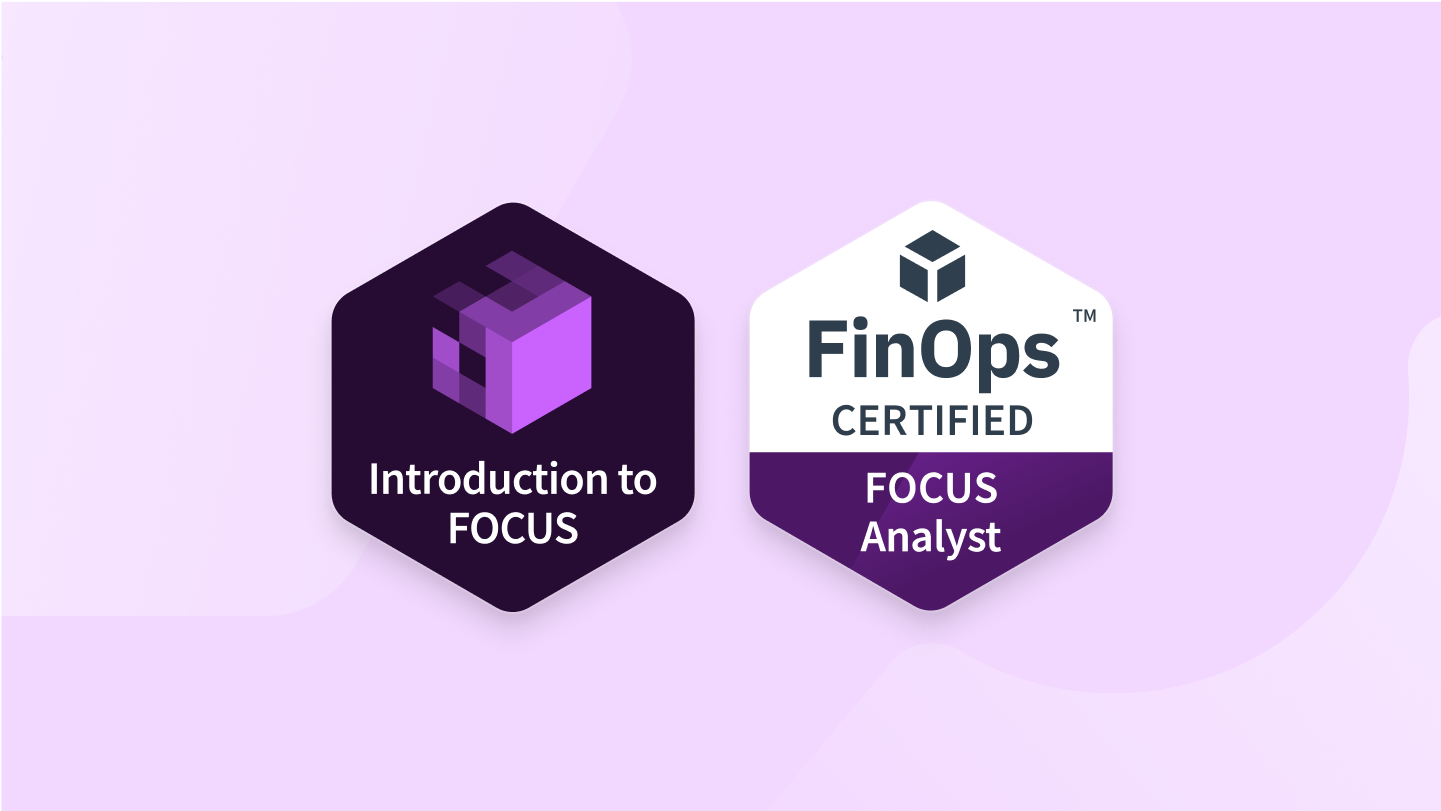
As multi-cloud cost data gets harder to normalize and compare, FOCUS Training & Certification is one of the most practical FinOps Foundation paths for teams that need consistent, “FinOps-ready” billing and usage datasets. FOCUS (FinOps Open Cost & Usage Specification) is an open-source effort to standardize how cloud providers and vendors generate cost and usage data, reducing complexity for common FinOps workflows.
This training focuses on how FOCUS enables FinOps practitioners to perform core activities—like chargeback/showback, cost allocation, budgeting, and forecasting—using a single, consistent set of instructions regardless of where the dataset originates. The goal is to make cloud billing data more usable, reduce reporting friction, and improve how teams communicate cloud value back to the business.
Key details / options:
- Introduction to FOCUS (free): A free introductory course with access to course content
- FinOps Certified FOCUS Analyst: The FinOps certification course and exam for a basic understanding of using FOCUS-conformed datasets
- Bundles: Multiple bundle paths pair FOCUS Analyst with Practitioner, Engineer, and/or Professional depending on your learning path
Learn more: https://learn.finops.org/page/focus
Cloud Provider FinOps Certifications & Training
Amazon Web Services, Microsoft Azure and Google Cloud Platform each offer specialized FinOps certifications to help FinOps professionals implement FinOps practices in each particular cloud.
8. AWS Certified Cloud Practitioner / Solutions Architect (Associate)
These are the most common “general AWS baseline” credentials to include in a FinOps list: Cloud Practitioner works best for teams that need shared AWS literacy across finance/ops/stakeholders, while Solutions Architect – Associate is better for engineers/architects who influence design decisions and need stronger depth (including cost-conscious architecture).
Both exams validate broad AWS understanding rather than FinOps tooling specifically—so they’re most useful here as the foundation that makes AWS billing concepts, service selection, and architecture tradeoffs easier to reason about when you move into dedicated cost/FinOps training.
- Choose Cloud Practitioner if you want a lighter, foundational AWS credential for a wider audience
- Choose Solutions Architect – Associate if the audience is technical and you want architecture depth (including cost/performance tradeoffs)
- Teams often standardize on one baseline “AWS cert level” and then pair it with AWS Cloud Financial Management (CFM) training for FinOps specifics (we’ll discuss later in this list)
Learn more about AWS FinOps Certifications here: https://aws.amazon.com/certification/certified-cloud-practitioner/ and https://aws.amazon.com/certification/certified-solutions-architect-associate/
9. AWS Skill Builder: Cloud Financial Management (CFM) digital training
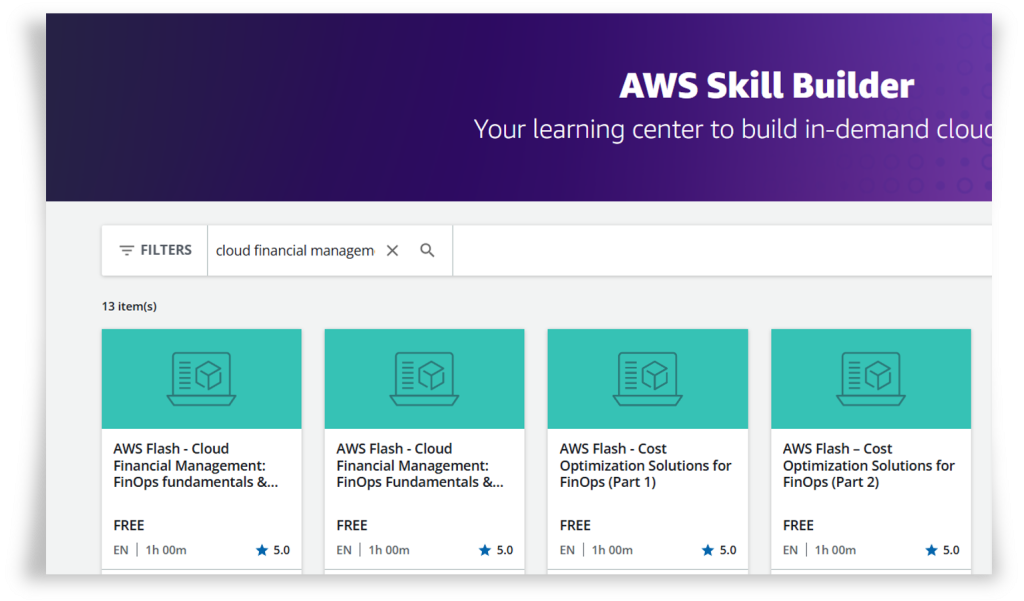
If you’re looking for AWS-specific FinOps enablement (especially for engineers and FinOps practitioners who need to get fluent in AWS cost tooling and optimization), the AWS Cloud Financial Management (CFM) digital training on AWS Skill Builder is one of the most practical additions to a FinOps certification list. It complements broad AWS certifications by going deeper on the day-to-day “how” of AWS cost management.
These courses focus on the core Cloud Financial Management motions—how to use AWS cost and billing tools, build better cost visibility and governance, and apply cost optimization techniques across common AWS services (compute, storage, databases, networking, analytics, containers, and more). The goal is to help teams operationalize FinOps on AWS with a shared framework and repeatable practices.
Options to complete it include:
- A set of short, modular digital courses (originally launched as four one-hour courses, offered free via AWS Skill Builder)
- A recommended progression: start with the two fundamentals, then move into the more technical optimization courses
10. Microsoft Azure (AZ-900 / AZ-104)
These are the most common baseline Microsoft credentials to pair with a FinOps learning path: AZ-900 is the lightweight foundation for anyone who needs shared Azure fluency, while AZ-104 is better for technical practitioners administering Azure who influence day-to-day configuration choices that affect cost and governance.
AZ-900 (Azure Fundamentals) validates foundational knowledge of cloud concepts, core Azure services, and Azure management/governance features and tools.
AZ-104 (Azure Administrator) validates the skills to configure, manage, secure, and administer key Azure functions (including identity, governance, storage, compute, and virtual networking).
- Choose AZ-900 if you want a broad, beginner-friendly Azure credential for a wide audience (finance/ops/stakeholders included).
- Choose AZ-104 if the audience is hands-on technical (admins/platform/ops) and you want deeper practical Azure administration coverage.
Learn more:
- https://learn.microsoft.com/en-us/credentials/certifications/azure-fundamentals/
- https://learn.microsoft.com/en-us/credentials/certifications/azure-administrator/
11. Microsoft Learn: “Get started with FinOps” + “Adopt FinOps on Azure”
If you want Azure-specific FinOps certification (beyond a general Azure knowledge), Microsoft Learn’s FinOps modules are a straightforward way to standardize how teams apply FinOps practices inside Azure. They’re designed to help organizations move from ad hoc cost conversations to a more repeatable operating model—using Microsoft’s guidance for implementing FinOps processes with Azure tooling.
These modules focus on the practical “how” of adopting FinOps in an Azure environment—introducing FinOps concepts, how FinOps fits into organizational processes, and how to apply FinOps practices using Azure’s cloud optimization capabilities to improve accountability and optimization over time.
- Start with “Get started with FinOps” as an on-ramp for shared concepts and language
- Follow with “Adopt FinOps on Azure” for a more Azure-specific implementation view
Learn more:
- https://learn.microsoft.com/en-us/training/modules/get-started-with-finops/
- https://learn.microsoft.com/en-us/training/modules/adopt-finops-on-azure/
12. Google Cloud (Cloud Digital Leader / Associate Cloud Engineer)
These are the most common baseline Google Cloud credentials to include in a FinOps learning path: Cloud Digital Leader is a broad, business-and-cloud fundamentals certification for mixed audiences, while Associate Cloud Engineer is the stronger choice for technical practitioners who deploy workloads and manage day-to-day operations.
Cloud Digital Leader validates foundational knowledge of cloud concepts and Google Cloud products/services, aimed at enabling people to participate in cloud-centric business efforts and decisions.
Associate Cloud Engineer validates skills around deploying applications, monitoring operations, and managing enterprise solutions on Google Cloud—useful for technical teams that influence configuration and usage patterns that drive spend.
- Choose Cloud Digital Leader for a beginner-friendly credential that works well for finance/ops/product stakeholders alongside technical teams
- Choose Associate Cloud Engineer for hands-on practitioners who will apply cost-conscious FinOps knowledge directly in how workloads are deployed and operated
Learn more:
- https://cloud.google.com/learn/certification/cloud-digital-leader
- https://cloud.google.com/learn/certification/cloud-engineer
13. Google Cloud Skills Boost: “Understand Your Google Cloud Costs” + “Optimize Your Google Cloud Costs”
If your team needs Google Cloud–specific training beyond a general FinOps certification, these two Google Cloud Skills Boost quests are a solid, practical sequence: first learn how to get cost visibility and organize billing, then move into cost controls and optimization. They’re designed for technology and finance professionals responsible for managing and optimizing Google Cloud spend.
The first quest (“Understand…”) focuses on the billing foundations—setting up and organizing billing, managing billing permissions, and using reporting/analysis tooling to track and analyze costs. The second quest (“Optimize…”) builds on that foundation with optimization tactics such as budgets/alerts, quota-based controls, and leveraging committed use discounts.
Learn more:
- https://www.cloudskillsboost.google/course_templates/775
- https://www.cloudskillsboost.google/course_templates/767
Supercharge your Cloud Cost Optimization with nOps
Beyond FinOps certifications, there are plenty of ways to level up your FinOps practice—but for busy engineering and FinOps teams, the scarcest resource is usually time. The fastest path to better outcomes is pairing strong fundamentals with automation that turns insights into action.
nOps helps teams optimize cloud spend with an automated platform built for modern FinOps. From commitment management and compute optimization to cost allocation and reporting, nOps continuously identifies savings opportunities, recommends the right actions, and helps you operationalize best practices—without adding manual overhead or slowing down engineering teams.
Ready to streamline your FinOps strategy and get more time back in your day? Request a demo to see how nOps can help you reduce waste, improve visibility, and scale FinOps across your organization.
nOps is entrusted with $3 billion in cloud spending for companies from startups to enterprise and was recently ranked #1 in G2’s Cloud Cost Management category.