
Are Reserved Instances Slowing Down Your Innovation?
Lately, while talking to customers, we have realized that users usually get stuck with Reserved Instance commitments, and are unable to modernize in accordance with the new innovations. With an attempt to discuss the RI restrictions and the solution here in this blog, lets dive in!
Long-term commitments such as Reserved Instances (RI) and Savings Plans offer significant cost savings. However, when a business commits to using a specific instance type for the long term, it becomes challenging to migrate workloads to newer and more cost-effective instance types that may be released in the future. This results in restricted workload modernization and hinders newer technology adoption if not managed carefully.
For example, suppose a business commits to using an RI for a specific instance type for a three-year term. When you make this commitment, you are reserving yesterday’s tech. And it is evident that AWS will have newer instance types in upcoming times. But, you are bound by the commitments; you can no longer innovate and take advantage of the new tech. Additionally, the overhead of managing these commitments is highly time-consuming.
Thus, to ensure that users can adapt to changing market conditions and take advantage of new technologies, businesses must balance their long-term commitments to cloud providers with the need for flexibility and adaptability. By doing so, they can optimize their cloud infrastructure for cost and performance.
This is where commitment management plays a crucial role.
nOps offers a risk-free commitment management solution that empowers your team to focus on innovation while balancing cost optimization with flexibility and adaptability in the cloud. With nOps, you can achieve savings similar to those offered by Reserved Instances, or even more significant ones, as the optimization continues regularly. The best part of the platform is that you start saving from day one.
There’s no need to go through budgeting or a pillar-to-pillar approval processes with internal stakeholders, (CEO > CFO > CTO > …) which can take weeks or even months.
You can check the estimated savings by enabling your account within nOps, which takes just 30 minutes. It is a 2-step simple process that involves:
- Onboard the nOps account and access the visibility on estimated savings.
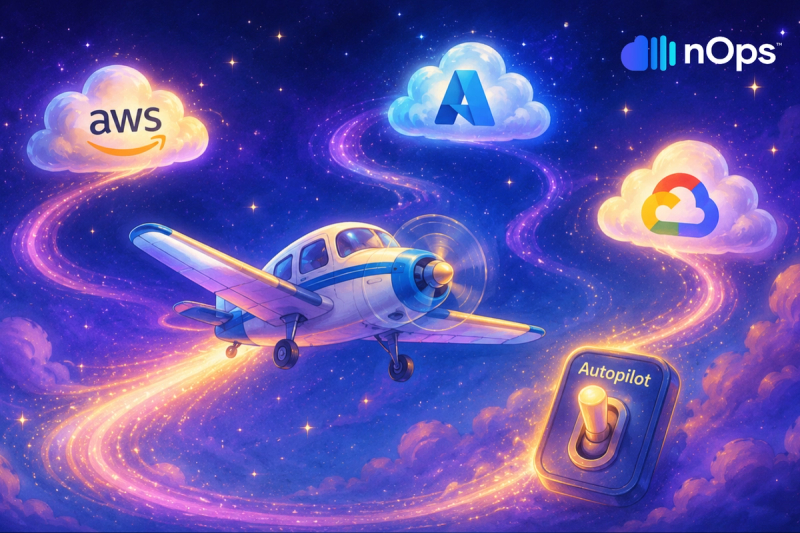
- If the savings make sense, setup and put your cost optimization on auto-pilot!
Everything without any commitment, either time or financial – completely risk-free!
So, your team now focuses on innovation, while nOps runs optimization on auto-pilot to help you track, analyze and optimize continuously!
If you are serious about your cloud costs, start saving with nOps today.

JT Giri
CEO
nops.io
JT Giri is a father, husband, and entrepreneur. He focuses on building a culture that allows teams to reach their highest potential. He enjoys HIIT workouts, learning, and meditating.
Demo
AI-Powered Cost Management Platform
Discover how much you can save in just 10 minutes!
Book a Demo
Are Reserved Instances Slowing Down Your Innovation?