Only 2% of CIOs
report spending less on cloud computing than they projected—which means almost everyone else is either overshooting budgets or flying blind when it comes to cloud costs. When you recognize that, you really have three options:
build your own in-house FinOps team, adopt a
FinOps platform to give your existing teams better visibility and controls, or
partner with a FinOps services provider to bring in outside expertise and managed execution. In this article, we’ll focus on that third path—FinOps services companies—what they do, where they shine, and how the top providers compare.
What is FinOps?
FinOps is a
cloud financial management practice that helps organizations get the most business value from every dollar they spend in the cloud. In FinOps, engineering, finance, and business teams all work from the same cost data and share responsibility for how cloud resources are used. Instead of treating the bill as a finance-only problem at the end of the month,
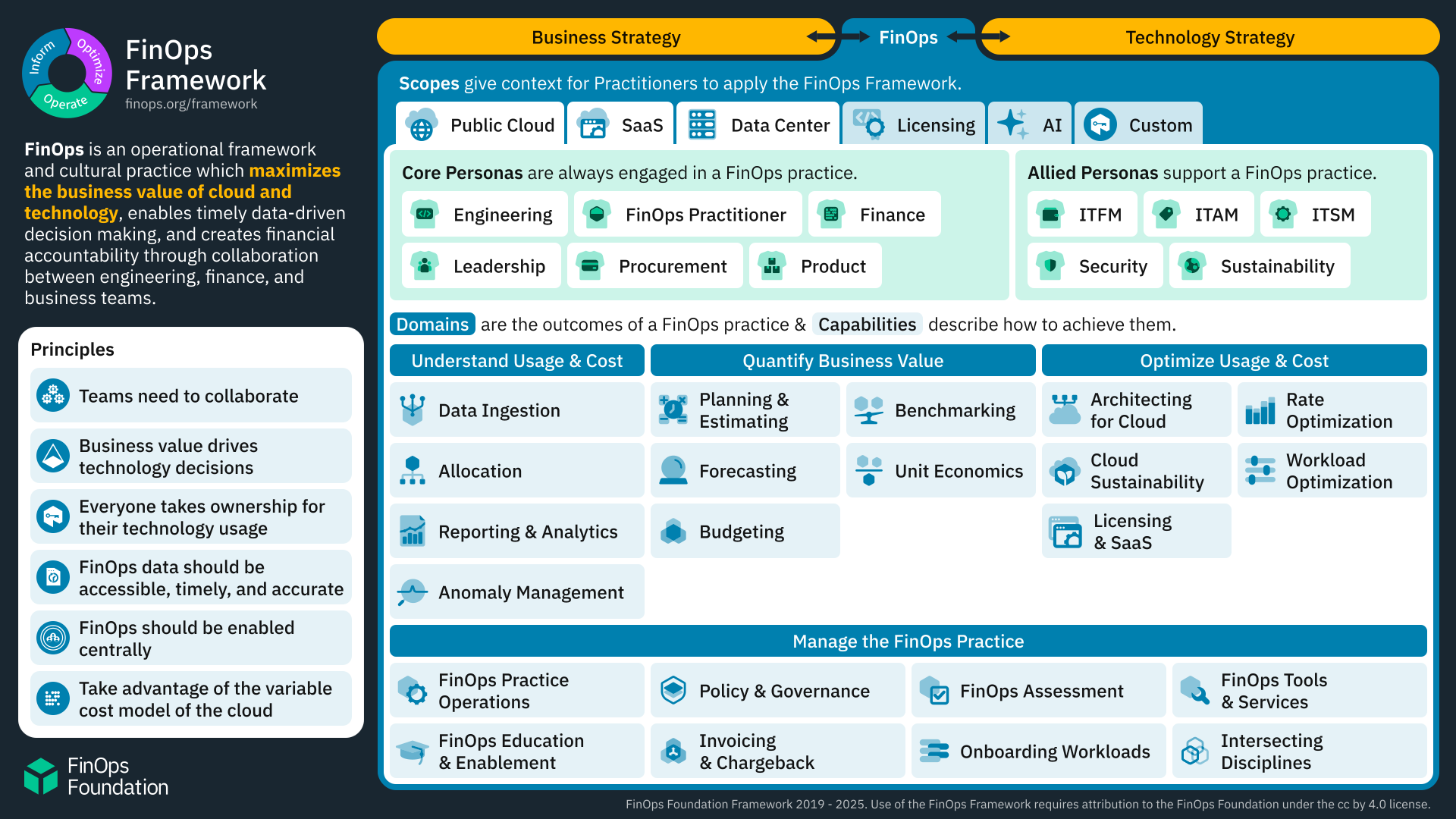
FinOps turns it into an ongoing, collaborative process grounded in real usage and real outcomes. You can check out the FinOps framework below (source: FinOps foundation) or read up on
FinOps best practices for more details on how it works.
Why Choose A FinOps Services Company?
Outsourcing FinOps gives you immediate expertise, bandwidth, and structure—so you can control cloud spend and improve financial accountability without having to build a full FinOps function from scratch. Pros of hiring FinOps services to optimize cloud costs include:
Faster Time to Impact
A services provider can step in with proven playbooks, tagging fixes, savings strategies, cost allocation and reporting frameworks. Instead of months of internal setup, teams start seeing clarity and optimizations to FinOps practice within weeks.
Dedicated FinOps Expertise
Cloud cost management isn’t something most engineers or finance teams specialize in. Services firms bring practitioners who do this every day—across multiple cloud providers, architectures, and industries—so you avoid common missteps and get guidance grounded in real-world patterns.
Continuous Optimization and Governance
FinOps isn’t a one-and-done project. Services providers monitor spend, surface new opportunities, adjust recommendations as workloads evolve, and keep stakeholders aligned on FinOps practice through regular reporting and reviews.
Support for Complex or Rapidly Changing Environments
Whether you’re dealing with multi-cloud sprawl, a major migration, M&A integration, or rapid product growth, external teams have experience navigating these transitions and stabilizing cloud spend during periods of high change.
Reduced Internal Overhead
Instead of hiring and onboarding a full FinOps team—often a mix of analysts, architects, and operations roles—you can rely on a cloud service partner to handle execution while your internal teams stay focused on delivering features and revenue.
What are the Disadvantages of a FinOps Service?
FinOps services also come with tradeoffs compared to hiring in-house, building internal tools, or leaning on a third party cloud optimization platform for your FinOps practice.
Cost Considerations
Specialized FinOps services can be expensive, especially on an ongoing basis. For smaller teams or organizations with tighter budgets, the price of a managed service may be hard to justify compared to lighter-weight cloud cost optimization tools or a small internal FinOps practice.
Risk of Over-Reliance
When an external provider drives most of your FinOps work, it can slow the development of in-house skills and ownership. Over time, you may find your organization heavily dependent on the vendor for visibility, analysis, and decision support — potentially leading to lock-in and lack of flexibility.
Integration Challenges
Bringing a FinOps service into your existing processes and tool stack isn’t always seamless. Aligning their reporting, workflows, and recommendations with your current engineering, finance, and procurement practices can take effort and may introduce friction at first.
Data Security and Confidentiality
To be effective, FinOps providers need deep access to your cloud usage and cost data—and sometimes broader business context. That level of access can raise data security, privacy, and compliance concerns, particularly in regulated industries.
Customization and Fit
Many FinOps services start with standard playbooks. Adapting those to your specific org structure, chargeback model, and product strategies can be time-consuming, and if the provider isn’t flexible enough, you may end up with a solution that doesn’t quite match how your business actually runs.
Top 10 FinOps Services
Having considered the benefits and tradeoffs, let’s take a look at the market-leading FinOps services to consider for your team.
#1: Accenture

Accenture is a global consulting and technology services firm with a dedicated FinOps practice and a large network of certified FinOps practitioners working across industries and regions. Their FinOps work is usually positioned as part of broader “Journey to Cloud” and cloud economics programs, helping enterprises tighten financial control while still scaling cloud adoption. Accenture’s FinOps services typically start with a capability and maturity assessment, followed by operating model design and governance setup. From there, they help clients integrate cloud cost management tooling (native or third-party), stand up tagging and allocation strategies, and embed FinOps processes like budgeting, forecasting, anomaly detection, and rightsizing into day-to-day operations. They also offer managed FinOps services, where Accenture’s team takes on ongoing monitoring, optimization, and reporting to drive continuous savings across AWS, Azure, and Google Cloud. FinOps Foundation:
https://www.finops.org/members/accenture/ Accenture FinOps Services:
https://aws.amazon.com/marketplace/pp/prodview-ikf2squc5i4tw #2: Deloitte

With a network of more than 60,000 cloud practitioners, over 260 FinOps professionals, and 28 delivery centers worldwide, Deloitte is geared toward large, complex organizations that need to bring more structure and predictability to cloud spend. Their FinOps work usually plugs into broader cloud transformation and “cloud economics” initiatives, rather than living as a standalone project. Beyond FinOps, Deloitte is one of the largest professional services networks in the world, providing audit, tax, consulting, and advisory services to nearly 90% of the Fortune 500 and thousands of private companies. In practice, that means its FinOps teams don’t just look at cloud bills—they connect cloud financial management to wider questions about M&A, operating models, sector-specific regulation, and long-term tech strategy. For organizations that want FinOps to influence budgeting, governance, and investment decisions—not just optimization tickets—Deloitte’s value proposition is the ability to tie cloud cost management into bigger board-level conversations about risk, growth, and return on digital investments. FinOps Foundation:
https://www.finops.org/members/deloitte/ Deloitte FinOps Practice:
https://www2.deloitte.com/us/en/what-we-do/capabilities/cloud-transformation/services/cloud-finops-services.html #3: PwC

PwC offers FinOps and cloud cost optimization services under its broader cloud transformation and “Cloud CFO” offerings, aimed at helping organizations get tighter financial control over public cloud while still supporting innovation. Their FinOps work typically combines advisory, accelerators like their FinOps Analyzer, and ongoing optimization to improve transparency, identify savings opportunities, and turn large, noisy cloud datasets into decision-ready insights for leadership. As one of the Big Four, PwC already works closely with CFOs and finance teams on governance, risk, and performance, and that lens shows up heavily in its FinOps positioning. Rather than treating FinOps as a purely technical cost-cutting exercise, PwC tends to frame it as part of the finance transformation journey: aligning cloud spend with business value, improving unit economics, and supporting decisions around AI, digital modernization, and multi-cloud strategy. For organizations that want FinOps embedded in budgeting, forecasting, and board-level discussions—not just in dashboards—PwC’s appeal is the ability to connect cloud cost management directly to financial strategy and corporate governance. FinOps Foundation:
https://www.finops.org/members/pwc/ PwC Cloud Cost Optimisation and FinOps:
https://www.pwc.com/gx/en/services/consulting/cloud-transformation/cloud-cost-optimisation-and-finops.html #4: Ernst & Young LLP (EY)

EY approaches FinOps as part of a broader effort to modernize how organizations plan, fund, and operate in the cloud. Rather than jumping straight into cost cutting, EY usually begins by examining how cloud spending connects to business priorities, product strategy, and operating-model design. Their FinOps work often includes quick assessments to surface immediate savings opportunities, but the larger goal is to help companies create a repeatable system for financial accountability as cloud adoption scales. EY’s differentiator is its emphasis on governance and cultural alignment. They help clients build a FinOps operating model that clearly defines ownership, decision rights, and KPI structures across engineering, finance, and product teams. Their practitioners also advise on architectural patterns, service selection, and unit economics—giving organizations a clearer view of what drives margin and where cloud investments actually pay off. For companies looking to mature their cloud financial practices while also elevating cost awareness across the organization, EY’s FinOps practice offers a more strategy-driven, governance-first approach than many traditional optimization services. FinOps Foundation:
https://www.finops.org/members/ey/ EY Cloud Cost Management & FinOps:
https://www.ey.com/en_us/cio/essential-steps-for-cloud-cost-management #5: SoftwareOne

SoftwareOne is a global platform, solutions, and services provider with deep roots in software licensing, cloud spend management, and software lifecycle management. As a FinOps Foundation member, it positions FinOps as a natural extension of what it’s already known for: helping customers tame complex hybrid and multi-cloud estates while staying on top of licensing and commercial risk. Its FinOps offering combines managed services, a FinOps Foundation–certified methodology, and its own FinOps for Cloud platform to help organizations gain transparency, predictability, and governance over cloud spend. SoftwareOne’s teams can run diagnostics to benchmark your current FinOps maturity, stand up or tune tooling (including their own platform or a tool of your choice), and then provide ongoing managed FinOps services to drive savings and operationalize financial accountability. Case studies highlight multi-hundred-thousand-dollar savings and scenarios where SoftwareOne helps clients both close immediate optimization gaps and build the internal capabilities needed to eventually run FinOps more independently. FinOps Foundation:
https://www.finops.org/members/softwareone/ SoftwareOne FinOps Services:
https://www.softwareone.com/en/cloud-financial-management #6: KPMG

KPMG delivers FinOps as part of its wider cloud and technology advisory work, with a strong focus on financial predictability, data-driven key performance indicators, and risk-aware transformation. Its teams typically help clients build out a FinOps capability framework—covering visibility, optimization, policies, and governance—so they can avoid paying a premium on cloud spend while still moving ahead with modernization and growth initiatives. As a global audit, tax, and advisory network operating in more than 140 countries, KPMG is often a fit for enterprises that want FinOps tied closely to corporate controls, compliance, and broader business strategy. In practice, that can mean designing a “cloud business office” or FinOps center of excellence, implementing tooling and automation for monitoring and reporting, and integrating cloud cost management into CFO- and board-level conversations about ROI and risk. If you’re looking for a partner that treats FinOps as part of overall cloud governance and financial management—not just a savings exercise—KPMG is typically geared toward that use case. FinOps Foundation:
https://www.finops.org/members/kpmg/ KPMG Cloud Cost Management & FinOps:
https://kpmg.com/us/en/articles/2023/financial-operations-cloud-cost.html #7: Anglepoint

Anglepoint is a global IT asset management (ITAM) and FinOps services provider, recognized by Gartner as a leader in software asset management. Its sweet spot is helping Global 2000 organizations manage the full lifecycle of technology spend across cloud, SaaS, and on-prem software—blending traditional ITAM discipline with modern FinOps practices. Anglepoint’s FinOps services are geared toward organizations that want cloud cost optimization tightly connected to licensing, audit risk, and broader technology governance. They offer program development (from maturity assessments to full program build-out), tool selection and implementation, cost saving opportunities, security and compliance assessments, and certified training through Anglepoint Academy. For companies dealing with complex hybrid estates, large software publisher relationships, or audit exposure, Anglepoint is a good fit when you don’t just want to lower cloud costs—you also want a unified approach to controlling software, SaaS, and cloud spend under one roof. FinOps Foundation:
https://www.finops.org/members/anglepoint/ Anglepoint FinOps Services:
https://www.anglepoint.com/services/cloud-cost-management/ #8: Kyndryl

Kyndryl is an IT infrastructure services company spun out of IBM that now describes itself as the world’s largest IT infrastructure services provider, serving thousands of enterprise customers in more than 60 countries. Its FinOps offering sits within a broader hybrid and multi-cloud operations portfolio, aimed at organizations running complex, mission-critical workloads across multiple providers and on-prem environments. Kyndryl’s FinOps services combine consulting, a FinOps Foundation–certified platform, and managed operations. The company emphasizes building a sustainable FinOps operating model: assessing current maturity, normalizing and allocating spend across clouds, improving tagging and data quality, and then continuously optimizing and reporting through Kyndryl’s platforms (including Kyndryl Bridge). With hundreds of FinOps-certified practitioners and recognition as a FinOps Certified Provider, Kyndryl is generally best suited for large enterprises that want FinOps tightly integrated with day-to-day infrastructure operations rather than a standalone optimization project. FinOps Foundation:
https://www.finops.org/members/kyndryl/ Kyndryl FinOps Services:
https://www.kyndryl.com/us/en/services/cloud/modern-operations/finops #9: Thoughtworks

Thoughtworks is a global technology consultancy best known for agile delivery and modern engineering practices, and it brings that same “build and automate” mindset to FinOps. Its FinOps offering combines cost reduction, revenue and margin focus, and an explicit sustainability lens: their GreenOps approach treats carbon and energy usage as first-class metrics alongside cloud spend, so teams can make tradeoffs across cost, performance, and environmental impact rather than looking at the bill in isolation. Thoughtworks is generally a fit for engineering-led organizations that want FinOps to be tightly integrated with product development and platform teams, not just run as a finance-side project. In addition to ongoing business operations consulting and implementation work, they also offer a structured “AWS FinOps Deep Dive Assessment” via AWS Marketplace, which is geared toward companies that want a focused, workshop-style engagement to understand their current cloud economics and shape a FinOps journey roadmap before investing in bigger changes. Thoughtworks FinOps Practice:
https://www.thoughtworks.com/en-us/what-we-do/cloud/finops Thoughtworks AWS FinOps Deep Dive Assessment:
https://aws.amazon.com/marketplace/pp/prodview-nq6osnr44bf22 #10: Softchoice

Softchoice is a North American IT solutions and services provider that’s leaned hard into FinOps as a way to help customers get lasting value from their cloud investments, not just one-time savings. Its FinOps portfolio is built around modular “foundational” and “advanced” services, plus managed cost optimization powered by platforms like VMware Tanzu CloudHealth. The goal is to help organizations move from ad hoc cost-cutting to a continuous, culture-driven approach to cloud financial management. Softchoice is generally a fit for organizations that want structured guidance and cultural change, not just tooling. Their FinOps Foundations engagements emphasize discovery, stakeholder workshops, maturity assessments, and executive alignment, then translate that into a practical roadmap and ongoing advisory or managed services. If you’re at an early or mid-stage of FinOps maturity and need help building the practice, educating teams, and achieving more cloud efficiency over your multi cloud environment, Softchoice positions itself squarely in that “help us get from understanding to execution” space. Softchoice FinOps Practice:
https://www.softchoice.com/solutions/cloud-data-center/cloud-migration-adoption-management/finops What are FinOps Services Competitors?
FinOps services aren’t the only way to manage cloud financial operations. Many organizations compare them against in-house teams and different types of FinOps tooling. Here’s how the main alternatives stack up.
| Competitor Type | What It Is | Pros | Cons | Examples |
| In-House FinOps Team | A team of full-time employees (analysts, architects, engineers, or finance partners) that owns cloud financial management internally. | Deep internal context; embedded in workflows; builds long-term FinOps maturity; direct control over priorities and processes. | Slowest to build; requires hiring specialized talent; higher fixed cost; impact depends heavily on team expertise and bandwidth. | A dedicated internal FinOps lead or team at companies like Airbnb, Netflix, or Capital One. |
| Third-Party FinOps Platform | A software platform that provides cost visibility, allocation, forecasting, optimization recommendations, and automation. | Real-time dashboards; automation; self-service access for engineering/finance; scalable across clouds; lower cost than managed services. | Requires internal ownership to operationalize; may not provide hands-on execution; recommendations can go unused without strong FinOps culture. | nOps, CloudZero, Apptio Cloudability, Harness, ProsperOps. |
| In-House FinOps Tooling (DIY) | A custom mix of native cloud tools, scripts, dashboards, and tagging frameworks created and maintained internally. | Lowest direct cost; highly customizable; leverages native AWS/Azure/GCP capabilities; good for teams with strong cloud and data engineering resources. | Requires significant engineering effort; limited automation; harder to maintain at scale; risk of gaps in forecasting, anomaly detection, and governance. | AWS Cost Explorer, AWS CUR + Athena, Azure Cost Management, GCP Billing Export + BigQuery + Looker dashboards. |
| General Cloud MSP (Managed Service Provider) | A cloud operations or migration provider that includes cost optimization as part of broader managed cloud services. | Helpful for smaller teams; bundles optimization with monitoring and ops; low lift to start. | Typically surface-level optimization; not deep FinOps maturity-building; limited financial governance expertise. | Rackspace, Mission Cloud, Onica by Rackspace, SHI. |
nOps is the top FinOps Services Alternative
If the downsides of a FinOps service give you pause—ongoing cost, slower visibility, limited automation, or the risk of becoming dependent on a third party—nOps gives you a different path. Instead of outsourcing FinOps, nOps helps your team
run FinOps with real-time data, automation, and workflows that plug directly into engineering. Here’s how nOps helps replace (or reduce) the need for FinOps services:
- Automated, FinOps-certified platform instead of manual services. nOps is an AI-powered, FinOps-certified cloud cost optimization platform, helping customers cut cloud spend by 50%+ on average using automation rather than costly services work.
- Better pricing model. nOps helps you save on resource optimization, autoscaling and discount management with simple, flat fee or percentage-of-savings models — so you can optimize costs without hiring expensive consultants or contractors.
- 100% cost allocation — even with messy tags and shared resources. nOps is built to deliver complete visibility and 100% cost allocation across cloud service providers, Kubernetes, SaaS and AI spend.
- Out-of-the-box unit economics (cost per customer, product, feature, team) Break down spend into meaningful business units — cost per customer, product, feature, team, or environment — for true unit economics.
- Autonomous optimization and commitment management, not just recommendations. Many tools stick to visibility only— nOps makes it easy to realize cost savings continuously and automatically. This is the work many FinOps services still do by hand; with nOps, it’s handled autonomously.
- Real-time alerts and AI FinOps agent instead of periodic reports. With anomaly detection, forecasting, and even an AI agent to monitor your cost data, nOps makes it easy to optimize your cloud infrastructure without manual work.
Want to try it out for free with in your own environment? Book a demo call with one of our Finops experts to find out how much you can save today. nOps manages $2 billion in cloud spend for our customers and is rated 5 stars on G2.  Skip to content