
Flexera Alternatives in 2026: Best Tools for ITAM, SaaS Management & Cloud FinOps
Flexera One spans IT asset management, software licensing, and cloud financial management through an expanding portfolio of acquired products. The January 2026 acquisitions of ProsperOps and Chaos Genius added autonomous commitment management capabilities to a suite that already included CloudCheckr (cloud visibility) and Spot (Kubernetes optimization). But breadth comes with trade-offs: multiple data models, varying integration depth, enterprise implementation timelines, and pricing that scales with cloud spend.
If you're evaluating Flexera alternatives, you may be facing some of these constraints. The good news? The commitment automation market has matured. Purpose-built platforms now deliver hourly rebalancing, faster onboarding, and transparent pricing without enterprise overhead. The right replacement still depends on which part of Flexera One you're replacing, because Flexera sells software asset management, SaaS management and cloud FinOps under one name and few vendors cover all three.
This guide compares 21 tools by segment: software asset management and ITAM, SaaS management, and cloud cost optimization. We'll break down automation depth, multi-cloud coverage, setup speed, and pricing models, and show how Flexera's acquisitions and pricing work, so you can find the platform that fits your use case.
Which Part of Flexera Are You Replacing? (Start Here)
Flexera One bundles four jobs: software asset management and ITAM, SaaS management, cloud cost and FinOps, and hybrid IT governance. No single alternative replaces all four, so match the replacement to the function you use. If cloud cost is the part you are replacing, nOps does it with hourly, automated commitment management across AWS, Azure and GCP.
Flexera One function | What to replace it with | Top 2 picks | Why |
|---|---|---|---|
Software asset management / ITAM | A SAM or ITAM platform with license reconciliation and audit reporting | ServiceNow, USU | Both appear on Gartner Peer Insights' list of Flexera One IT Asset Management alternatives, alongside Ivanti, ManageEngine and Certero. |
SaaS management & shadow AI | A SaaS management platform with discovery, renewals and license reclamation | Zylo, CloudEagle.ai | Both are built around SaaS discovery and renewal management rather than on-premises license compliance. |
Cloud cost & FinOps | A FinOps platform with automated commitment management | nOps, Usage.ai | Both automate commitment management across AWS, Azure and GCP instead of stopping at recommendations. |
Hybrid/on-prem governance | An ITAM platform that covers on-prem, cloud and SaaS assets | ServiceNow, Certero | ServiceNow ties asset data to its CMDB and ITSM workflows, and Certero describes a hybrid IT asset management platform that spans hardware, software, SaaS and cloud. |
What Is Flexera One?
Flexera One is an enterprise IT management platform covering IT asset management (ITAM), software asset management (SAM), cloud cost optimization, and SaaS governance. The platform's defining characteristic is its acquisition-driven structure — it's not a single organically built product but a collection of specialized tools operating under one portfolio. Flexera positions itself as the all-in-one solution for enterprises managing hybrid IT estates, cloud workloads, and complex licensing portfolios. The trade-off is operational complexity: teams needing fast, focused cloud cost savings often evaluate purpose-built alternatives.
IT asset management (ITAM) and software license compliance (SAM)
Flexera One IT Asset Management tracks hardware and software assets across hybrid environments. Its software asset management side handles license compliance and audit defense for publishers such as Microsoft, Oracle, SAP and IBM, and Flexera says the platform is IBM-certified and Oracle-verified. ITAM is licensed on clients, servers and containers, according to Flexera's license metrics.
SaaS management
Flexera One SaaS Management covers subscription tracking and renewal optimization, and Flexera positions it for finding known and shadow SaaS and AI waste. It is licensed per user, and Flexera's definition of a user includes service accounts, bots and AI agents as well as employees.
Cloud cost management (FinOps)
Flexera One Cloud Cost Optimization works across AWS, Azure, Google Cloud and regional providers, with cost allocation for chargeback and showback. The product traces back to RightScale Optima, which Flexera acquired in 2018. Commitment management comes from ProsperOps, which Flexera describes as managing Reserved Instances, Savings Plans and CUDs, and data cloud optimization for Snowflake and Databricks comes from Chaos Genius. CloudCheckr, which arrived with the Spot portfolio, is sold as a separate product line rather than as the Flexera One cost module.
Hybrid and on-prem governance
Flexera One IT Visibility gives a view across on-premises, cloud and SaaS estates, and it draws on Technopedia, Flexera's reference library of technology asset data. Customers running the on-premises FlexNet Manager Suite can move to Flexera One, which Flexera's community team says contains a close match for FlexNet Manager Suite capabilities.
Flexera Container Optimization (Kubernetes and container cost management)
Flexera's Kubernetes product is Container Optimization, built on Ocean, which Flexera acquired as Spot Ocean. It monitors for pending pods, resizes clusters to workload constraints and scales down underutilized nodes. Elastigroup handles VM spot management under the same Workload Optimization umbrella. One naming note: Kubex is not a Flexera product. Kubex is the brand of Densify, which renamed itself Kubex on January 1, 2026 in a rebrand that Densify says involved no acquisition or change of ownership. So Flexera does optimize Kubernetes, through Container Optimization, but it does not sell Kubex.
How Flexera Got Here: The Acquisition Timeline
Most of Flexera's cloud and FinOps products came from acquisitions made since 2018. Flexera is privately held and majority-owned by Thoma Bravo, which agreed to buy its majority stake in December 2020. Each acquisition brought distinct capabilities, but also distinct data models, user interfaces, and implementation requirements.
Flexera One consolidation
Flexera bought RightScale in September 2018, adding the Optima cost optimization tool that became the base of Flexera Cloud Cost Optimization. It launched Flexera One in 2020 as the SaaS platform that brings ITAM, SAM, cloud cost and SaaS management together. On February 15, 2024 it completed its acquisition of Snow Software, adding software asset management and SaaS management products that Flexera continues to support alongside its own.
CloudCheckr
CloudCheckr, a cloud cost management and governance platform for enterprises, MSPs and distributors, joined Flexera on March 3, 2025 as part of the Spot portfolio. Flexera tells CloudCheckr customers they can extend into Flexera One FinOps and Cloud Cost Optimization, but CloudCheckr still has its own AWS Marketplace listing.
Spot.io (Kubernetes and spot instance optimization)
NetApp acquired Spot, formerly Spotinst, in 2020, and Flexera completed its acquisition of the Spot portfolio from NetApp on March 3, 2025. The deal added Eco for commitments, Elastigroup for spot automation, Ocean for container management and CloudCheckr, which Flexera said filled gaps in its Kubernetes and spot capabilities.
ProsperOps — automated commitment management for AWS, Azure, GCP (January 2026)
Flexera announced its acquisition of ProsperOps on January 6, 2026. ProsperOps automates commitment management for AWS, Azure and Google Cloud, and Flexera says it manages about $6 billion in annual cloud usage. Flexera is running ProsperOps as a standalone division with its own go-to-market during integration.
Chaos Genius — AI-driven FinOps analytics, plus Snowflake/Databricks cost management (January 2026)
Flexera announced Chaos Genius the same day. Chaos Genius uses AI agents to optimize Snowflake and Databricks spend, and Flexera cites cost reductions of up to 30% for Fortune 500 customers. Unlike ProsperOps, Chaos Genius's staff and functions were integrated into Flexera immediately.
What each acquisition added, and the open question about product priorities
Together the deals gave Flexera cloud cost visibility (RightScale, CloudCheckr), Kubernetes and VM automation (Spot), commitment management (ProsperOps) and data cloud optimization (Chaos Genius), on top of the ITAM, SAM and SaaS products from Snow. The open question is how tightly these products fit together. The ITAM Review noted that acquisitions deliver breadth quickly, but turning several products into one console and one operating model is a serious engineering lift, and it asked what the integration roadmap looks like when ProsperOps runs standalone.
Flexera has since moved on part of that. It made Unified Autonomous Optimization, which coordinates ProsperOps with Ocean and Elastigroup, generally available on June 10, 2026, and introduced ProsperOps+, a bundle priced on outcomes. ITAM, SaaS and cloud cost remain separate products with their own license metrics, so evaluate each module on its own.
Why Teams Look for Flexera Alternatives
Flexera's portfolio breadth appeals to IT governance organizations managing diverse technology stacks, but depending on your organization, there may be limitations.
Implementation speed and services overhead
Depending on product(s), Flexera implementations can span weeks to months, involving multiple module rollouts, cross-system integrations, and enterprise onboarding cycles. Reviewers on the AWS Marketplace listing describe Flexera One as capable but not plug-and-play, citing training needs and a complex initial setup. Organizations needing immediate cost visibility and automated savings activation may encounter friction during deployment.
Commitment automation depth
Flexera added autonomous commitment management through ProsperOps, which was announced as a standalone division and has since begun to be coordinated with Flexera's workload optimization products. As the ITAM Review noted, the acquisition reinforces FinOps and ITAM convergence while leaving a real integration job ahead. Buyers should confirm how commitment management is packaged module by module, and whether it is the ProsperOps+ bundle or a separate contract.
Multi-cloud coverage variability
Flexera supports AWS, Azure, and GCP, but depth varies by module. The former CloudCheckr platform historically focused on AWS before expanding multi-cloud visibility. ProsperOps covers AWS, GCP and Azure for commitment management.
Pricing complexity and minimum commitments
Flexera One is sold module by module, and each module is metered differently: cloud cost on spend under management, IT asset management on devices, SaaS management on users. Spend is measured before discounts, so negotiating a better rate with your cloud provider does not shrink the base Flexera prices against. The pricing section below covers how each part works.
ITAM-first heritage vs FinOps-native tooling
Flexera began as a software licensing and asset management company, and its FinOps products arrived mostly through acquisition from 2018 on. FinOps-native platforms start from cloud billing data and commitments, so onboarding centers on a billing connection rather than agents and discovery.
Flexera Pricing: How the Model Works
Flexera sells Flexera One through quotes and private offers, but its AWS Marketplace listings and published license metrics show how each module is measured and what the entry prices look like. For a module-by-module breakdown, see nOps's Flexera pricing guide.
Percentage-of-cloud-spend structure
Flexera One Cloud Cost Optimization is metered on spend under management. One AWS Marketplace listing prices a 12-month contract at $50,000 for up to $1 million of yearly cloud spend under management, which is 5% at the top of that tier. A second listing offers a fixed $40,681 annual price for organizations spending $125,000 a month on AWS, about 2.7% of $1.5 million in yearly spend, plus a percent-of-monthly-spend option with a $1,000 minimum monthly charge. Across the two published options the rate runs from roughly 2.7% to 5%. Contracts run 12, 24 or 36 months, and fees are non-cancellable and non-refundable.
Spend under management is defined broadly. Flexera's product terms count the total cost in every connected bill source on an unamortized, as-incurred basis, before credits, discounts or refunds, and including taxes and support charges. Usage and cost data from AI model providers counts as a bill source as well.
Module and add-on structure
Each Flexera One product is licensed on its own metric, and a customer using several pays on several metrics at once.
Product | License metric |
|---|---|
Cloud Cost Optimization | Spend under management |
IT Asset Management | Clients, servers and containers (ten containers count as one server) |
SaaS Management | Users, including service accounts, bots and AI agents |
Cloud License Management | Cloud instances |
Data Cloud Insights | Spend under management |
Bundles combine metrics. Flexera One Enterprise, for example, packages IT Visibility, ITAM Standard, SaaS Management and Cloud Cost Optimization among others, and it is measured on all of their metrics. ProsperOps+ pairs ProsperOps with any Flexera FinOps product and is priced on outcomes rather than spend.
Key Features to Look for in a Flexera Alternative
When evaluating Flexera One alternatives, prioritize these capabilities:
Commitment automation
Commitment management is where most cloud savings accumulate — but automation depth varies dramatically across platforms. Look for:
- Autonomous execution: platforms that buy, monitor, exchange, and retire commitments without manual intervention, versus recommendation-only models requiring approval workflows
- Rebalancing frequency: hourly vs. daily vs. weekly adjustments make measurable impact when workload patterns shift
- Convertible RI strategies: mid-term exchanges as usage evolves reduce lock-in risk while maintaining discount depth
- Multi-cloud coverage: AWS, Azure, and GCP support for both compute and non-compute services (RDS, ElastiCache, Redshift, Azure SQL, Cloud SQL)
- Savings Plans and Reserved Instances: platforms handling both instruments provide more optimization flexibility
Multi-cloud cost management
Effective multi-cloud platforms normalize billing data across AWS, Azure, and GCP into unified views. Key features:
- Consolidated dashboards showing total spend, trends, and allocation across all providers
- Cross-cloud cost allocation with tagging, business unit mapping, and showback/chargeback
- Provider-specific optimization: each cloud has unique commitment types, discount structures, and rightsizing opportunities
- AWS, Azure, GCP, Kubernetes, SaaS & AI coverage so you can analyze all of your costs in a single pane of glass.
Cost visibility and forecasting
Visibility is table stakes, but depth matters. The checklist of key features includes:
- Real-time dashboards (hourly or daily refresh) vs. batch updates
- Anomaly detection flagging unexpected spend spikes before they compound
- Forecasting based on historical trends, seasonality, and planned changes
- Unit economics: cost per customer, per transaction, or per product for SaaS teams
- Budget tracking with alerts when thresholds approach
Infrastructure and Kubernetes optimization
Beyond commitments, some infrastructure optimization capabilities include:
- Rightsizing recommendations for over-provisioned EC2, RDS, and compute instances
- Idle resource detection (unattached EBS volumes, stopped instances still incurring charges, orphaned snapshots)
- Automated scheduling for non-production resources (dev/test environments running 24/7)
- Storage optimization (GP2 to GP3 migrations, snapshot lifecycle policies)
- One-click execution vs. manual implementation
- Cluster rightsizing, bin-packing and spot orchestration for container-heavy estates, which Flexera covers with Container Optimization and Cast AI and Kubex cover as dedicated tools
License and SaaS discovery (for ITAM/SaaS replacements)
If you are replacing Flexera's ITAM or SaaS modules, judge the alternative on discovery accuracy and license reconciliation rather than cloud cost features:
- Discovery across clients, servers, containers and cloud instances, with inventory data normalized against a software recognition library such as Flexera's Technopedia or Eracent's IT-Pedia
- Publisher-specific license metrics for vendors such as Microsoft, Oracle, IBM, SAP and Adobe, with effective license position reports that vendors will accept in an audit
- SaaS discovery that goes beyond single sign-on, using identity, expense and contract data to find unsanctioned apps and AI tools
- Renewal tracking and license reclamation that act on unused seats instead of only reporting them
Top Flexera Alternatives by Segment
Flexera sells three different kinds of software under one name, so the alternatives below are grouped by the part of Flexera One they replace. Each segment opens with when to replace that part and carries its own comparison table.
Software Asset Management & ITAM
Replace this part of Flexera One if license compliance, audit defense and hardware and software inventory are your main use. ServiceNow, Ivanti, USU, ManageEngine and Certero all appear on Gartner Peer Insights' list of alternatives to Flexera One IT Asset Management. Snow Software appears there too, but Flexera owns it.
Platform | Best for | Pricing model |
|---|---|---|
ServiceNow | Enterprises already on ServiceNow ITSM | Subscription by assets or users (quote) |
USU | Complex vendor agreements and datacenter licensing | Subscription by assets, users or devices (quote) |
Ivanti | ITAM tied to Ivanti endpoint and service tools | Platform fee plus cost per license (quote) |
Eracent | Publisher-specific license reconciliation | Annual subscription (quote) |
ManageEngine AssetExplorer | Straightforward asset tracking | Annual, by IT asset count (published) |
Snow Software | Existing Snow customers (owned by Flexera) | Quote from Flexera |
Certero | SAP, Oracle and IBM estates | Subscription by devices or users (quote) |
ServiceNow (ITSM + ITAM)
ServiceNow's Software Asset Management Pro and Hardware Asset Management Pro run on the same workflow platform as its IT service management, so asset and license data can feed the CMDB and ticketing processes that many enterprises already run there.
Best for: Enterprises already standardized on ServiceNow that want license compliance inside their existing ITSM workflows.
Key capabilities
- Software license tracking and compliance with automated workflows
- Hardware asset lifecycle management through HAM Pro
- Asset data tied to the ServiceNow CMDB
- Standard, Professional and Enterprise packaging tiers
Pricing model: Subscription, typically priced by the number of assets or users managed and quoted by sales.
Pros: One platform for ITSM and ITAM, and a 4.3 average rating on Gartner Peer Insights.
Cons: The enterprise-oriented architecture and pricing suit smaller organizations less, and the product depends on ServiceNow as the underlying platform.
Replaces: Software asset management and ITAM, and hybrid governance for ServiceNow shops.
USU
USU's software asset management product (formerly Aspera) covers client and datacenter environments and can be hosted in the cloud or on-premises. USU's product business, which also includes IT service management and IT operations management, has been majority-owned by Thoma Bravo since late 2024, the same firm that owns Flexera.
Best for: Large enterprises with complex vendor agreements and datacenter licensing.
Key capabilities
- License analysis for complex vendor agreements and audit readiness, which reviewers on Gartner Peer Insights credit it with
- Client and datacenter coverage in one platform
- Integrations with more than 50 systems and databases, including Oracle Database, IBM PVU and Microsoft SQL Server, according to USU's fact sheet
Pricing model: Subscription, typically structured by managed software assets, users or devices, with quotes from USU.
Pros: A 4.5 average rating across about 150 ratings on Gartner Peer Insights, and datacenter licensing handled alongside client estates.
Cons: Thoma Bravo owns both USU's product business and Flexera, which matters if vendor independence is a reason for leaving Flexera. It is also an ITAM product, with no FinOps or commitment management.
Replaces: Software asset management and ITAM, including datacenter license management.
Ivanti
Ivanti Neurons for ITAM consolidates hardware and software asset records into a single database and is offered as a cloud subscription or on-premises.
Best for: Teams that want ITAM connected to Ivanti's endpoint and service management tools.
Key capabilities
- Software and hardware inventory tracking with license management
- Depreciation and disposal management
- Barcoding and RFID support, plus work order management
Pricing model: Quote-based. Ivanti's platform page describes a platform fee plus a cost per license.
Pros: A single asset database with lifecycle features such as depreciation, disposal and work orders.
Cons: No published prices, and it is not a cloud cost or FinOps tool.
Replaces: ITAM and hardware asset management.
Eracent
Eracent, based in Riegelsville, Pennsylvania, sells the IT Management Center (ITMC) suite for ITAM and SAM, including ITMC Discovery, ITMC Lifecycle and the IT-Pedia product data library.
Best for: Organizations that need publisher-specific license reconciliation, particularly for Microsoft, Oracle and IBM estates.
Key capabilities
- Continuous License Reconciliation modules that produce effective license position reports
- Cross-platform discovery and software and server utilization measurement
- IT-Pedia, a product data library that normalizes data for CMDBs and other systems
- A certified ITMC integration for ServiceNow
Pricing model: Custom quotes sold as annual subscriptions or hosted solutions. Eracent does not publish standard list prices.
Pros: Deep license reconciliation for major publishers, with its own data normalization library.
Cons: Prices are not published, and cloud and SaaS support extends an on-premises license management core, so FinOps use cases need a separate tool.
Replaces: Software asset management and ITAM, and hybrid and on-prem governance.
ManageEngine AssetExplorer
ManageEngine AssetExplorer is a dedicated IT asset management product from ManageEngine, available in cloud and on-premises versions.
Best for: IT teams that want straightforward asset tracking with published pricing.
Key capabilities
- Discovery, inventory, tracking and retirement of hardware and software assets
- Software license tracking
- Separate cloud and on-premises editions
Pricing model: Annual subscriptions priced by the number of IT assets managed, per ManageEngine's pricing page.
Pros: Published pricing and a free trial.
Cons: It does not cover SaaS management or cloud FinOps.
Replaces: ITAM and basic software license tracking.
Snow Software
Snow Software's license management and Atlas platform cover software asset management and SaaS management. Flexera completed its acquisition of Snow on February 15, 2024, so Snow is now a Flexera product line rather than a way to leave Flexera.
Best for: Teams that already run Snow and want to compare it with Flexera One inside the same vendor.
Key capabilities
- Software license optimization and compliance
- SaaS management
- Continued support, with Flexera saying it will enhance, maintain and support both Flexera and Snow solutions
Pricing model: Quoted by Flexera, with Snow Software remaining the contract entity for existing customers.
Pros: Snow License Manager averages 4.5 across about 330 ratings on Gartner Peer Insights.
Cons: Same vendor and owner as Flexera One, with overlapping roadmaps.
Replaces: Software asset management and SaaS management, within Flexera.
Certero
Certero sells CerteroX SAM and companion ITAM, SaaS and cloud products, which it positions as an AI-powered hybrid IT asset management platform.
Best for: Enterprises with SAP, Oracle or IBM estates that need software asset management across desktop, datacenter, SaaS and cloud.
Key capabilities
- Automated recognition and categorization of the software estate
- License position analysis across publishers such as Microsoft, Oracle, IBM and SAP
- On-premises or single- and multi-tenant SaaS hosting
Pricing model: Subscription, typically structured by managed devices or users, with custom quotes.
Pros: Software asset management depth across major publishers.
Cons: Hardware asset management is less comprehensive than its software side, according to fitgap's profile, and pricing is positioned for enterprises.
Replaces: Software asset management and ITAM.
SaaS Management & Shadow AI
Replace this part of Flexera One if SaaS discovery, renewals and shadow AI visibility matter more than license reconciliation. Productiv, a frequent name in older lists, ceased operations on August 6, 2026, so it is not covered here.
Platform | Best for | Pricing model |
|---|---|---|
CloudEagle.ai | Fast start with procurement workflows | Subscription tailored to usage; $500 per month entry listing on AWS Marketplace |
Zylo | Enterprise application estates | Custom quote (Core, Premium, Enterprise) |
Torii | SaaS discovery tied to identity workflows | Tailored quote |
CloudEagle.ai
CloudEagle.ai, founded in 2021 and based in California, is an AI-powered SaaS management and identity governance platform for IT, security, finance and procurement teams.
Best for: Teams that want SaaS discovery, renewals and procurement workflows in one place, and a quick start.
Key capabilities
- SaaS and AI app discovery through what CloudEagle cites as 500+ integrations
- License management with automated reclamation of unused seats
- Contract and renewal management
- Identity governance and access reviews
Pricing model: Subscription pricing tailored to users, apps and integrations. An entry-level SaaS Optimization dimension is listed at $500 per month on AWS Marketplace.
Pros: SaaS-native design, with a 30-minute onboarding that CloudEagle cites.
Cons: A younger company than Flexera or Zylo, and it does not cover ITAM license reconciliation or cloud FinOps.
Replaces: SaaS management and shadow AI.
Zylo
Zylo, founded in 2016 and based in Indianapolis, is an enterprise SaaS management platform built for IT and finance teams to discover, optimize and govern their software portfolios.
Best for: Large enterprises managing a big application estate with a formal renewal process.
Key capabilities
- SaaS inventory discovery and spend tracking
- License and renewal management
- Support for consumption-based pricing models, added in 2025, per CB Insights
Pricing model: Custom quotes across Core, Premium and Enterprise tiers.
Pros: An established SaaS-only vendor with a large benchmark dataset, which Zylo says spans 40M licenses and $75B in spend.
Cons: No public pricing, and no ITAM or FinOps scope.
Replaces: SaaS management.
Torii
Torii, which describes itself as a Freshworks company, is a discovery-first SaaS management and identity governance platform. Torii says it was named a Leader in Gartner's 2026 Magic Quadrant for SaaS Management Platforms.
Best for: IT teams that want SaaS discovery tied to identity workflows such as onboarding, offboarding and access reviews.
Key capabilities
- App discovery through what Torii cites as 200-plus integrations
- License and renewal workflows, with expense and contract integrations
- An AI management product that tracks token consumption and AI usage and spend by department
Pricing model: Priced to your environment through a tailored quote.
Pros: SaaS management, identity governance and AI usage tracking from one vendor.
Cons: No ITAM license reconciliation or cloud cost management, and its ownership has recently changed.
Replaces: SaaS management and shadow AI.
Cloud Cost & FinOps
Replace this part of Flexera One if cloud cost visibility, commitment management and workload optimization are your main use. Flexera's FinOps stack is the product of five acquisitions, so the platforms below either cover a narrower slice in more depth or put the pieces in one product.
Platform | Commitment Automation | Multi-Cloud Support | Setup Time | Pricing Model | Primary Strength |
|---|---|---|---|---|---|
nOps | Hourly autonomous | AWS, Azure, GCP | 5 minutes | Savings-based | Cost optimization + visibility |
Usage.ai | Autopilot or CoPilot approval | AWS, Azure, GCP | Read-only evaluation first | Share of savings | Insured commitments |
Cloudability | Add-on through Cloudwiry | AWS, Azure, GCP | Weeks | Percentage of spend | FinOps reporting and benchmarking |
Finout | Recommendation-driven | AWS, Azure, GCP + SaaS | Days | Per-cluster/account | Multi-cloud + SaaS unit economics |
Cast AI | Automated (Kubernetes-specific) | AWS, Azure, GCP (K8s) | Days | Per-cluster | Kubernetes bin-packing + Spot orchestration |
Archera | Automated purchasing + mgmt | AWS, Azure, GCP | Days | Flexible pricing | Commitment automation focus |
Zesty | Commitment Manager (AWS EC2) | AWS, Azure | Hours | Usage-based + savings-based | Kubernetes and storage automation |
Datadog | Recommendation-only | AWS, Azure, GCP | Already deployed | Percentage of spend | Cost + observability unified |
Densify (now Kubex) | Recommendation-driven | AWS, Azure, GCP + on-prem | Weeks | $1/vCPU/month (Kubernetes plan) | Kubernetes and GPU rightsizing |
Umbrella (formerly Anodot) | Recommendation-driven | AWS, Azure, GCP | Weeks | Percentage of spend | AI-driven anomaly detection |
Azure Cost Management | Recommendation-only | Azure only | Instant (native) | Free | Azure-native tracking |
AWS Cost Explorer | Recommendation-only | AWS only | Instant (native) | Free | AWS-native tracking |
nOps (Best Flexera Alternative for Automated Commitment Management)
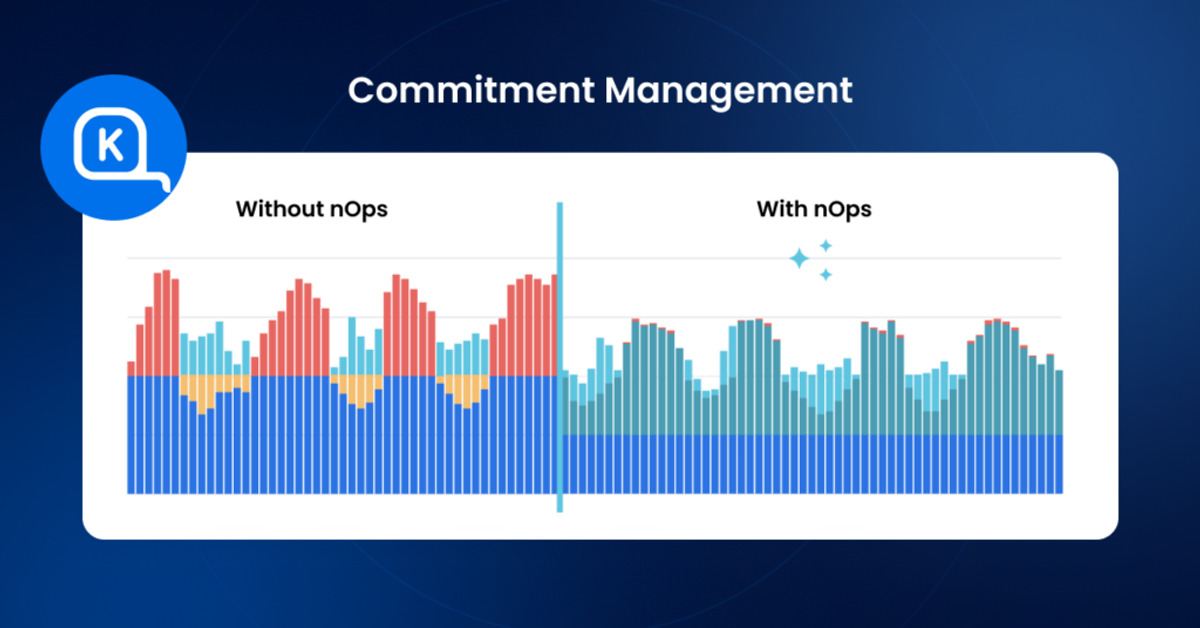
nOps is a multi-cloud cost optimization platform built for teams wanting continuous, autonomous savings execution without enterprise implementation overhead. The platform combines commitment optimization and cost visibility across AWS, Azure, and GCP with focus on speed-to-value and measurable outcomes.
What differentiates nOps from Flexera One:
- 5-minute setup with no infra changes vs. weeks-to-months implementation cycles
- Hourly commitment layering and rebalancing for industry-leading Effective Savings Rates, often 20% higher than competitors.
- Savings-based pricing (only pay when net new results are delivered) vs. potentially charging for existing commitments
- Single unified platform vs. multiple acquired modules with varying integration levels. AWS, Azure, GCP, AI and K8s visibility and optimization in one pane of glass.
- Free Savings Analysis to find out how much you can save in 30 minutes
Best for: Organizations looking for quick results on savings plus visibility in one unified platform
Pricing model: Savings-based. You only pay when net new results are delivered.
Pros: Fastest time-to-value in the category (immediate insights, savings activation within hours); truly autonomous commitment optimization; results-based pricing with no vendor lock-in; multi-cloud coverage without gaps (AWS, Azure, GCP for compute and database commitments)
Cons: Doesn't focus on ITAM, SAM, or the hybrid IT governance capabilities that Flexera One offers
Replaces: Flexera One's cloud cost and FinOps modules, especially commitment and rate optimization through ProsperOps.
Usage.ai
Usage.ai is a commitment optimization specialist built around Flex Insured Commitments, which pair automated purchasing with cashback protection for eligible underutilization, subject to program terms. It supports AWS, Azure and Google Cloud, and its closest Flexera counterpart is ProsperOps.
Best for: Teams whose main concern is the risk of over-committing, and who want commitment automation with financial protection.
Key capabilities
- Autopilot execution or CoPilot approval workflows, set by service
- Flex Insured Commitments with cashback for eligible underutilization
- Commitment coverage across AWS, Azure and Google Cloud
- Read-only connection to evaluate before granting purchasing permission
Pricing model: A percentage of the realized savings generated through its Flex Commitment Program.
Pros: Financial protection against underutilization, and a pricing model tied to savings.
Cons: Focused on commitments, so visibility, allocation and workload optimization sit elsewhere, and protection applies only to eligible commitments. See nOps's Usage.ai alternatives guide for the trade-offs in detail.
Replaces: Flexera's ProsperOps commitment management.
IBM Cloudability
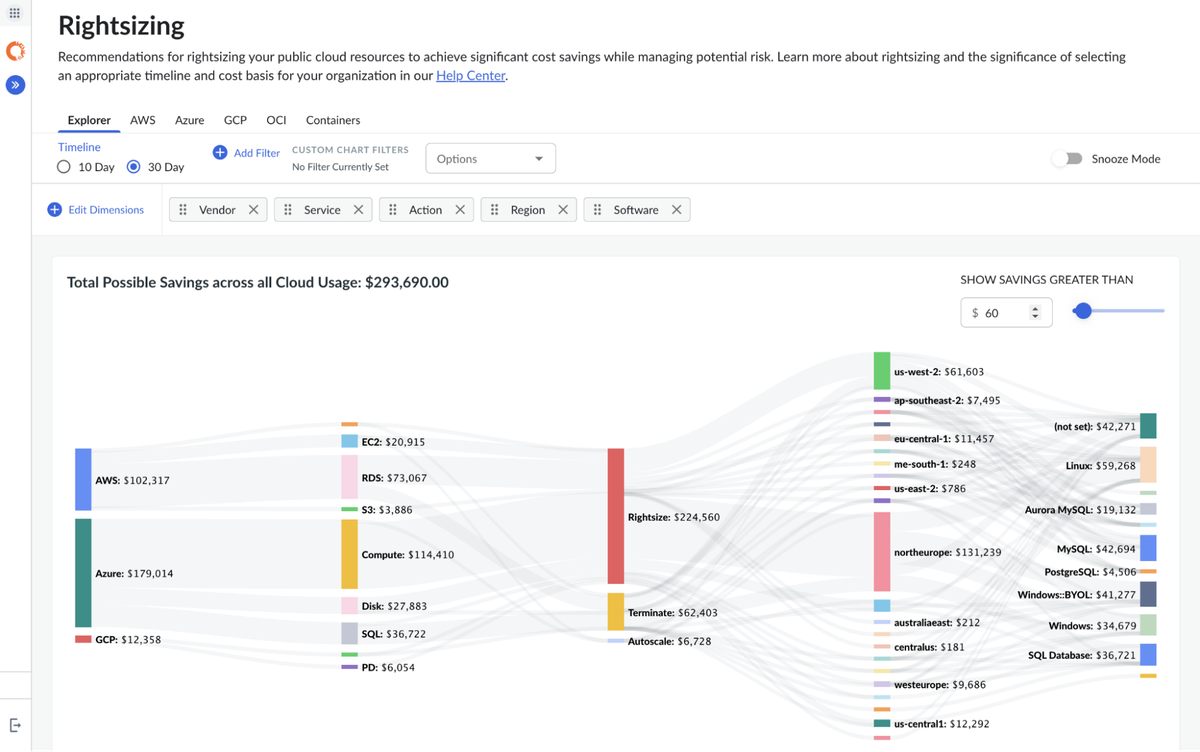
Cloudability (IBM Apptio) is a FinOps analytics and cost management platform emphasizing executive-level reporting, cost allocation, and FinOps maturity benchmarking across AWS, Azure, and GCP.
Best for: Enterprises prioritizing FinOps reporting and governance with internal teams executing recommendations.
Key capabilities
- Multi-cloud cost visibility (AWS, Azure, GCP)
- 100% cost allocation with business unit mapping and chargeback workflows
- FinOps maturity benchmarking against industry peers
- Technology Business Management (TBM) integration
- Executive dashboards and custom reporting
- Reserved Instance and Savings Plan recommendations
- Budget tracking, forecasting, and anomaly detection
- Policy-driven rightsizing recommendations
Pricing model: Enterprise pricing based on a percentage of spend.
Pros: Deep FinOps governance with strong cost allocation, benchmarking, and TBM integration for complex organizations requiring executive-level visibility.
Cons: Commitment management is advisory-only or an add-on through Cloudwiry, enterprise pricing with percentage-of-spend models, and longer implementation cycles than cloud-native alternatives.
Replaces: Flexera's cloud cost visibility, allocation and reporting.
Finout
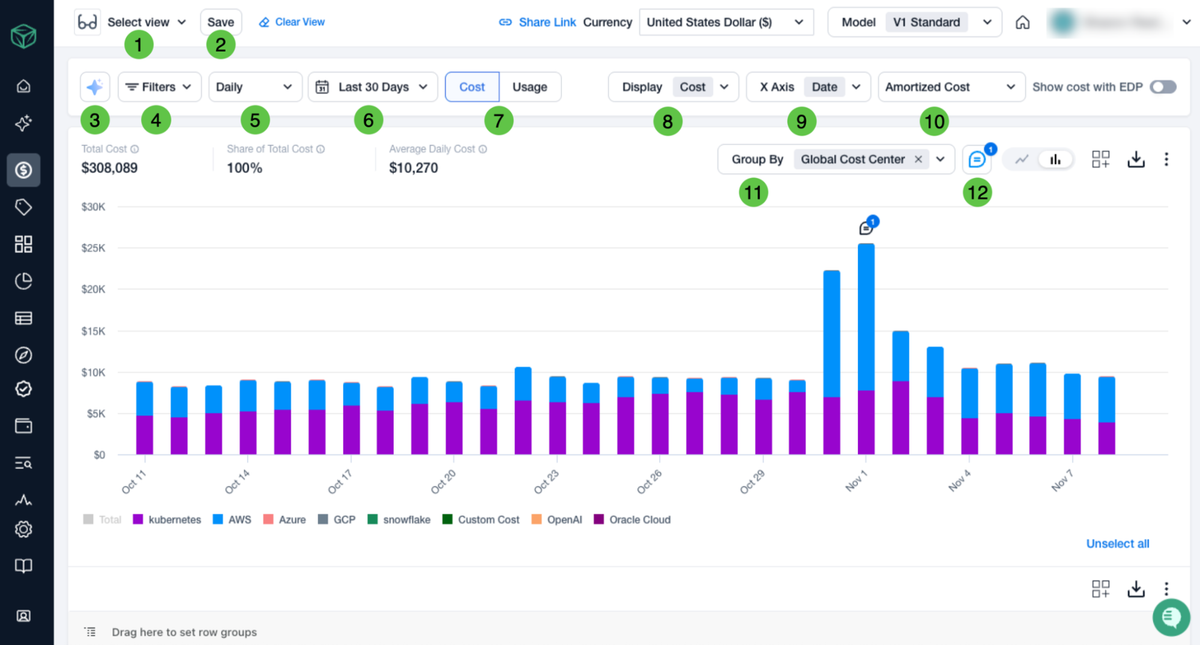
Finout is a cloud cost management platform extending beyond traditional AWS/Azure/GCP to include SaaS spend, data platforms (Snowflake, Databricks), and Kubernetes visibility. The platform emphasizes unit economics and developer-friendly interfaces.
Best for: Engineering-led organizations with diverse spend across cloud, SaaS, and data platforms that prioritize visibility and unit economics over automated optimization/savings.
Key capabilities
- Multi-cloud visibility across AWS, Azure, GCP
- SaaS cost tracking for 20+ providers (Datadog, Snowflake, MongoDB, etc.)
- Kubernetes cost allocation with pod-level granularity
- Unit economics (cost per customer, per transaction)
- Custom dashboards and real-time alerts
- FinOps Foundation alignment
Pricing model: Per-cluster or per-account.
Pros: Unified visibility across cloud, SaaS, and data platforms with strong unit economics features ideal for engineering-led SaaS organizations.
Cons: Commitment management is recommendation-based (not autonomous), with less depth in lifecycle automation compared to specialized commitment tools.
Replaces: Flexera's cloud cost visibility and allocation, plus data cloud and SaaS cost visibility.
CAST AI

Cast AI is a Kubernetes-first cloud cost optimization platform combining cluster rightsizing, Spot instance orchestration, and commitment management specifically for containerized workloads. The platform automates node selection, bin-packing, and cost-aware autoscaling.
Best for: Organizations where Kubernetes represents the majority of cloud spend.
Key capabilities
- Automated Kubernetes cluster rightsizing and bin-packing
- Intelligent Spot instance management with fallback orchestration
- Multi-cloud Kubernetes support (AWS EKS, Azure AKS, Google GKE)
- Commitment management for Kubernetes nodes
- Real-time cost visibility at pod, namespace, and workload levels
- Autoscaler integration (Cluster Autoscaler, Karpenter)
Pricing model: Per-cluster.
Pros: Purpose-built for Kubernetes with deep container optimization including automated bin-packing, Spot orchestration, and workload-aware resource allocation that other platforms handle manually.
Cons: Scope limited to Kubernetes with no coverage for non-containerized compute, storage, databases, or mixed VM/container architectures.
Replaces: Flexera Container Optimization (Ocean).
Archera
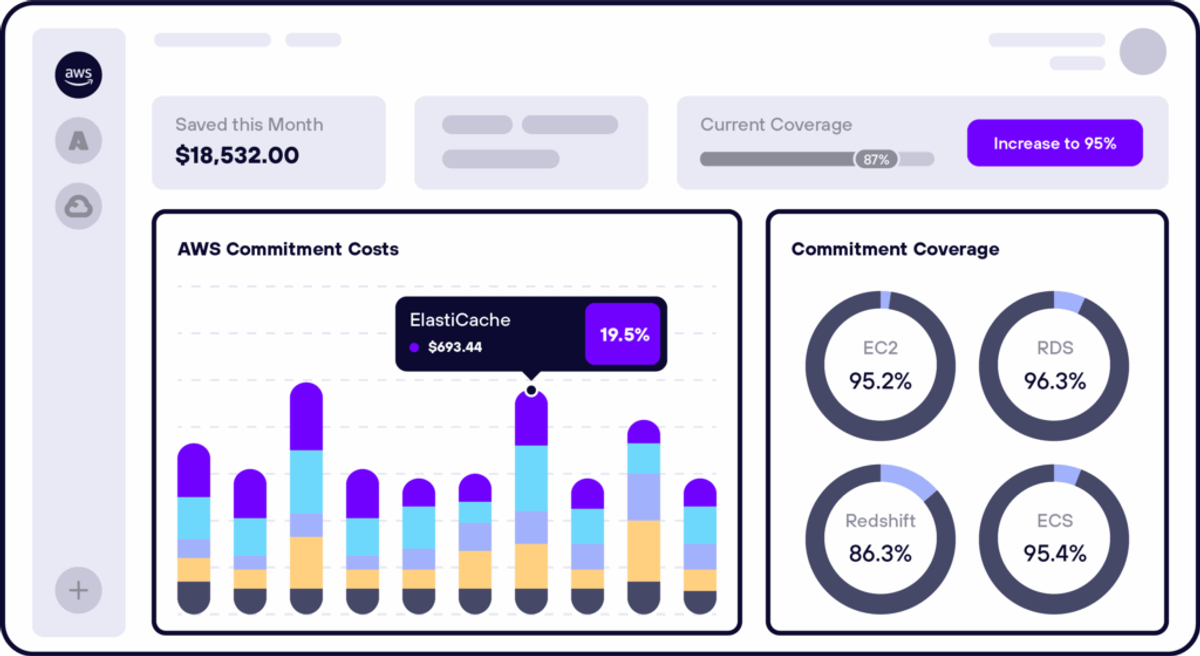
Archera specializes in Insured Commitments — cloud Reserved Instances, Savings Plans, and Committed Use Discounts wrapped with money-back guarantees and terms as short as 30 days.
Best for: Teams with established cost visibility seeking flexible, risk-free commitment automation.
Key capabilities
- Insured Commitments with money-back guarantees (30–40% savings, 30-day minimum terms)
- Automated commitment purchasing and lifecycle management
- Multi-cloud coverage (AWS, Azure, GCP)
- Convertible RI exchanges and short-term commitment flexibility
- Cost visibility and forecasting
- Integration with existing cloud billing workflows
Pricing model: Performance-based and flexible pricing models.
Pros: Unique insurance-backed commitment model eliminates long-term lock-in risk while delivering savings equivalent to 3-year commitments on 30-day terms.
Cons: Narrower scope than full-stack platforms with limited visibility and rightsizing features outside of commitment management.
Replaces: Flexera's ProsperOps commitment management.
Zesty
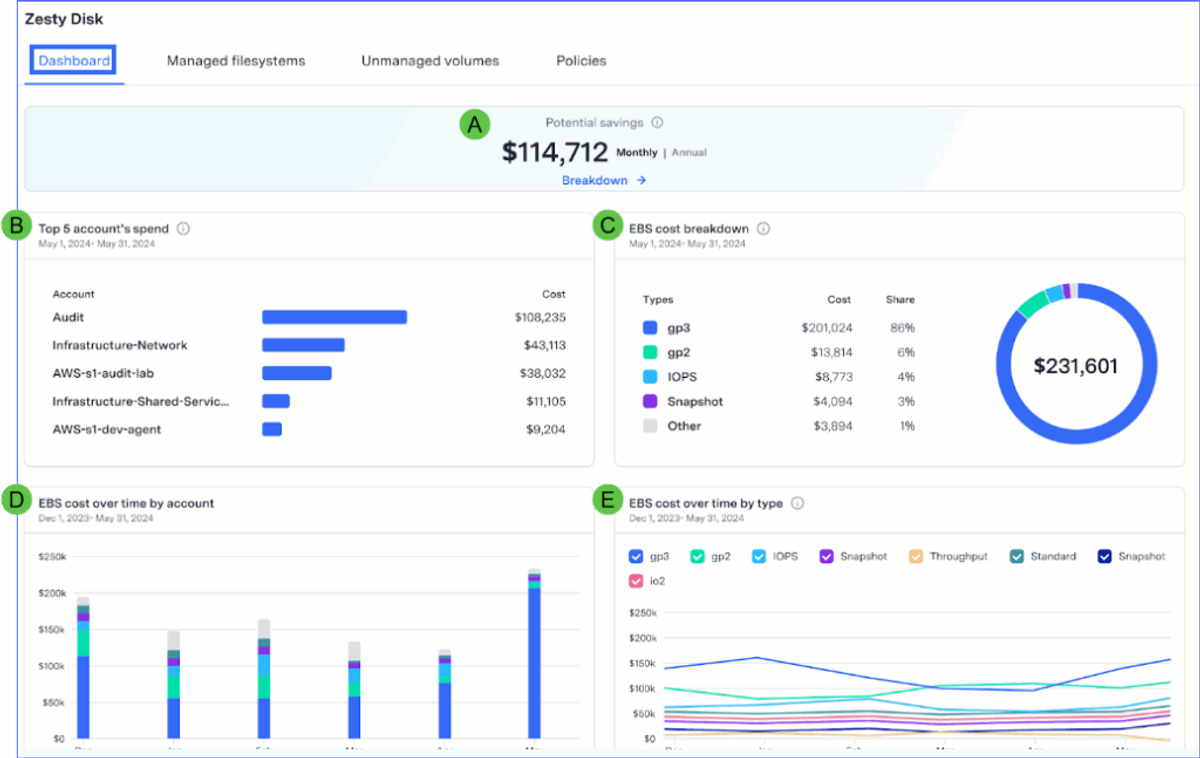
Zesty started with automated EBS storage management and now also offers Kompass for Kubernetes optimization and Commitment Manager for commitments. It supports AWS and Azure: Zesty Disk covers AWS EBS and Azure Managed Disks, and Zesty Insights covers AWS and Azure services. Zesty's documentation says Commitment Manager currently supports AWS EC2, including EKS and ECS backed by EC2, while its website also lists Azure commitment optimization. Google Cloud support is not documented.
Best for: AWS-heavy teams, or AWS and Azure teams, with significant Kubernetes or block storage spend.
Key capabilities
- Automated EBS volume rightsizing and dynamic scaling, plus Azure Managed Disks
- Kompass for pod rightsizing, headroom reduction and persistent volume scaling
- Commitment Manager for AWS EC2 commitments
- Real-time disk performance monitoring
- One-click deployment with CloudFormation
Pricing model: Usage-based for Kompass and Zesty Disk and savings-based for Commitment Manager, as covered in nOps's Zesty pricing guide.
Pros: Unique ability to automatically shrink EBS volumes (addressing a native AWS limitation) with dynamic runtime storage management other platforms handle manually.
Cons: Cloud coverage stops at AWS and Azure, and the scope is narrower than full-stack platforms.
Replaces: Flexera's workload and container optimization, and AWS EC2 commitment management.
Datadog
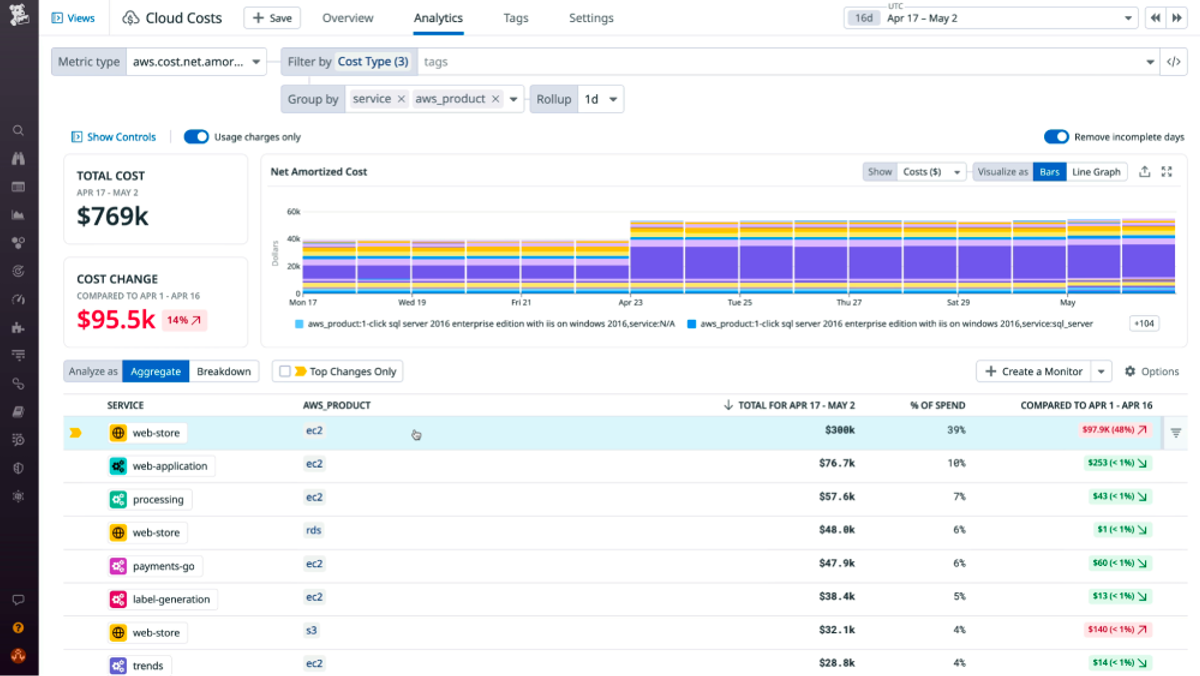
Datadog is primarily an observability and monitoring platform, but includes cloud cost tracking features that integrate with infrastructure metrics, APM, and log analytics. This allows teams to correlate performance and cost data in one interface.
Best for: Engineering teams already using Datadog for observability.
Key capabilities
- Cloud cost tracking for AWS, Azure, and GCP
- Cost allocation by service, team, or environment using tags
- Cost anomaly detection integrated with performance monitoring
- Rightsizing recommendations based on actual resource utilization
- Unified view of cost, performance, and reliability metrics
Pricing model: Percentage of spend.
Pros: Already deployed in many organizations for observability, enabling cost-performance correlation (e.g., "this service costs $X with Y% error rate") without adding another vendor.
Cons: Cost management is a feature (not the core product), no commitment lifecycle automation, and Datadog itself represents a significant cost line item for many teams.
Replaces: Flexera's cloud cost visibility, for teams that already run Datadog.
Densify (now Kubex)
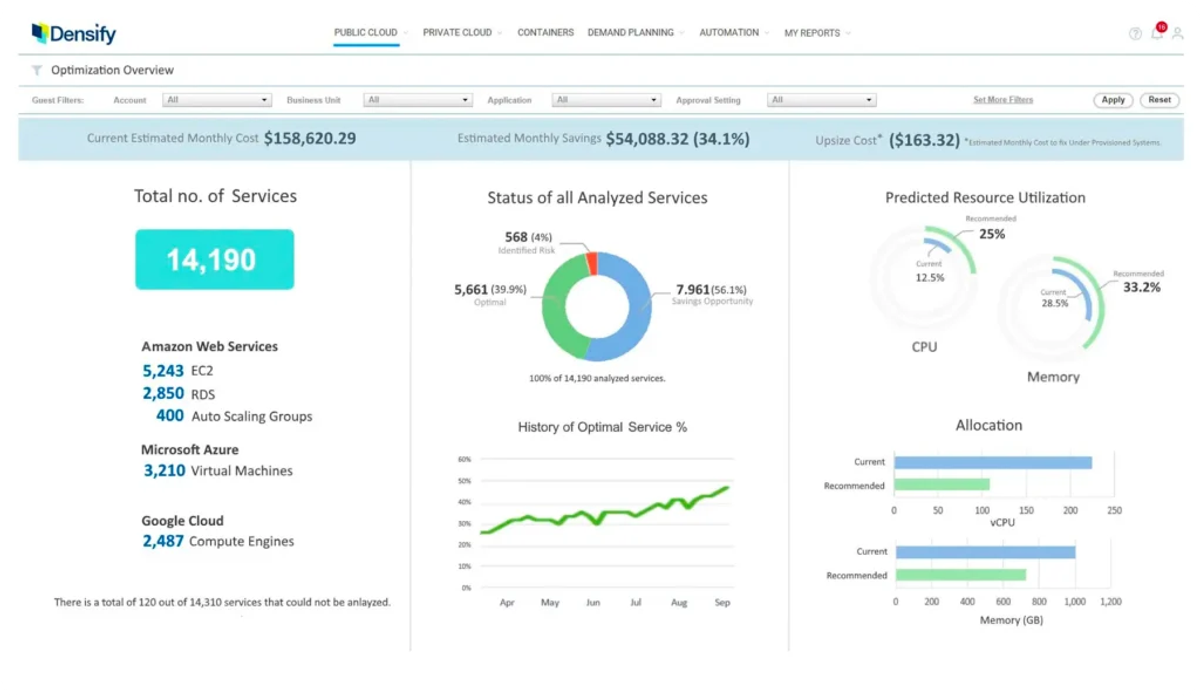
Densify rebranded as Kubex on January 1, 2026. The change was a company-wide rebrand, not an acquisition, and Kubex now focuses on automated resource optimization for Kubernetes, GPU and AI workloads across cloud and on-premises infrastructure.
Best for: Enterprises with Kubernetes or GPU-heavy estates needing accurate rightsizing, including hybrid environments.
Key capabilities
- Rightsizing for Kubernetes containers and node optimization
- GPU optimization, with coordinated CPU, memory, storage and GPU recommendations
- Guardrail-based automation to execute approved optimization actions
- Auto Scaling group and VM scale set optimization, plus RDS optimization
- Support for AWS, Azure, GCP and Oracle, and for EKS, AKS, GKE, OpenShift and other Kubernetes platforms, in the cloud or on-prem, per Kubex's pricing page
Pricing model: Published usage-based pricing. The Kubernetes Resource Optimization plan is $1 per vCPU per month, with a 60-day free trial, and an Enterprise plan adds GPU optimization at custom pricing.
Pros: Published pricing and broad platform support, with a focus on safe, policy-controlled automation.
Cons: Focused on resource optimization, so commitment management and ITAM sit elsewhere.
Replaces: Flexera Container Optimization (Ocean) and workload optimization.
Umbrella (formerly Anodot)
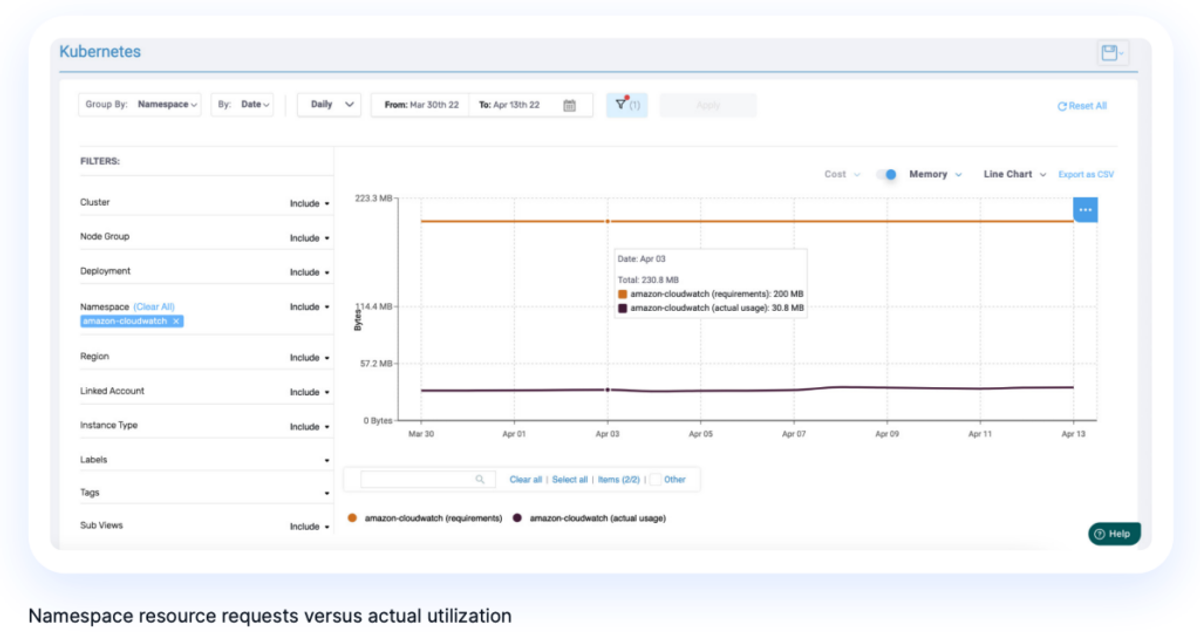
Anodot formed a business unit called Umbrella in April 2025, and Anodot's own site now says its cloud cost optimization is now Umbrella. The Umbrella platform is a cloud cost management product for MSPs and enterprises that emphasizes AI-powered anomaly detection and forecasting. It monitors cost patterns and alerts teams to unexpected changes before they compound.
Best for: Organizations prioritizing fast anomaly detection with internal teams executing recommendations.
Key capabilities
- AI-driven anomaly detection for cost spikes
- Multi-cloud cost visibility (AWS, Azure, GCP)
- Rightsizing and commitment recommendations
- Cost forecasting and budget tracking
- Kubernetes cost allocation
- Integration with FinOps workflows
Pricing model: Percentage of spend.
Pros: Strong AI-powered anomaly detection catches cost issues other platforms miss with fast alert-to-action workflows for real-time spend changes.
Cons: Recommendation-driven commitment management (not autonomous) with less execution depth than platforms offering continuous optimization, and percentage-of-spend pricing model.
Replaces: Flexera's cost visibility and anomaly detection.
Azure Cost Management / AWS Cost Explorer (native baseline)
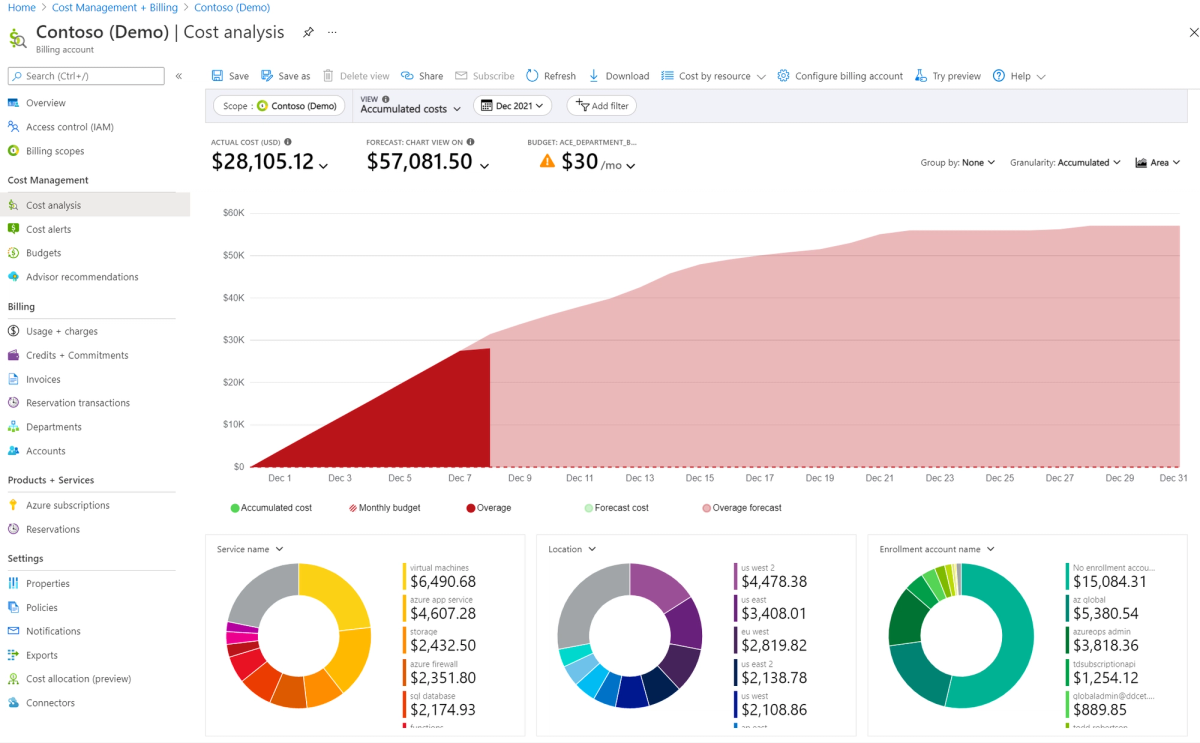
Azure Cost Management and AWS Cost Explorer are the native cost tools from Microsoft and Amazon. Both are free for their customers and integrate directly with the Azure portal and AWS console workflows.
Best for: Organizations on a single cloud with basic cost management needs.
Key capabilities
- Azure Cost Management covers cost analysis, budgets and threshold alerts, Azure Advisor rightsizing recommendations, and allocation by subscription, resource group or tags
- AWS Cost Explorer covers cost and usage reports with customizable filters, forecasting from historical spend, cost anomaly detection, and AWS Budgets integration
- Both provide Reserved Instance and Savings Plan recommendations
Pricing model: Free for their respective cloud customers.
Pros: Free with native console integration, real-time visibility without third-party data ingestion, and sufficient for single-cloud organizations with basic needs.
Cons: Each covers only its own cloud (no multi-cloud or cross-provider visibility), recommendation-only for commitments and rightsizing, and limited depth for complex FinOps workflows.
Replaces: Basic cost visibility, as the native baseline against which to judge any paid tool.
Feature Comparison Table
This table puts Flexera One next to every tool in the guide. A dash means the capability is not a documented focus of the product.
Platform | ITAM/SAM | SaaS management | Cloud FinOps | Commitment automation | Kubernetes | Multi-cloud | Time to value | Pricing model |
|---|---|---|---|---|---|---|---|---|
Flexera One | Yes | Yes | Yes | Yes (ProsperOps) | Yes (Container Optimization) | AWS, Azure, GCP and regional providers | Weeks to months | Quote; metered per module |
ServiceNow | Yes | - | - | - | - | - | Discovery-led rollout | Subscription by assets or users |
USU | Yes | - | - | - | - | - | Discovery-led rollout | Subscription by assets, users or devices |
Ivanti | Yes | - | - | - | - | - | Discovery-led rollout | Platform fee plus per license |
Eracent | Yes | Partial | - | - | - | - | Discovery-led rollout | Annual subscription (quote) |
ManageEngine AssetExplorer | Yes | - | - | - | - | - | Discovery-led rollout | Annual, by IT asset count |
Snow Software | Yes | Yes | - | - | - | - | Discovery-led rollout | Quote from Flexera |
Certero | Yes | Partial | - | - | - | - | Discovery-led rollout | Subscription by devices or users |
CloudEagle.ai | - | Yes | - | - | - | - | 30-minute onboarding (vendor-cited) | Subscription (tailored) |
Zylo | - | Yes | - | - | - | - | - | Custom quote |
Torii | - | Yes | - | - | - | - | - | Tailored quote |
nOps | - | Partial | Yes | Hourly autonomous | Partial (visibility) | AWS, Azure, GCP | 5 minutes | Savings-based |
Usage.ai | - | - | Partial | Autopilot or CoPilot | - | AWS, Azure, GCP | Read-only evaluation first | Share of savings |
IBM Cloudability | - | - | Yes | Add-on (Cloudwiry) | - | AWS, Azure, GCP | Weeks | Percentage of spend |
Finout | - | Partial (SaaS costs) | Yes | Recommendation-driven | Partial (allocation) | AWS, Azure, GCP | Days | Per-cluster/account |
CAST AI | - | - | Partial | Kubernetes nodes | Yes | AWS, Azure, GCP (K8s) | Days | Per-cluster |
Archera | - | - | Partial | Yes | - | AWS, Azure, GCP | Days | Flexible pricing |
Zesty | - | - | Partial | AWS EC2 | Yes (Kompass) | AWS, Azure | Hours | Usage-based + savings-based |
Datadog | - | - | Partial | Recommendation-only | - | AWS, Azure, GCP | Already deployed | Percentage of spend |
Densify (now Kubex) | - | - | Partial | Recommendation-driven | Yes | AWS, Azure, GCP, Oracle | Weeks | $1/vCPU/month (Kubernetes plan) |
Umbrella (formerly Anodot) | - | - | Yes | Recommendation-driven | Partial (allocation) | AWS, Azure, GCP | Weeks | Percentage of spend |
Azure Cost Management / AWS Cost Explorer | - | - | Partial | Recommendation-only | - | Single cloud each | Instant (native) | Free |
How to Choose the Right Flexera Alternative
Start from the function you use most, then decide how much of Flexera One you want to replace at once. The four questions below separate most shortlists.
ITAM-led vs FinOps-led requirement
If vendor audits and license position drive the purchase, shortlist from the software asset management segment and judge tools on publisher coverage for Microsoft, Oracle, IBM and SAP. If the cloud bill drives it, shortlist from the FinOps segment. The FinOps Foundation and the ITAM Forum formed a strategic partnership in June 2025 to bring cloud cost management and software compliance closer together, but the tools in each segment are still built around different data, so most teams pick by the larger of the two problems.
Enterprise governance vs automation-first
Flexera's cloud cost module is built around collaboration between governance teams and business units, with allocation for chargeback and showback. Automation-first platforms such as nOps, Usage.ai and Archera execute commitment purchases and rebalancing themselves. The ITAM Review's advice for going autonomous is a useful checklist: know who authorizes purchases, where the kill switch is, where the audit trail lives, and how optimization is prevented from degrading performance.
Single-vendor consolidation vs best-of-breed
Consolidating on Flexera One reduces vendor count, but each module has its own license metric and its own rollout, and reviewers on the AWS Marketplace listing describe the initial setup as complex. Best-of-breed pairs an ITAM or SaaS tool with a FinOps platform that connects through a billing integration, which keeps cloud cost savings from waiting on a wider ITAM project.
Mid-market vs enterprise
Flexera One skews toward large organizations: 73.5% of its G2 reviews come from the enterprise segment, and its published entry prices start at $50,000 a year for the spend-tiered package. Mid-market teams usually get further with savings-based or usage-based FinOps pricing and, on the ITAM side, tools with published prices such as ManageEngine AssetExplorer.
Why nOps Is the Best Flexera Alternative for Cloud Cost
Flexera One delivers breadth — spanning ITAM, SAM, cloud cost, and SaaS governance across hybrid environments. But breadth comes with trade-offs: longer implementation cycles, multiple data models, and, outside the ProsperOps+ bundle, pricing that scales with spend rather than results.
nOps was built to deliver deeper commitment automation, faster onboarding, and better pricing alignment than Flexera's suite-based approach. It sets up in 5 minutes across AWS, Azure and GCP, with no infra changes and no months of implementation. Commitments are bought and rebalanced hourly, so optimization runs continuously instead of ending at a report. We optimize, and you get the credit — customers have described it as being like picking $20 bills off the ground. For a side-by-side view, see Flexera vs nOps.
You can book a 30-minute Free Savings Analysis to find out if you’re already perfectly optimized or if we can find you more incremental effort-free savings.
nOps manages $5 billion in AI and cloud spend and was recently ranked #1 in G2's Cloud Cost Management category.
Demo
AI-Powered Cost Management Platform
Discover how much you can save in just 10 minutes!
Book a Demo
Frequently Asked Questions
These are the questions people ask most often about Flexera and the tools that compete with it.
Is Flexera a FinOps tool?
Partly. Flexera One includes a FinOps solution with cloud cost optimization, rate optimization through ProsperOps, workload optimization and data cloud optimization, but the company's heritage is ITAM and SAM, and its FinOps products came mostly through acquisitions. The Flexera One platform also covers ITAM and SaaS management, so reviews of it span several categories.
Who owns Flexera Software LLC?
Thoma Bravo holds the majority stake. It agreed to buy the majority in December 2020, with TA Associates and Ontario Teachers' Pension Plan remaining meaningful shareholders. Thoma Bravo also took a majority stake in USU's product business in 2024.
Are FlexNet and Flexera the same?
No. Flexera is the company, and FlexNet is a family of its products, including FlexNet Manager Suite, the on-premises SAM product. Flexera One is the SaaS platform that consolidates SAM, ITAM, cloud cost management and SaaS management, and Flexera customers have moved from FlexNet Manager Suite to Flexera One, as in this European insurer's migration in under a week.
What is Flexera web metering?
Flexera Web Metering is a browser extension that tracks web application use for license compliance and cost optimization. It works with the FlexNet Inventory Agent or Snow Inventory Agent and collects only the URLs of visited sites that relate to licensable web applications.
Who are Flexera's main competitors?
It depends on the module. For ITAM and SAM, Gartner Peer Insights lists ServiceNow, Ivanti, USU, ManageEngine and Certero among Flexera One alternatives. For SaaS management, the main competitors are Zylo, CloudEagle.ai and Torii. For cloud FinOps, they include nOps, Usage.ai, IBM Cloudability, Finout, Cast AI and Archera.
What companies use Flexera?
Flexera says more than 50,000 organizations rely on Flexera and its Technopedia library. Its published case studies include Chegg and Ticketmaster for workload optimization, and enterprises such as AstraZeneca, DBS Bank, Carlsberg and Northern Trust for IT asset management.
Why do companies switch from Flexera?
The most common reasons are setup time, pricing and scope. Reviewers describe Flexera One's initial setup as complex, each module is metered on a different license metric, and the FinOps products arrived through acquisitions that are still being integrated. Teams that only need one part of the suite, such as cloud cost or SaaS management, often move to a tool built for that job.
Is Flexera One good for FinOps or ITAM?
Both, but ITAM and SAM are its core. Flexera began as a software licensing company and is established for license compliance, audit defense and hybrid IT governance. Its FinOps products came mostly through acquisitions: Flexera One Cloud Cost Optimization covers visibility and allocation, and commitment management comes from ProsperOps. Teams whose main problem is the cloud bill usually evaluate FinOps-native tools alongside it.
How does Flexera pricing compare to alternatives?
Flexera's published AWS Marketplace prices work out to roughly 2.7% to 5% of cloud spend under management, with entry points of $1,000 a month or $50,000 a year and 12-, 24- or 36-month contracts. Alternatives: nOps uses savings-based pricing (pay for results only), Usage.ai charges a share of realized savings, Kubex publishes $1 per vCPU per month for Kubernetes optimization, and native tools (AWS Cost Explorer, Azure Cost Management) are free. Savings-based models align better.
What's the best Flexera alternative for automated cost optimization?
nOps manages commitments hourly and autonomously across AWS, Azure and GCP, sets up in 5 minutes and charges only on the savings it delivers. Usage.ai and Archera are the other commitment-focused options, and Cast AI, Kubex and Zesty cover Kubernetes and storage optimization.
Discover how much you can save in just 10 minutes. Book a demo and see nOps on your own cloud bill.