
Best SaaS Spend Management Tools (2026)
Organizations now spend an average of $55.7 million a year on SaaS, 8% more than the year before. However, organizations are aware of only 30 to 50% of the SaaS applications actually in use (Gartner), and the bill itself has changed shape: alongside seat licenses that renew once a year, a growing share of software is now metered by usage, from AI coding assistants to API tokens to data platform credits. Most SaaS management tools were built to track seat licenses and are still catching up to the usage-based part of the bill.
This guide explains everything you need to know about SaaS spend management and compares 19 SaaS spend management tools, grouped by the approach each one takes.
What Is SaaS Spend Management?
SaaS spend management is the practice of finding every software subscription a company pays for, tracking what each one costs and how much it is used, and acting on that data through renewals, license changes, budgets and approvals. It covers traditional seat-based subscriptions like a CRM or design tool, and increasingly the usage-based charges that come with AI tools and data platforms.
The tools built for it overlap with several neighboring categories. That overlap is why buyers comparing SaaS spend management software often end up looking at products that do quite different jobs.
SaaS spend management vs SaaS management platforms
SaaS management platforms (SMPs) cover the whole application lifecycle: discovery, access, provisioning, offboarding, security and spend. Gartner tracks them as their own market, and its 2026 Magic Quadrant evaluated 16 vendors. SaaS spend management is the financial part of that work. Most SMPs include spend features, but a team that only needs spend control can also choose a procurement, finance or FinOps tool with no access management at all.
SaaS spend management vs expense and procurement tools
Expense management tools record what employees spent after the fact, and procurement tools control how new purchases get requested and approved. Both touch software, since subscriptions are often bought on a corporate card or through a purchase request, but neither on its own tracks whether licenses get used or when a contract renews. Several corporate card and procurement platforms have added subscription tracking on top of their core product, which is why some of them appear in this list.
SaaS spend management vs cloud cost management
Cloud cost management tools work at the infrastructure layer: compute, storage, Kubernetes and the AI models running in AWS, Azure and Google Cloud. G2 draws the line the same way, describing SaaS spend management as application-layer and cloud cost management as infrastructure-layer.
The two categories meet wherever SaaS is metered like infrastructure. A Snowflake or Databricks contract, an AI coding tool billed partly by usage, or a SaaS product bought through a cloud marketplace that burns down a cloud commitment all behave more like a cloud bill than a seat license. FinOps platforms handle that usage-based spend well, while finding unsanctioned apps through SSO logs and expense reports remains the job of SaaS management platforms.
Why SaaS Spend Gets Out of Control
Gartner puts growth in SaaS spend per employee at 25% a year, with up to 30% of licenses unused or underused. That growth comes from a few patterns that show up at almost every company:
- Teams buy software on corporate cards and expense reports without going through IT or procurement, so no one holds a complete list of what the company pays for.
- Licenses outlive the people and projects they were bought for, and different teams buy overlapping tools for the same job.
- Contracts renew automatically, often with built-in price increases, and the renewal date passes before anyone reviews usage.
- More software is billed by usage instead of seats, so the cost moves month to month and can't be fixed at signing. In Zylo's 2026 SaaS Management Index, 78% of IT leaders reported unexpected charges tied to consumption or AI pricing.
What SaaS Spend Management Tools Do
Every SaaS tool in this guide does some version of the six jobs below. Where they differ is which job the product was built around, and that is how the tool list later in this guide is grouped.
Discovery
Discovery builds the inventory of every app in use, including ones IT never approved. Tools pull from several sources: finance systems and expense reports show what the company pays for, SSO and identity providers show who logs in, browser extensions and endpoint agents catch apps used outside SSO, and direct API connections give license-level detail. No single source finds everything, which is why vendors like Flexera combine browser, CASB, SSO, API and financial data. Discovery from payment data alone misses free tools, and discovery from SSO alone misses anything bought on a card.
License and usage tracking
Usage tracking compares what you pay for against what people actually use, measured by last login, active days, feature use or seat tier. It is how teams find inactive SaaS licenses, users on a higher tier than they need and two tools doing the same job. The quality depends on the integration: a direct API connection to an app can report activity per user, while SSO data only shows that someone signed in. Some platforms act on the data automatically, reclaiming or downgrading a license once usage drops below a threshold.
Renewals and contracts
Contract tracking keeps renewal dates, notice periods, price increase clauses and committed spend in one place, with alerts early enough to renegotiate or cancel. Some tools now extract terms from uploaded contracts and invoices automatically. For usage-based contracts the number that matters is burndown, meaning how much of a committed amount has been consumed and whether the company is on pace to overspend or leave part of it unused.
Budgets, approvals and spend limits
Budgets and approvals stop spend before it happens instead of reporting it afterward. Procurement-led tools route new purchases through intake forms and approval chains, and card-based tools issue a virtual card per subscription with a hard limit. For usage-billed tools the control point moves to the seat: a spend limit per person, a budget per team and a workflow for raising a limit when someone needs more.
Benchmarking and negotiation
Benchmarking compares what you pay against what similar companies pay for the same product. Vendors build these datasets from the contracts they see across their customer base, and some pair them with procurement specialists who negotiate renewals on your behalf. It matters most for companies with a few large contracts coming up for renewal, where a few percentage points on price is real money.
AI and usage-based spend tracking
AI tools do not fit the seat-license model most SaaS management was built on. An enterprise AI subscription or coding assistant can combine a seat fee with usage charges that vary several times over between users, and API access is billed entirely per token. The FinOps Foundation reports that managing the cost of tokens in SaaS-model AI is currently the top challenge its practitioners face.
Tracking this spend means pulling usage data from each provider, attributing it to people and teams, and comparing it against budgets daily instead of at renewal. For engineering tools it also means asking what the spend produced, which is the subject of our guides to AI cost observability and AI coding ROI.
Best SaaS Spend Management Tools
The 19 tools below are grouped by the approach each one takes to SaaS spend, with the larger platforms first in each group. The approaches are complementary more often than they compete, and many companies pair a SaaS management platform for discovery and licenses with a procurement, finance or FinOps tool for the part of the bill that platform covers less well.
SaaS spend management platforms at a glance
This table summarizes each tool's approach and the buyer it fits best.
Tool | Approach | Best for |
|---|---|---|
Zylo | Discovery-led | Large enterprises with a SAM or procurement team managing big SaaS portfolios |
Torii | Discovery-led | IT teams that want browser-based discovery and lifecycle automation together |
Flexera One | Discovery-led | Enterprises already using Flexera for software licensing and IT asset management |
ServiceNow | Discovery-led | Companies running IT service management on ServiceNow |
Vertice | Procurement and negotiation-led | Teams that want to hand off negotiations to procurement specialists |
Tropic | Procurement and negotiation-led | Procurement teams that run their own negotiations with market data |
Spendflo | Procurement and negotiation-led | Mid-size companies building a procurement function |
SpendHound | Procurement and negotiation-led | Growing companies that want free benchmarks and negotiation help |
Ramp | Finance and payment-led | Companies already running cards and bills on Ramp |
Airbase | Finance and payment-led | Mid-market companies that want one approval flow for non-payroll spend |
Cledara | Finance and payment-led | Scale-ups whose SaaS spend sits on company cards |
CloudEagle | Identity and security-led | Companies that want spend, access and AI policy from one vendor |
1Password SaaS Manager | Identity and security-led | 1Password customers bringing shadow IT and AI tools under access policies |
Zluri | Identity and security-led | IT teams running access governance and license optimization together |
BetterCloud | Identity and security-led | IT teams focused on automating onboarding and offboarding |
nOps | Usage-based and AI spend governance | Companies where AI and usage-based software are a large or growing share of spend |
Vantage | Usage-based and AI spend governance | Engineering-led teams that want fast self-serve setup |
CloudZero | Usage-based and AI spend governance | SaaS companies focused on unit costs per customer or feature |
Finout | Usage-based and AI spend governance | Finance-led FinOps teams that want one allocated view of cloud and AI costs |
Discovery-led platforms
Discovery-led platforms start by finding every app in use, then build license tracking, renewals and automation on top of that inventory. They are the closest match to what most people mean by SaaS spend management solutions, and the strongest choice when the main problem is not knowing what the company pays for. Most of them added AI and consumption tracking over the past year, and their depth there varies.
1. Zylo, best for large enterprise SaaS portfolios
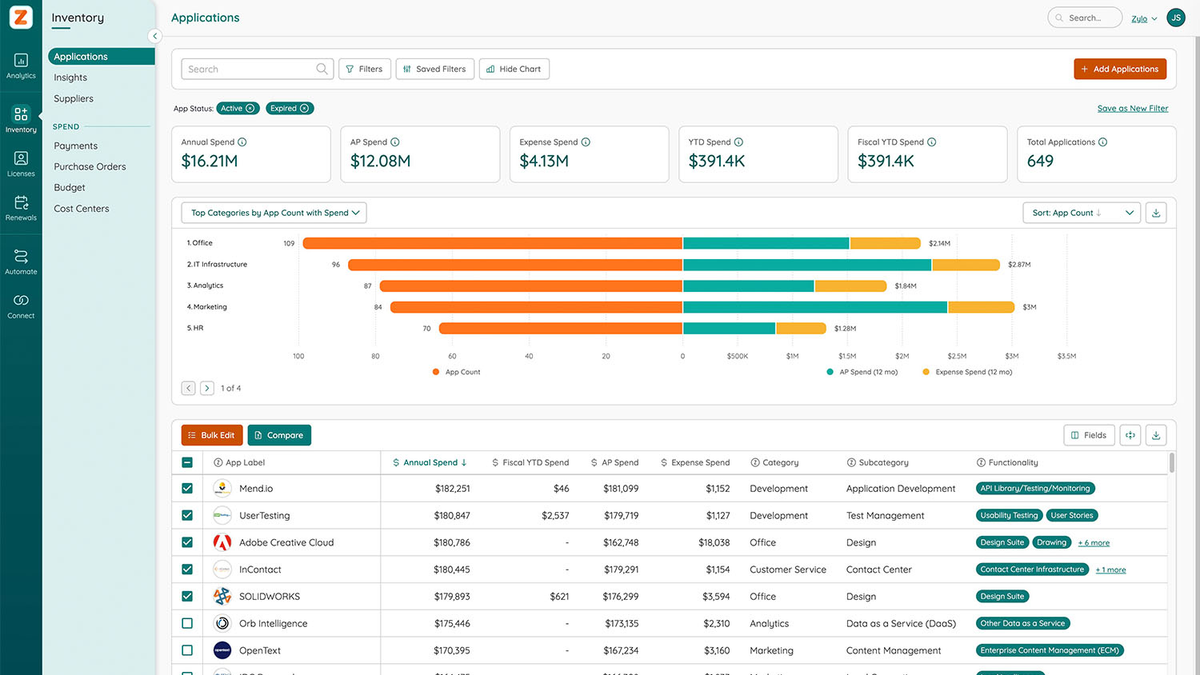
Zylo is an enterprise SaaS management platform built as a system of record for software spend. It discovers applications by connecting to finance and expense systems such as Coupa, NetSuite, SAP Concur and Workday, then adds usage data from SSO and direct app integrations. Gartner named Zylo a Leader in its 2026 Magic Quadrant for SaaS Management Platforms.
In April 2026 Zylo launched Consumption Cost Management, which tracks usage-based spend from OpenAI, Anthropic, Databricks, Snowflake and Google Vertex AI against contract commitments. It also offers negotiation services and publishes an annual SaaS Management Index. Zylo fits large enterprises with big portfolios and a software asset management or procurement team to run it.
- Zylo Clarity AI identifies savings opportunities and, according to Zylo, drafts and runs the workflow to capture them.
- Its pricing benchmarks draw on more than $100 billion in AI, SaaS and cloud spend data.
- An MCP server makes Zylo's spend and contract data available inside the AI tools a team already uses.
2. Torii, best for discovery plus lifecycle automation
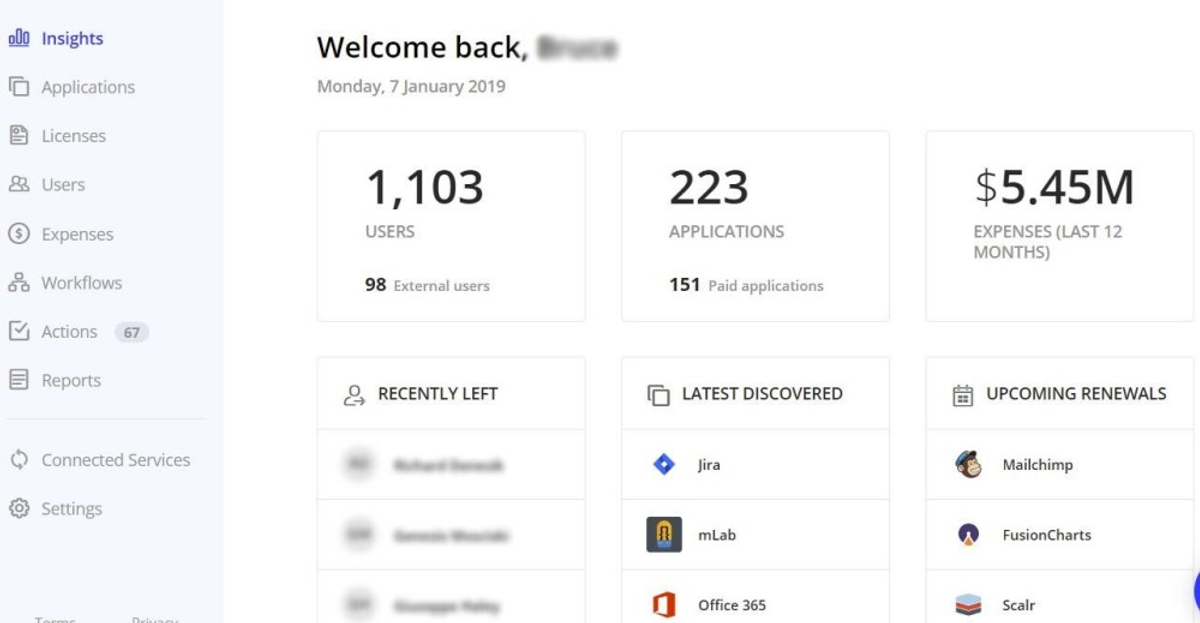
Torii, now a Freshworks company, approaches discovery from the browser, using an extension to catch apps that never show up in SSO or finance systems, and ties each app to its owner, usage and spend. Its workflow engine automates onboarding, offboarding and license reclamation, and Torii says it has been named a Leader in Gartner's Magic Quadrant three years in a row.
Its AI Dashboard, launched in May 2026, brings AI usage, spend and security risk into one view and flags teams paying for overlapping AI coding tools. Torii suits IT teams that want discovery and lifecycle automation in the same product.
- Detects shadow IT from OAuth grants, catching apps employees sign in to with their Google or Microsoft accounts.
- AI contract ingestion reads uploaded contracts, detects renewal clauses and alerts owners before an auto-renewal.
- Breaks token usage down by user and model, monitors keys, tokens and agents, and forecasts AI spend.
- Routes access requests to app owners with SLAs and single or dual approvals, requested in the app or over chat.
3. Flexera One, best for existing Flexera customers
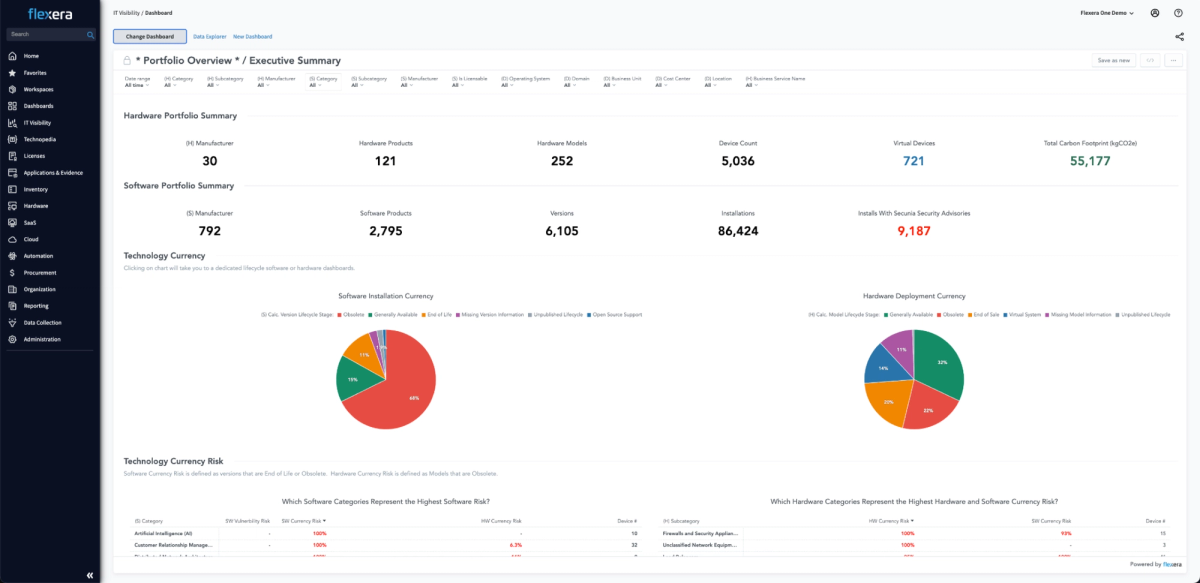
Flexera One SaaS Management sits inside Flexera's broader platform for IT asset management and FinOps, which also covers on-premises software licensing and cloud costs. It discovers SaaS through browser, CASB, agent, SSO, API and financial data, and keeps contract details current with AI-based invoice and contract ingestion plus integrations with procurement systems such as SAP Concur and Coupa.
Flexera was named a Leader in Gartner's 2026 Magic Quadrant for the second consecutive year. It is the natural choice for enterprises already using Flexera for software licensing that want SaaS managed in the same system.
- Combines online and installed usage for hybrid apps such as Microsoft 365 and Adobe Creative Cloud, and ties it to contract and financial data.
- Recommends a cheaper bundle when users only need part of an expensive SaaS subscription.
- Targets SaaS spend optimization on the largest enterprise vendors, including ServiceNow, Salesforce and Microsoft.
- Related modules optimize Databricks spend and detect double payments between pay-as-you-go and bring-your-own-license cloud software.
4. ServiceNow, best for companies running ServiceNow
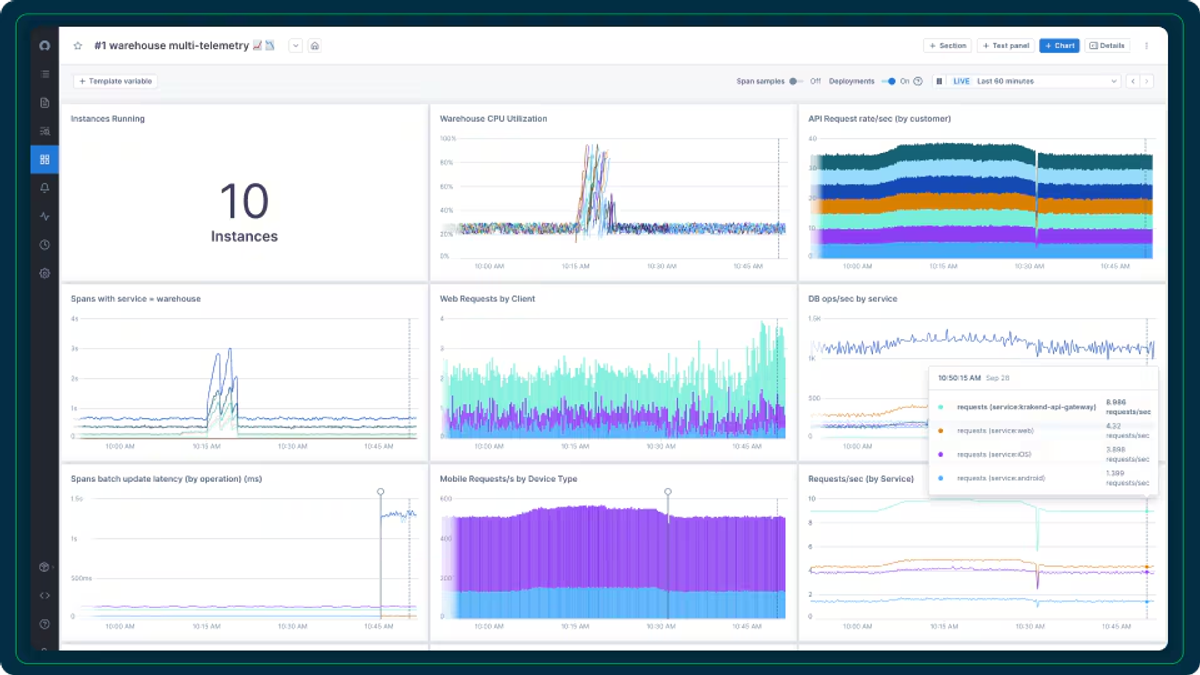
ServiceNow SaaS License Management extends ServiceNow's Software Asset Management into SaaS. It detects shadow IT from URLs accessed on endpoint devices, flags overlapping software, and finds unmanaged spend in imported financial data, with license reclamation running through the same workflows IT already uses for requests and approvals.
ServiceNow moved from Niche Player to Leader in Gartner's 2026 Magic Quadrant. It makes the most sense for companies that already run IT service management on ServiceNow and want SaaS in the same place.
- Connects directly to popular SaaS vendors, with low-code API connections for apps that lack an out-of-the-box integration.
- Reads SSO apps in Okta and Azure AD to tie software to the people signing in.
- Uses usage analysis to rightsize license types, moving people off premium tiers they don't use.
Procurement and negotiation-led platforms
Procurement-led platforms focus on the moment money gets committed: new purchase requests, renewals and negotiations. They combine intake and approval workflows with pricing benchmarks built from contracts across their customer base, and several include procurement specialists who negotiate on your behalf. They fit companies whose cost savings come mainly from a set of large contracts, and they do less of the day-to-day license and software usage work.
5. Vertice, best for outsourced negotiations
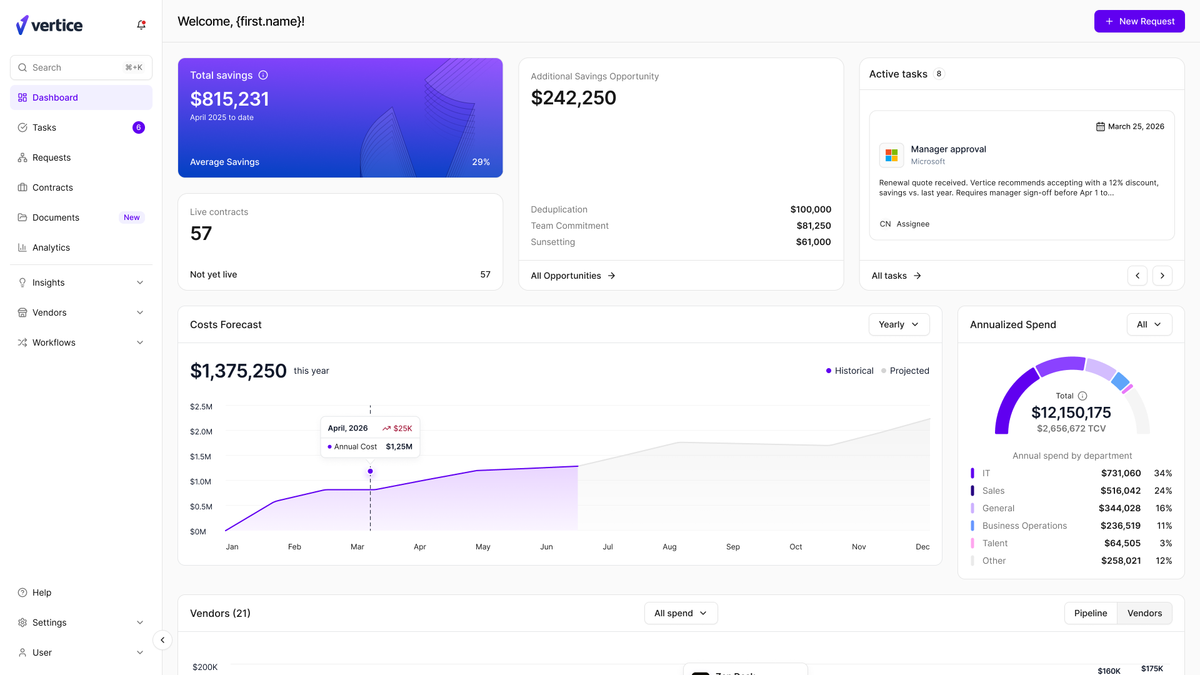
Vertice is a procurement platform covering intake, approvals, vendor onboarding, contract management and SaaS purchasing, with optional negotiation by its own buyers. In June 2026 it acquired Vendr, and the combined pricing data covers more than $75 billion in spend across 32,000 vendors. It suits finance and procurement teams that want to hand off negotiations while keeping one system for purchasing.
- Vertice guarantees savings on the contracts its buyers negotiate for you.
- Its AI agents handle compliance and legal review, benchmarking and negotiation, and Vertice says they are trained on more than 70 procurement tasks.
- Procure-to-pay extracts and codes invoices automatically and checks them against negotiated terms before approval.
- Separate modules cover cloud cost optimization and AI cost optimization alongside SaaS purchasing.
6. Tropic, best for in-house procurement teams
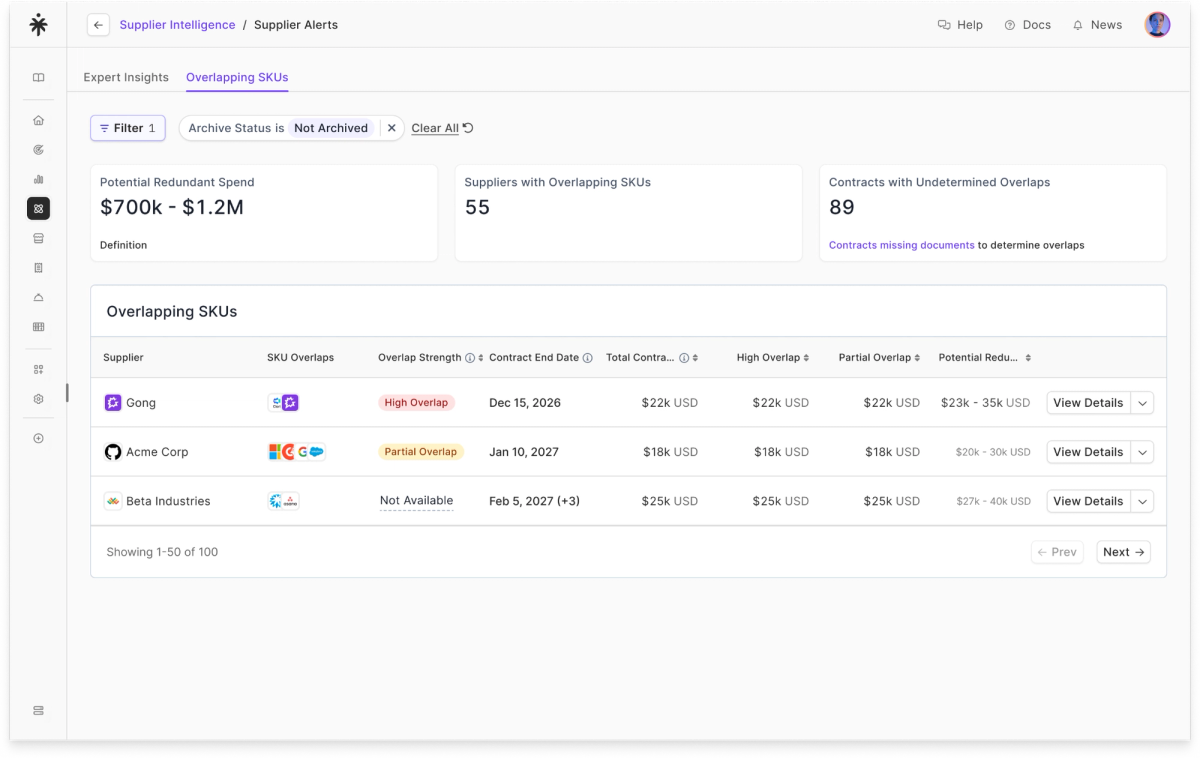
Tropic pairs procurement workflows with pricing intelligence drawn from what it describes on G2 as more than $23 billion in spend data and 100,000 live negotiations. It analyzes contracts down to the SKU to find overlapping tools, ranks upcoming renewals by savings potential, and tracks committed versus consumed spend for AI providers by model, user, department and API key. It fits procurement teams that run their own negotiations and want current market data behind them.
- Renewal and proposal agents manage upcoming renewals and prepare negotiation proposals.
- Willingness-to-negotiate settings let teams set a different negotiation posture for new purchases and for renewals.
- Supplier alerts and spend compliance monitoring flag market changes and spend that falls outside policy.
7. Spendflo, best for companies building a procurement function
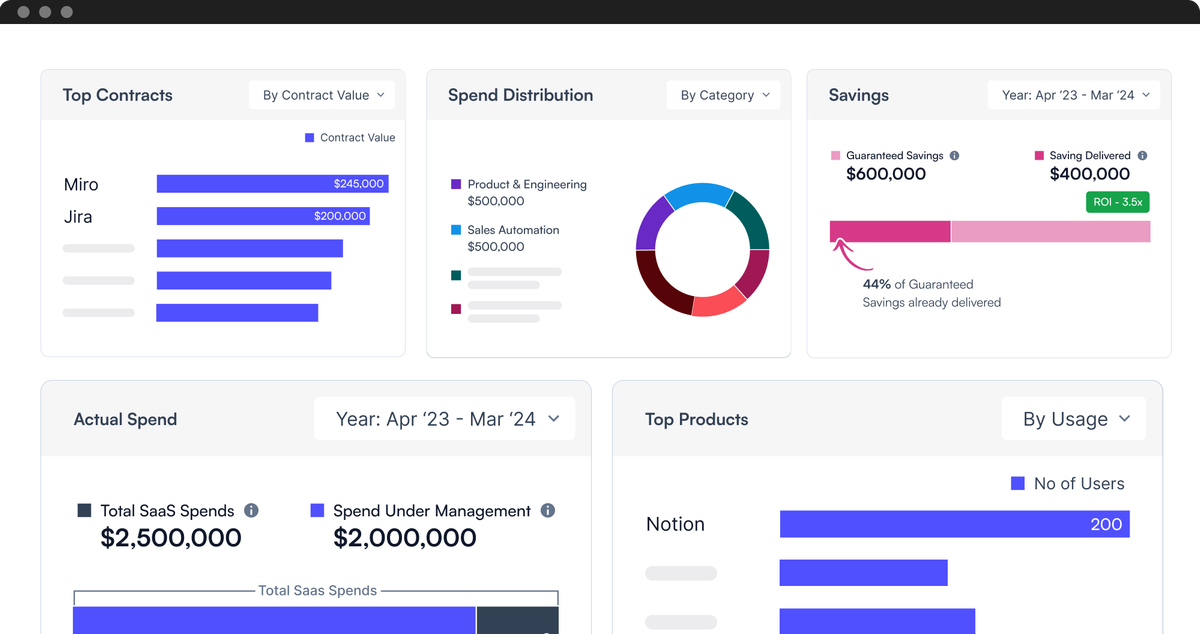
Spendflo started out as SaaS buying support and has grown into an intake-to-pay procurement platform. Its AI agent, Flo, routes purchase requests, enforces policy, reviews contracts against legal playbooks, tracks renewals and matches invoices to purchase orders, according to its G2 profile, and its team also handles sourcing and negotiation. Spendflo suits mid-size companies building out a procurement function that want software and services from one vendor.
- Flo is priced on the deals it closes rather than per seat, and Spendflo says it goes live in 14 days.
- Checks the budget when a request is submitted and flags gaps before it goes for approval.
- Detects auto-renewals 60 days out and attaches benchmark data for the negotiation.
- Creates a draft vendor record when a vendor is missing, so the request isn't held up, and runs third-party risk checks.
8. SpendHound, best for free benchmarks and negotiation help
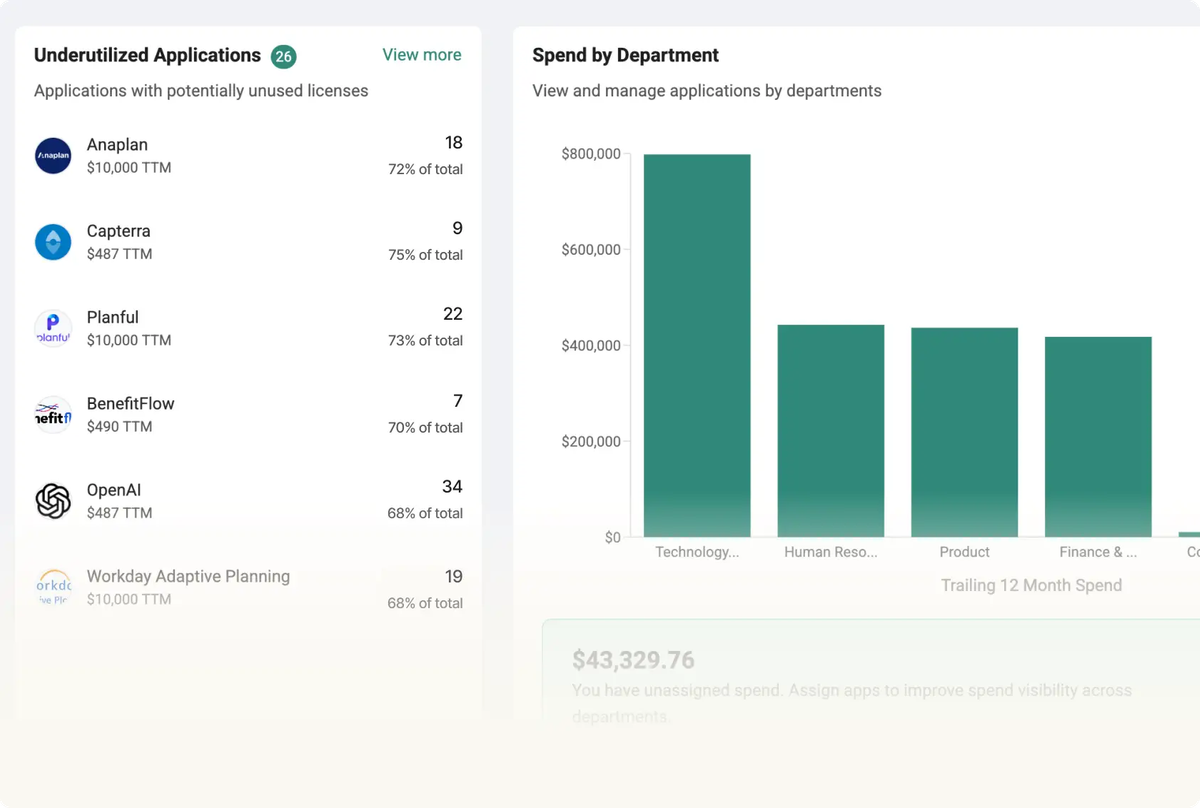
SpendHound, a YipitData company, combines spend visibility and renewal tracking with pricing benchmarks covering more than 10,000 vendors and access to its procurement experts. It is free for companies under 1,000 employees, which makes it the easiest tool on this list to try, and it recently added free AI spend visibility across providers. It fits finance teams at growing companies that want benchmarks and negotiation help without a large contract.
- Benchmarks are SKU-level and come from more than 1,500 contributing companies.
- Tracks token consumption and model-level cost daily for providers including Anthropic, OpenAI, Cursor and Amazon Bedrock.
- A contracts hub keeps contracts, invoices and SOWs searchable and linked to renewal dates and spend history.
- Its procurement experts work with you in Slack, with benchmark-backed strategy and drafted negotiation emails.
Finance and payment-led platforms
Finance-led tools control SaaS spend at the payment layer. Each subscription gets its own virtual card or vendor record, with a limit, an owner and renewal alerts attached, so spend is controlled before money moves. They suit finance teams at companies that buy most software on cards, and they see less of how software gets used than discovery-led platforms do.
9. Ramp, best for companies already on Ramp
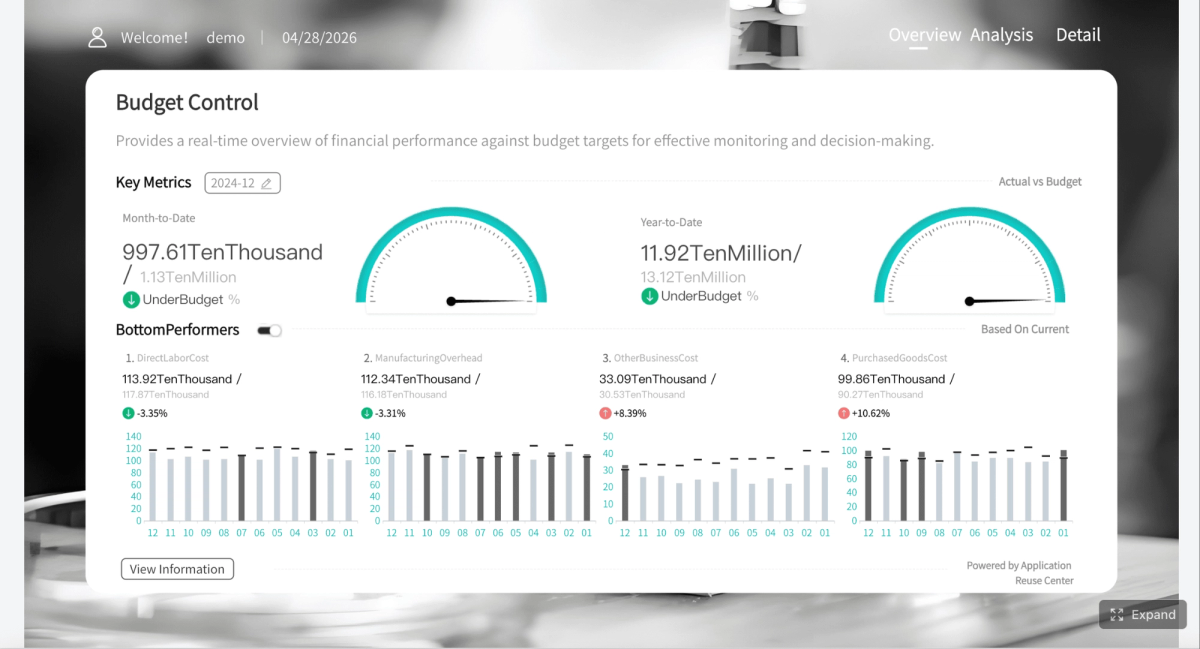
Ramp is a corporate card and spend management platform that has built SaaS controls into its vendor management. It detects shadow SaaS from card-only subscriptions with no vendor record, sends renewal alerts with pricing benchmarks 90 days before the deadline, and ranks savings opportunities by negotiation potential. Its Seat Intelligence feature connects to identity tools such as Okta to flag inactive users. Ramp fits companies that already run their cards and bills on it.
- Price Intelligence compares what you pay against Ramp's transaction data, and you can upload a contract to benchmark its price.
- Pulls SKU names and start and end dates out of contracts without manual entry.
- Compares cost per user across software SKUs to support negotiations.
10. Airbase, best for mid-market non-payroll spend
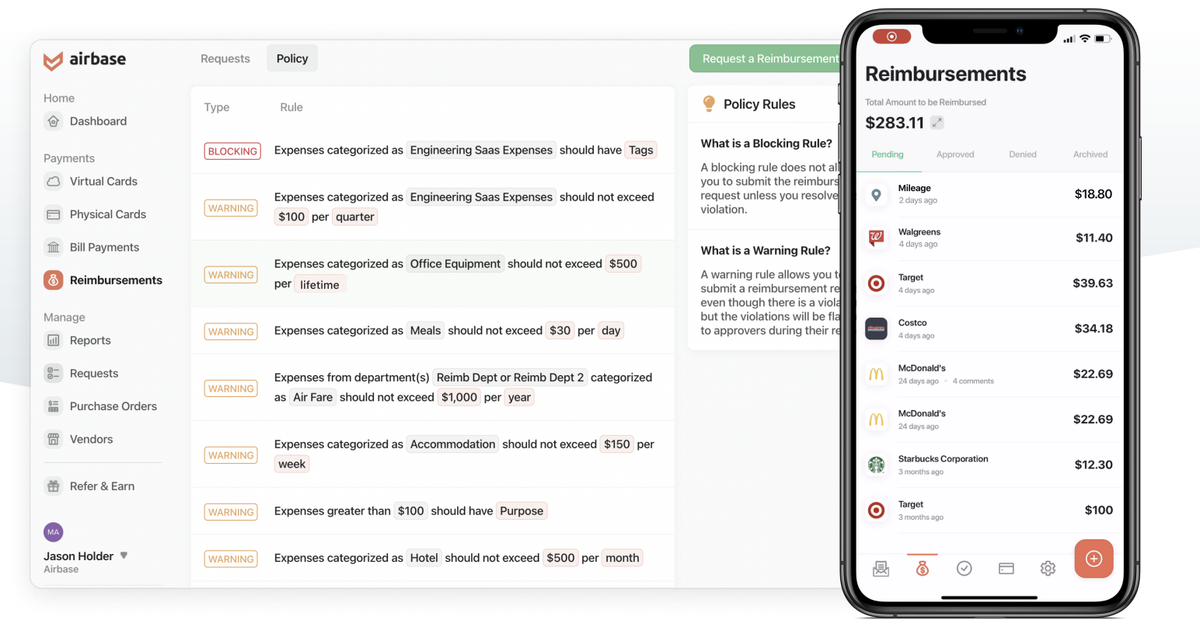
Airbase, part of Paylocity since a 2024 acquisition, combines guided procurement, accounts payable, expense management and corporate cards. For software it issues vendor-specific and recurring virtual cards, checks for duplicate subscriptions, warns owners and accounting before renewals, and lets cards expire to block unwanted auto-renewals, as its platform overview describes. It suits mid-market companies that want one approval flow for all non-payroll spend.
- Guided procurement workflows support sequential or parallel approvals and integrate with Jira, Ironclad and Asana.
- AP automation covers OCR invoice ingestion, two- and three-way PO matching, and payment by ACH, check, wire or virtual card.
- Automated amortization and accruals spread prepaid annual subscriptions across the right periods as part of bill processing.
- Syncs all non-payroll spend to NetSuite, Sage Intacct, QuickBooks or Xero.
11. Cledara, best for card-based SaaS spend
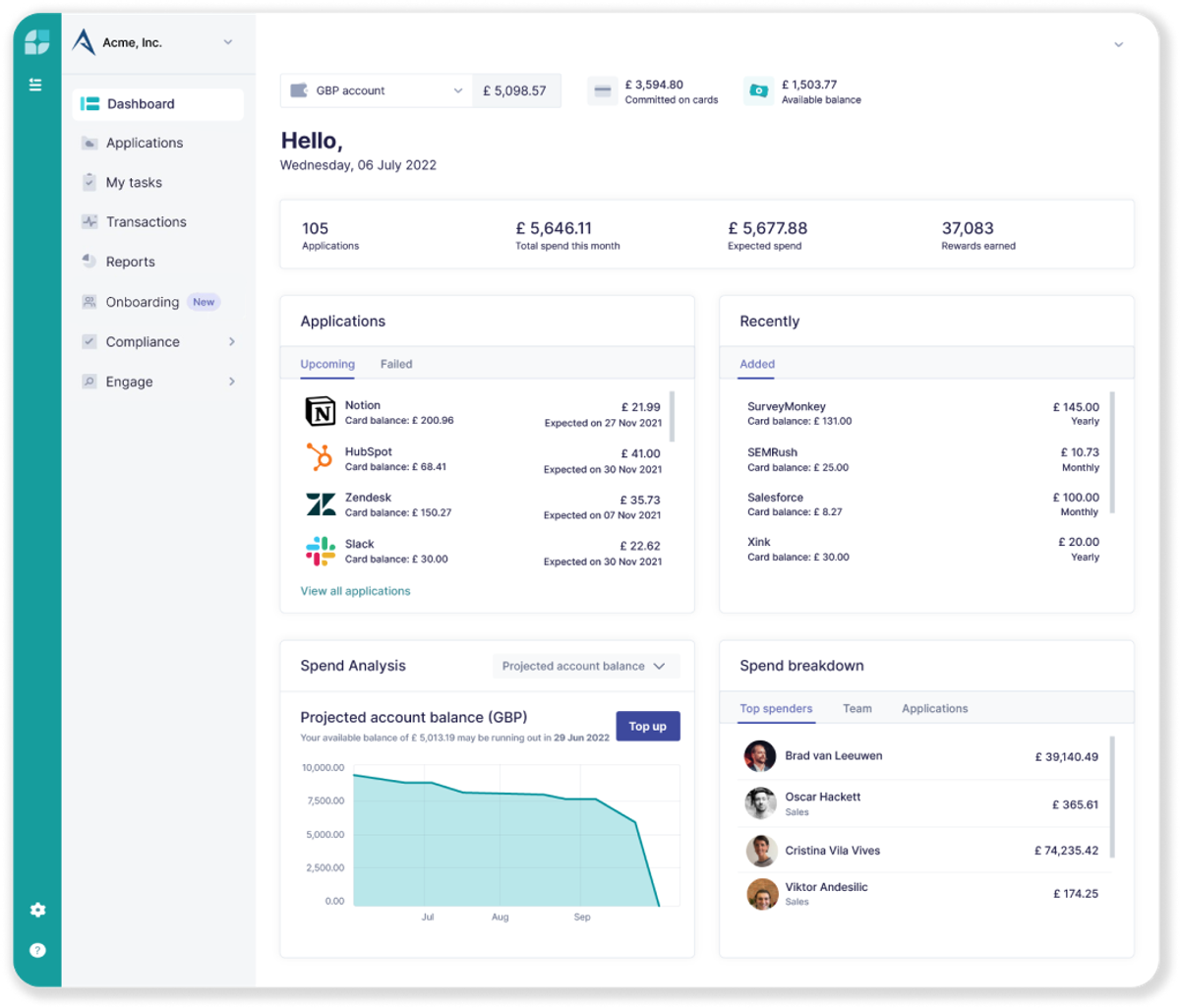
Cledara is built for finance teams at software-heavy companies. It pairs a SaaS inventory with payment control, giving each subscription its own virtual card and spend limit, routing purchase requests through approvals, and capturing invoices automatically for sync to accounting software such as Xero and QuickBooks. It also tracks renewals and flags duplicate tools. Cledara fits scale-ups whose main SaaS problem is card sprawl rather than enterprise license management.
- Cards are issued per subscription rather than per person, so tools keep working when the employee who bought them leaves.
- The Cledara Agent signs in to connected tools to fetch invoices from vendor portals and adds or removes users as people join and leave, with approval required for each job.
- Tracks AI provider usage daily against budgets, alerts finance in Slack at a set threshold and stops spikes at the limit.
- Shows seat usage for each tool and cancels unused tools in one click.
Identity and security-led platforms
Identity-led platforms come at SaaS from access: who has an account, what they can do with it and whether it should be removed. Spend control follows from the same data, since an account deprovisioned at offboarding is also a license that stops being paid for. They fit IT and security teams that own both access governance and the software budget, and their savings tend to come from reclaimed licenses more than from negotiation or budgets.
12. CloudEagle, best for spend, access and AI policy in one platform
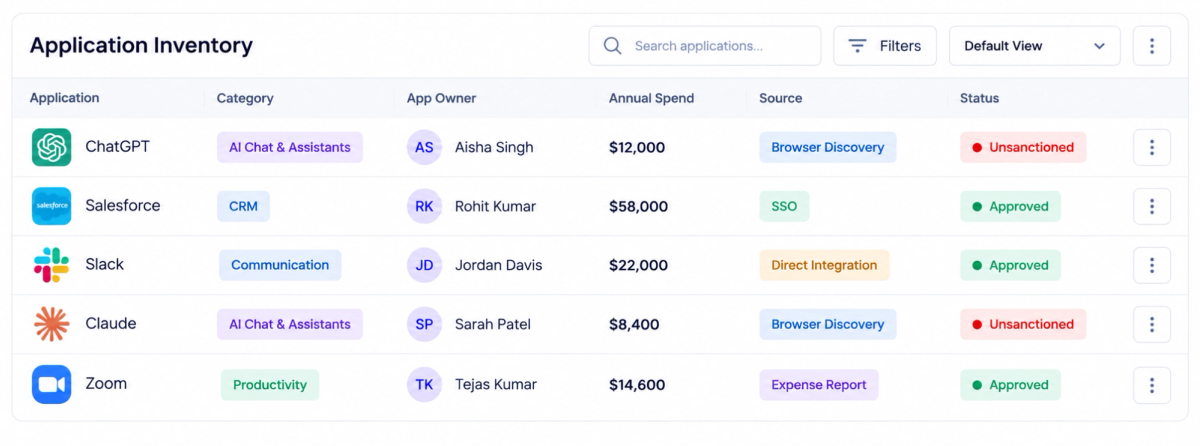
CloudEagle.ai covers SaaS management, procurement, identity governance and AI governance in separate modules, with more than 500 integrations used for discovery, according to its G2 profile. It governs non-human identities such as service accounts and AI agents alongside employees, automates access reviews and license harvesting through workflows that run in Slack, and is among the vendors Gartner evaluated in its 2026 Magic Quadrant. It fits companies that want spend, access and AI policy from one vendor.
- Maps AI apps, agents and MCP servers, tracks token consumption by user, team and tool, and enforces AI policy through a secure browser.
- Price benchmarks draw on more than $50 billion in SaaS transactions, with buying guides and outsourced procurement available.
- Reads renewal dates and terms from contracts with AI and starts renewal workflows 90 days ahead.
- EagleEye agents monitor SaaS and AI environments around the clock and act on anomalies.
13. 1Password SaaS Manager, best for 1Password customers
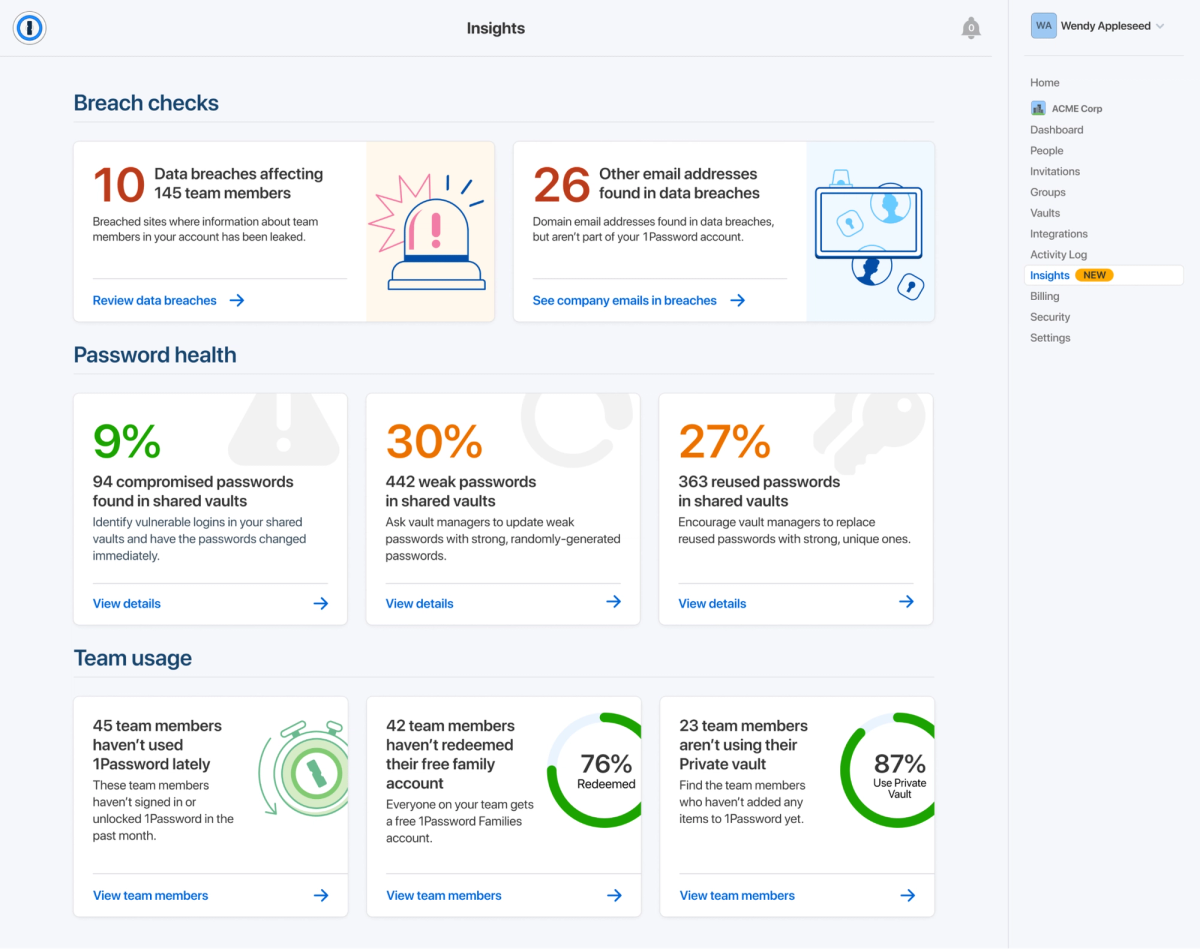
1Password SaaS Manager, formerly Trelica, builds on 1Password's identity and access products. It discovers apps through identity providers, SSO, finance systems, its browser extension and 1Password vaults, connects to more than 400 apps for provisioning and access reviews, and tracks AI spend by team, user, model and API key with burn-rate alerts. 1Password was named a Leader in Gartner's 2026 Magic Quadrant. It suits companies already on 1Password that want shadow IT and AI tools under the same access policies.
- Finds shared and sensitive credentials in 1Password vaults, so admins can review high-risk accounts and transfer ownership.
- Reads uploaded contracts with AI to pull out key terms and renewal timing.
- Exports access review audit trails with supporting material attached for auditors.
- Builds new connectors on request at no charge for any app with an open API.
14. Zluri, best for identity governance
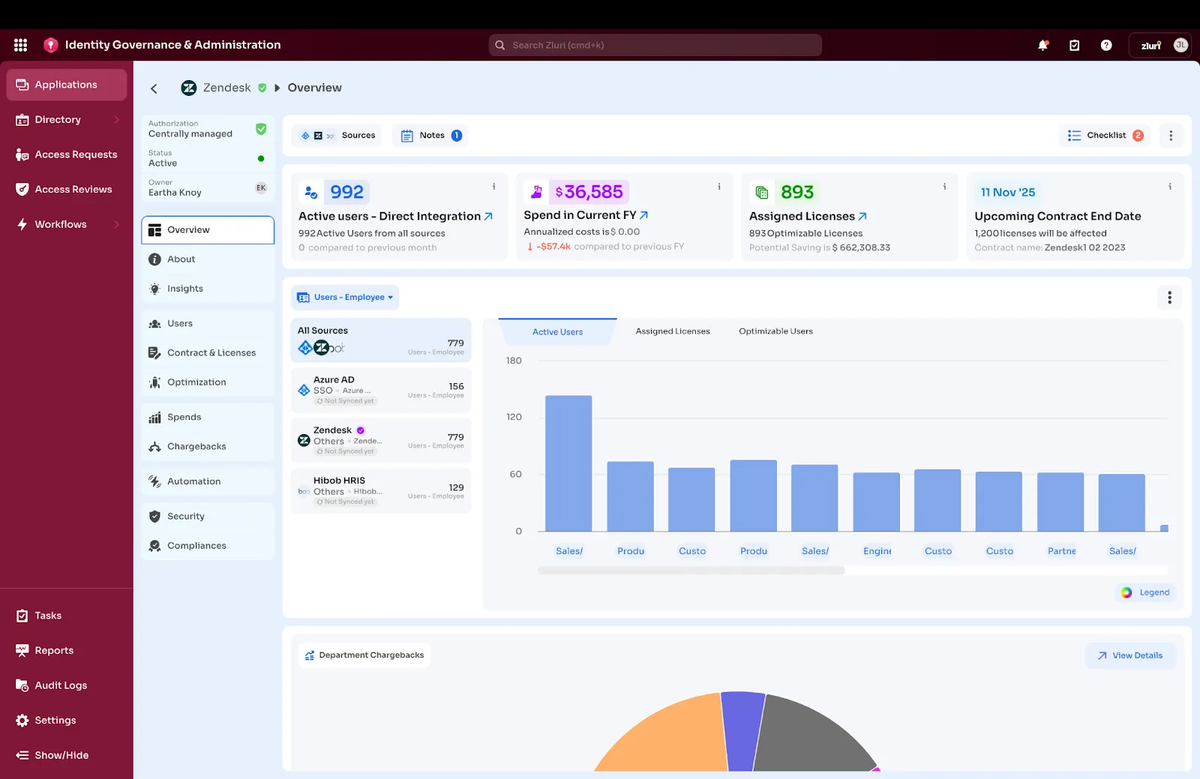
Zluri began as a SaaS management platform and now sells it as one part of a broader identity governance product. Its SaaS management module lists nine discovery methods, including browser and desktop agents, and more than 800 integrations, and it uses that data for both license optimization and access reviews. It fits security-minded IT teams that want access governance and spend control running off the same discovery data.
- Builds an identity graph of human and non-human identities across SaaS, cloud and on-premises apps, showing effective permissions and full access paths.
- More than 1,500 automated actions fix over-privileged access, toxic permission combinations and dormant accounts.
- A universal identity connector reaches custom and homegrown apps that have no native integration.
15. BetterCloud, best for user lifecycle automation
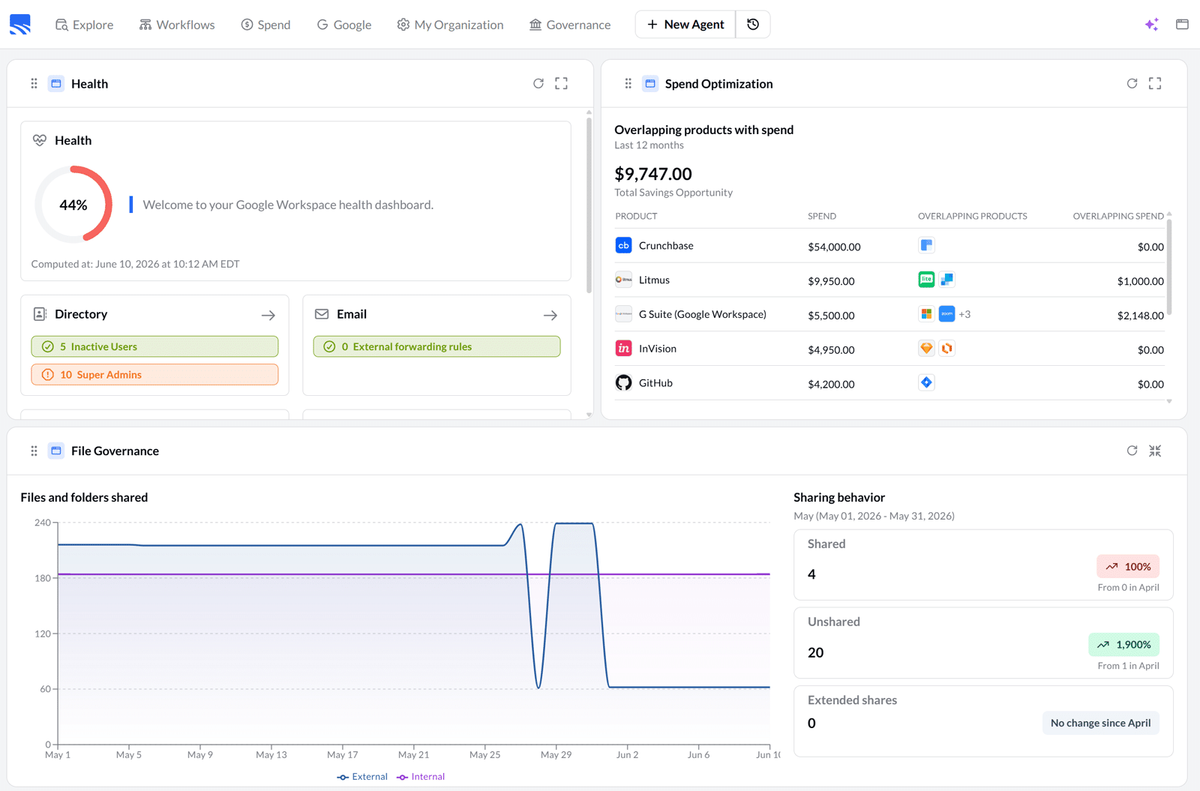
BetterCloud, acquired by CoreStack in March 2026, is best known for no-code workflows that automate onboarding, offboarding and security policies across SaaS apps. Its Spend Optimization module adds contract renewal tracking and policy-driven license reclamation for apps including ChatGPT, Box and Asana. It suits IT teams whose first priority is automating the user lifecycle, with spend control following from that work.
- AI cost governance breaks token volume and spend down by model, provider, agent, shared service account and user.
- File governance finds sensitive files and risky sharing settings and fixes them automatically.
- An IT agent built in its AI Agent Studio takes actions on request, with approval required before each one runs.
- Connects to more than 125 apps, including Google Workspace, Microsoft 365 and Okta.
Usage-based and AI spend governance platforms
The last group comes from FinOps rather than IT. These platforms were built to manage cloud bills, which have always been usage-based, and have extended the same allocation, budgeting and anomaly detection to SaaS and AI providers. They are the strongest option for the fastest-growing part of software spend (AI seats, API tokens and data platforms billed by consumption), especially when that spend needs to be allocated to teams and products alongside the cloud bill. Finding unsanctioned apps through SSO and expense data is outside their scope, so companies with a large seat-based portfolio usually pair one with a SaaS management platform.
16. nOps, best for AI and usage-based spend
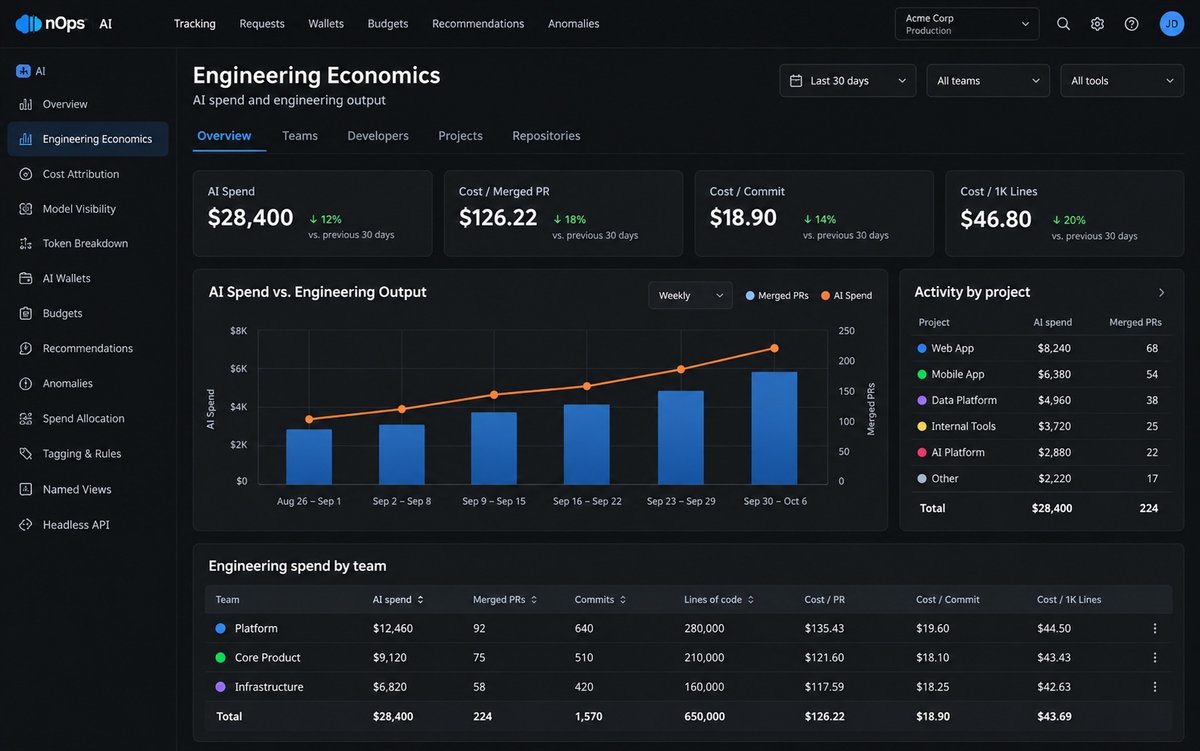
AI tools have made a growing share of software spend behave like a cloud bill. What a team spends on an enterprise AI subscription or coding assistant depends on how heavily each person uses it, the charges land in several billing systems, and an annual budget set at signing stops holding once adoption grows. nOps manages that spend with the same controls FinOps teams use for cloud infrastructure.
For AI tools, nOps works where the cost is created: each person's usage. Spend from AI providers and coding assistants is tied to the teams and projects behind it, and when someone reaches their limit, an approver sees their usage history and can raise the limit, approve it for a few days or decline. People who need more aren't blocked, and the group still lands on budget.
Because the same platform already manages AWS, Azure, Google Cloud and Kubernetes, AI and SaaS costs sit next to the infrastructure they run on. That matters for SaaS such as Databricks or Snowflake bought through a cloud marketplace, which draws down a cloud commitment, and for measuring AI spend against what it produced, such as cost per merged pull request.
- Covers AWS, Azure, Google Cloud, Kubernetes, AI providers and SaaS in one platform, with 100% of spend allocated to teams, products and customers.
- AI wallets and budgets set group budgets and per-person spend limits for AI tools, with an approval workflow when someone needs more.
- Attributes AI spend, including developer tools, to the teams, projects and customers behind it without tagging changes.
- Hourly anomaly detection flags cost spikes across cloud and AI spend.
- Tracks cloud commitments and SaaS contracts with burndown, so you can see whether you're on pace to use what you committed to.
17. Vantage, best for self-serve engineering teams
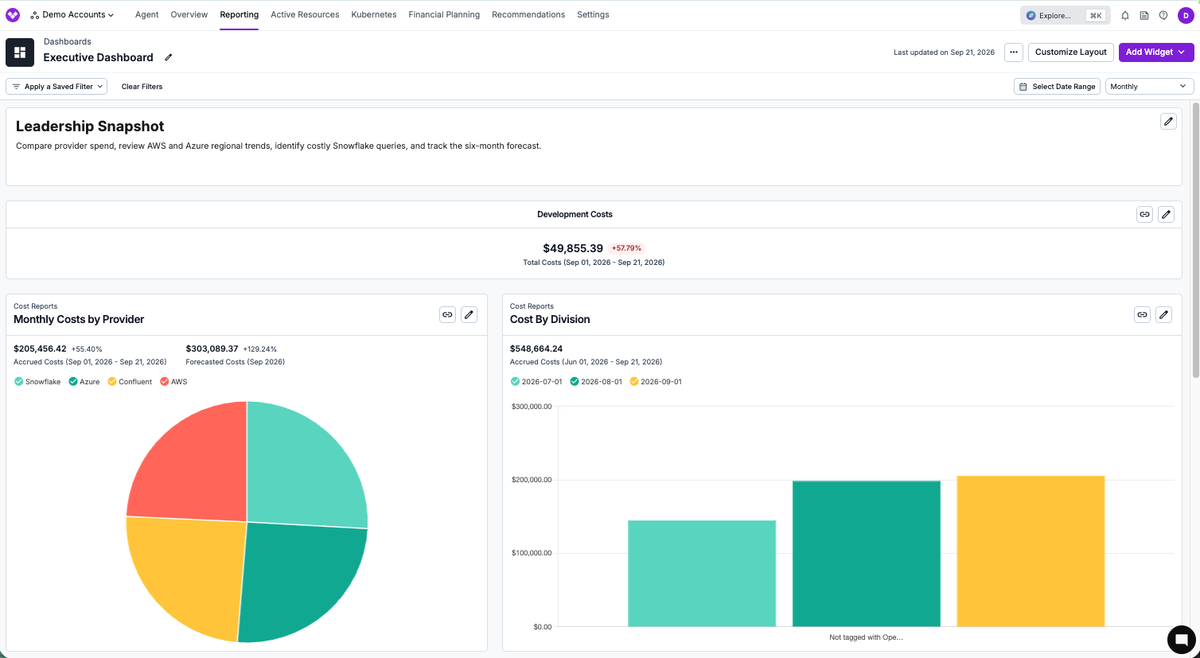
Vantage describes itself as a system of record for allocating and optimizing cloud, SaaS and AI costs, with an integrations library of more than 40 providers. Its native OpenAI, Anthropic and Cursor integrations show token costs by developer, model and project, and it recently added GitHub Copilot costs by user. Vantage has public self-serve pricing tiers and an MCP server for querying cost data, which makes it a good fit for engineering-led teams that want to set up quickly on their own. Our Vantage vs nOps vs CloudZero comparison covers how the three differ.
- Autopilot buys AWS Savings Plans automatically.
- A Kubernetes agent breaks compute down by namespace and label and finds idle cluster and pod waste.
- Network flow reports show which resources drive data transfer costs.
- A Terraform provider lets teams manage every Vantage resource as code.
18. CloudZero, best for unit costs per customer
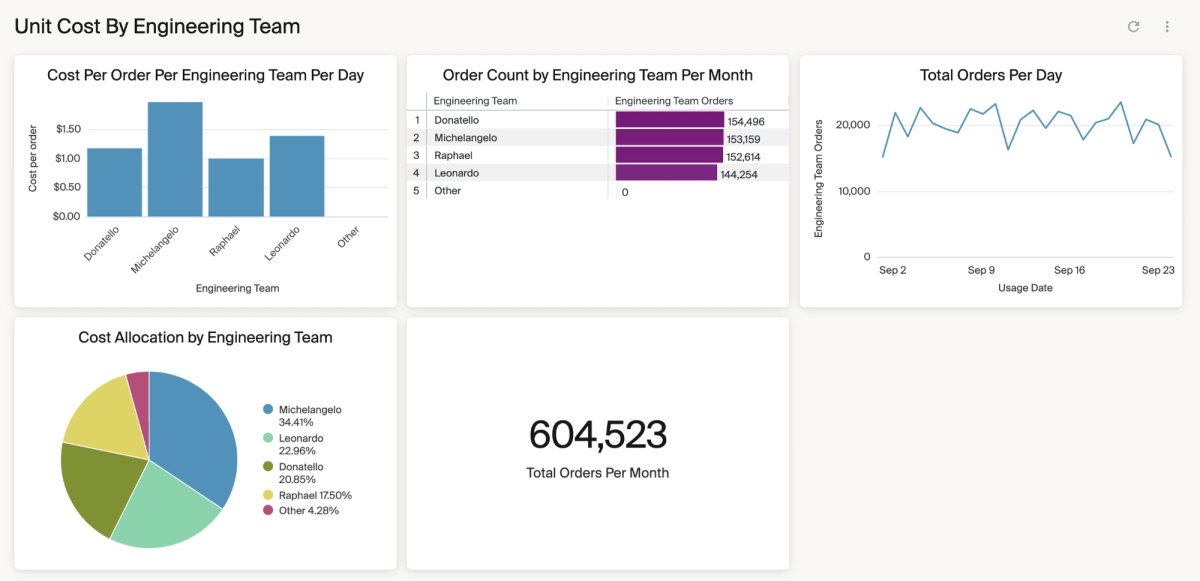
CloudZero brings AI, cloud and SaaS spend into one view and ties it to business dimensions such as customer, product and feature. Its AI platform integrations pull usage from providers including Anthropic and OpenAI into the same allocation model as cloud costs, and its allocation engine assigns spend without depending on complete tagging. CloudZero fits engineering-led SaaS companies focused on unit costs per customer or feature.
- CostFormation lets platform teams define the allocation structure once, so finance and engineering report from the same numbers.
- AI Signals capture AI calls from streaming telemetry, with anomaly signals within seconds and full allocation within hours.
- AI Hub shows what model calls, agents and workloads cost, including inside coding agents.
- Analytics reports cover margin per product and ROI per AI feature.
19. Finout, best for finance-led FinOps teams
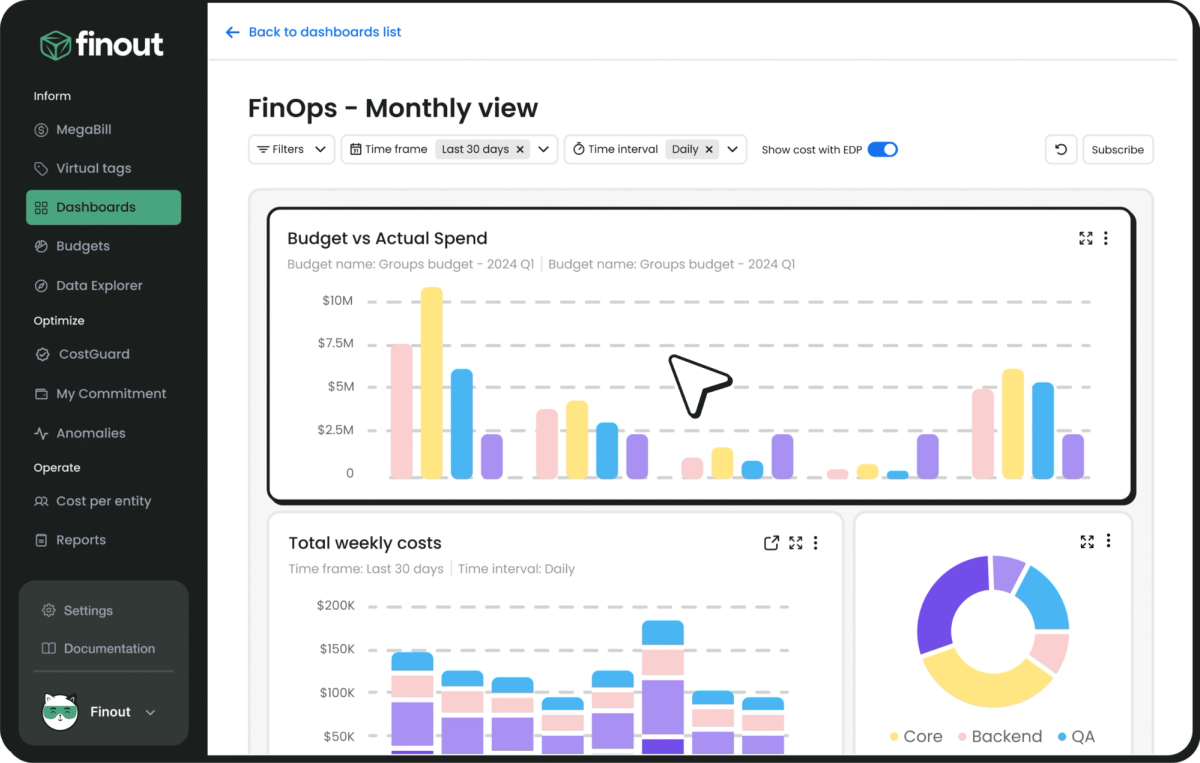
Finout consolidates cloud, Kubernetes, data, AI and SaaS software costs into a single bill it calls the MegaBill, and allocates it with virtual tags instead of requiring tags at the source. Its OpenAI integration pulls API token and Codex credit usage, its Anthropic integration breaks costs down by model, token type and team, and anomaly alerts go to Slack, email or PagerDuty. Finout fits finance-led FinOps teams that want one allocated view across cloud and AI providers.
- A Detection Agent scans for waste and anomalies, and an Investigation Agent writes a root cause analysis for each finding, covering blast radius and ownership.
- Billy, a read-only AI FinOps assistant, answers cost questions with role-based scoping and audit logging.
- Shared cost rules reallocate shared spend across teams.
- Pricing is a flat platform fee based on spend under management, with no per-seat charges.
How to Choose a SaaS Spend Management Tool
Start with who owns the problem. When IT owns software, discovery-led and identity-led platforms fit, because their data comes from systems IT already runs. When procurement owns renewals, a procurement-led platform puts benchmarks and negotiation support where the decisions get made. When finance owns the budget and most software is bought on cards, a finance-led tool controls spend at the point of payment.
Then look at how your software is billed. If most spend is annual seat licenses, license reclamation and renewal management will produce most of the savings. If a growing share is AI tools, API usage and data platform credits, you need daily usage data from those providers, budgets that work per seat and per team, and a way to allocate the cost to the teams that drive it. That is where FinOps platforms are strongest, and it is the part of the bill that changes fastest.
Before any demo, check integration coverage against your own stack: your finance or ERP system, your identity provider and the ten applications you spend the most on. A platform that connects deeply to the few apps that make up most of your bill is worth more than a long integration list.
Finally, decide how much work you want done for you. Some vendors sell software your team runs, while others include procurement specialists who negotiate on your behalf. Services-led options usually cost more, but they suit companies without procurement staff.
Where nOps Fits In
Fully managing software spend now means managing usage: AI seats, API tokens and data platform credits that behave more like a cloud bill than a license, across AWS, GCP and Azure and every provider running on top of them.
That's where nOps comes in: helping FinOps and finance teams understand, allocate, and govern AI and SaaS costs alongside the rest of their cloud and AI infrastructure.
- Unified visibility: Get all of your spending from AWS, GCP, Azure, AI, and SaaS in one place, with cost allocation by application, customer, team, or business unit to understand what's driving AI spend and where optimization will have the greatest impact.
- AI budget governance: Set group budgets and seat-level spend limits for AI tools, route limit increases to approvers with full usage context, and rebalance limits so teams stay unblocked within budget.
- Commitment Management: Automatically maximize discounts and minimize commitment risk across eligible cloud infrastructure supporting your AI workloads. Customers typically save ~20% by switching to nOps, and with results-based pricing, you pay only when you get better results.
We've talked to companies that can save millions on their cloud bills by switching to nOps from competitors. Book a free savings analysis to quantify exactly how much more you could save across the infrastructure supporting your AI workloads and the rest of your cloud environment.
nOps manages $5B+ in cloud spend and was recently rated #1 in G2's Cloud Cost Management
Demo
AI-Powered Cost Management Platform
Discover how much you can save in just 10 minutes!
Book a Demo