Skip to content


- Blog
- Commitment Management
- Archera Pricing (2026): Plans, Cost Structure, and Commitment Insurance Explained
Archera Pricing (2026): Plans, Cost Structure, and Commitment Insurance Explained
AWS commitments are a bet. You trade flexibility for discounted rates, locking in 1–3 year Reserved Instances or Savings Plans in exchange for lower unit costs. When your forecasts are accurate, the math works in your favor. When they’re not, you can end up paying for capacity you don’t use.
That tension — savings versus risk — is the backdrop for Archera. The company positions itself around the downside of cloud commitments, offering a way to offset the financial impact if usage drops below what you committed to with AWS.
This guide breaks down how Archera’s pricing actually works in 2026: what you’re paying for, how premiums are structured, what drives total cost, and how commitment insurance compares to simply managing commitments yourself.
What Does Archera Do?
Archera is a commitment management suite for AWS services. It’s designed to help teams plan, manage, and monitor long-term cloud commitments with more financial structure than AWS-native tooling typically provides.
Instead of being a general multi-cloud platform, Archera is more narrowly oriented around commitment outcomes: how much you commit, how those commitments perform over time, and how much risk your commitment strategies introduce.
The rest of this section breaks down the main components of the suite and what each one is intended to do.
What Features Does Archera Offer?
Key features include:
Commitment Insurance for AWS SPs & RIs
Archera sells cloud commitment insurance for AWS. Customers pay a fee, and in return Archera agrees to reimburse them if their actual AWS usage falls short of the RIs and SPs they committed to.
Essentially, this is a financial product layered on top of commitments. At a practical level, you’re still signing the same long-term commitment directly with AWS to get discounted rates. But in case your forecasts are wrong or your usage changes, Archera can help absorb some of the downside risk. And in exchange, you pay a higher fee.
Whether this “insurance” is valuable depends on how predictable your workloads are and how comfortable you are carrying commitment risk yourself.
Commitment Optimization Automation
The platform can provide analysis and recommendations around how much to commit and where, based on observed usage. In some deployments, this is paired with workflow or automation support to help teams implement and maintain a target commitment posture over time.
Cloud Visibility & Reporting
Archera includes reporting that breaks down commitment performance (e.g., utilization trends and financial exposure) and summarizes how commitments are tracking versus expectations. This makes commitment-related spend easier to interpret for both engineering and finance stakeholders.
Forecasting & Risk Analysis
The platform can model future usage and estimate the likelihood and magnitude of underutilization with scenario modeling. This is used to quantify downside exposure associated with purchasing commitments before they are made.
FinOps Budget Protection
Archera supports budget-aligned views and controls, such as tracking commitment exposure against budgets, producing finance-friendly summaries, and providing inputs for internal governance around who can commit spend and at what levels.
Archera Pricing: How Much Does Archera Cost in 2026?
Archera’s free tier includes various features such as commitment recommendations and basic reporting on your commitments. The main cost impact is when you opt for advanced features. Insurance is charged as a premium tied to each insured commitment, and advanced reporting features is charged as a flat rate.
How Archera Pricing Works
Let’s look at how each component works in concrete detail.
Commitment Insurance / "Guaranteed Reserved Instances"
Insurance from Archera is structured as a premium tied to specific commitments. Public materials describe a monthly premium billing model, with charges varying based on the commitment’s configuration, risk profile, and selected term length (commonly 30 days or one year).
Rather than altering the underlying AWS contract, Archera layers this premium on top of standard Reserved Instances or Savings Plans. Savings shown within the platform are typically presented net of the GRI premium.
In practical terms, the more commitment volume you insure, the more premium you pay.
Advanced Reporting Features
According to Archera’s pricing page, these features delivered as a service and priced by flat-rate tier based on your professional services needs, the number of cloud service provider (CSP), SaaS services, and custom data sources you want to integrate, and your custom dashboard requirements
Minimum Spend Requirements
Public materials describe an “always free” tier and a “Pro” tier that’s free under a monthly spend threshold (e.g., “Pro free for < $5000 spend/mo”), which implies there may be usage/spend-based eligibility thresholds for which tier you fall into. Exact minimums and qualification criteria can vary by plan and how you’re buying (direct vs marketplace).
Contract Terms and Coverage Period
For insured commitments specifically, Archera’s help/pricing materials reference two primary term lengths: 30 days and 1 year, with premiums differing by term and risk. Advanced Reporting, separately, is described as a service with tiered monthly pricing—so its “term” tends to behave more like a service agreement than a per-commitment insurance term.
AWS Marketplace
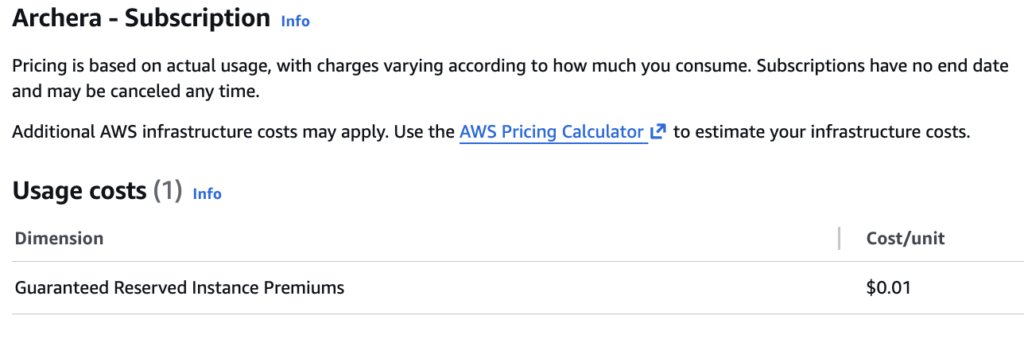
If you buy Archera via AWS Marketplace, the listing is structured as a SaaS subscription billed on your AWS bill, and the platform line item is $0 (Archera’s Free Platform).
Costs show up as metered usage dimensions tied to paid components—on the Marketplace listing, the paid dimension shown is “Guaranteed Reserved Instance Premiums” at $0.01 per unit (AWS Marketplace uses “units” for metering; it doesn’t mean the premium is literally one cent in total).
Subscriptions can be canceled, and the listing also states fees are non-cancellable and non-refundable (except as required by law).
Key Drawbacks of Archera’s Pricing Model
While Archera’s model can make sense for certain organizations, its pricing structure has tradeoffs that teams should understand before committing.
Limited pricing transparency: Archera doesn’t publish a simple rate card for premiums or services, so most teams won’t know their “real” price until they run an analysis and get a quote (and Marketplace metering units don’t map cleanly to an effective percentage without context).
Primarily focused on AWS commitments: The value and billing model are centered on AWS commitment instruments (AWS Savings Plans/RIs), so it’s less relevant if your biggest optimization opportunities are outside commitments (e.g., Kubernetes, Azure services, GCP, AI, etc.).
Insurance-based pricing can add net cost: Because you’re paying a premium for risk transfer, you can end up paying more overall when utilization stays high and forecasts are accurate—i.e., you paid for protection you didn’t really use.
Premiums scale with how much you insure: Fees generally grow with the volume of commitments you choose to cover, so “using it more” often means paying more, even if your underlying AWS environment isn’t growing proportionally.
Savings comparisons can be less straightforward: If savings are presented net of premiums, it can be harder to compare “gross AWS discount savings” versus “net after Archera fees” billing impact without doing extra math.
May require enterprise-style purchasing: Depending on how you purchase (direct vs. Marketplace) and whether you add add-on services, you may be dealing with custom terms, services scope, and contract negotiations rather than simple self-serve pricing.
Optimization is narrower than full FinOps platforms: If your goal is continuous optimization across spend categories (rightsizing, scheduling, waste detection, unit economics, anomaly management), Archera’s pricing is tied most directly to different commitment strategies rather than holistic optimization.
Is There a Better Archera Alternative?
Archera’s model is built around insuring commitment risk, and is primarily AWS-focused. You lock into commitments, then pay an additional premium to reduce the downside if utilization drops. It’s a financial hedge layered on top of a long-term bet.
nOps takes a fundamentally different approach.
Instead of charging you to insure against risk, nOps is designed to reduce the risk in the first place through continuous, automated commitment optimization for AWS, Azure and GCP. Its hourly optimization engine makes small, frequent commitment adjustments so coverage stays aligned with real usage, offering ~20%+ savings over competitors while automatically maximizing flexibility.
That difference changes the economics.
With Archera, the more commitments you insure, the more premium you pay. If utilization stays high, you’ve paid for protection you didn’t need. The cost and usage scales with coverage.
nOps lowers your risk and improves your savings without manual work or additional fees. Because you pay only a portion of savings, customers have described adopting nOps as like “picking $20 bills off the ground” — there’s no downside to seeing if you get more savings out of your commitments with a free savings analysis.
nOps is entrusted with $3 billion in cloud spending and was recently rated #1 in G2’s Cloud Cost Management category.

Demo
AI-Powered Cost Management Platform
Discover how much you can save in just 10 minutes!
Frequently Asked Questions
Let’s dive into a few FAQ about Archera platform features and pricing.
How much does Archera cost?
Archera does not publish standard pricing. Archera’s free features include some commitment management capabilities. In addition to the completely free features, customers pay when they purchase Insured Commitments or certain add-on services like Advanced Reporting. The total bill depends on how much commitment coverage you purchase, the size of your spending, and your private pricing agreement.
What pricing model does Archera use?
A monetized insurance/financial-product model layered on top of commitment management: you pay for flexibility and risk transfer, plus optional advanced cost management platform features. That’s different from tools that charge for continuous optimization—Archera’s bill grows when you insure more commitments, not necessarily when you optimize more.
How does Archera commitment insurance work?
Archera enables organizations to insure cloud commitments, enabling them to modify or exit certain reservations under defined terms. In exchange, customers pay a premium for that flexibility, effectively shifting commitment risk from the buyer to Archera.
Is Archera suitable for mid-size companies?
Archera can be valuable for mid-size companies with volatile or unpredictable workloads that hesitate to lock into long-term commitments. However, organizations seeking continuous rate optimization or broader FinOps automation may require additional tooling or selected strategies beyond commitment insurance.
What are alternatives to Archera for cloud cost optimization?
Alternatives include platforms focused on end-to-end commitment automation and continuous rate optimization, such as nOps. These solutions aim to proactively manage coverage, eliminate waste, and optimize pricing across cloud environments—not just mitigate commitment risk after the fact.

Last Updated: March 4, 2026, Commitment Management
Tags
Last Updated: March 4, 2026, Commitment Management