Skip to content


The State of FinOps 2026: Recap & Key Takeaways
The State of FinOps is an annual survey conducted by the FinOps Foundation since 2020 to collect information about key priorities, industry trends, and evolving FinOps practices.
The 2026 State of FinOps report is newly released, and it highlights how quickly FinOps is expanding in scope and influence. Here are the top takeaways and statistics from this year’s findings.
TL;DR
- AI is now the top future FinOps priority. Teams are focused on tracking and allocating AI costs (and using AI to speed up FinOps work), and AI spend is rising across cloud, SaaS, private cloud, and data centers—often with pressure to fund AI by finding savings elsewhere.
- Cutting waste is still job #1, but the easy wins are gone. Workload optimization remains the top priority, but practitioners say they’ve already tackled the big obvious waste and now face lots of smaller, harder-to-capture savings.
- FinOps now covers way more than public cloud. Most teams manage or plan to manage SaaS, software licensing, private cloud, and data center costs, and some are starting to include labor (28%)—pushing FinOps toward “total technology spend,” not just AWS/Azure/GCP.
- FinOps leadership is becoming more senior and more influential. Most FinOps teams now report into the CTO/CIO org, and executive engagement correlates with much more influence over big technology choices. FinOps teams stay small by design—and scale through champions.
- Teams are trying to catch cost issues earlier—before code ships—but it’s hard to prove impact. “Pre-deployment” cost estimation is a top desired capability, yet teams struggle to measure and reward cost prevention because once a cost is avoided, there’s nothing to “save” on a bill.
1. AI Dominates the Agenda: Both Managing It and Using It
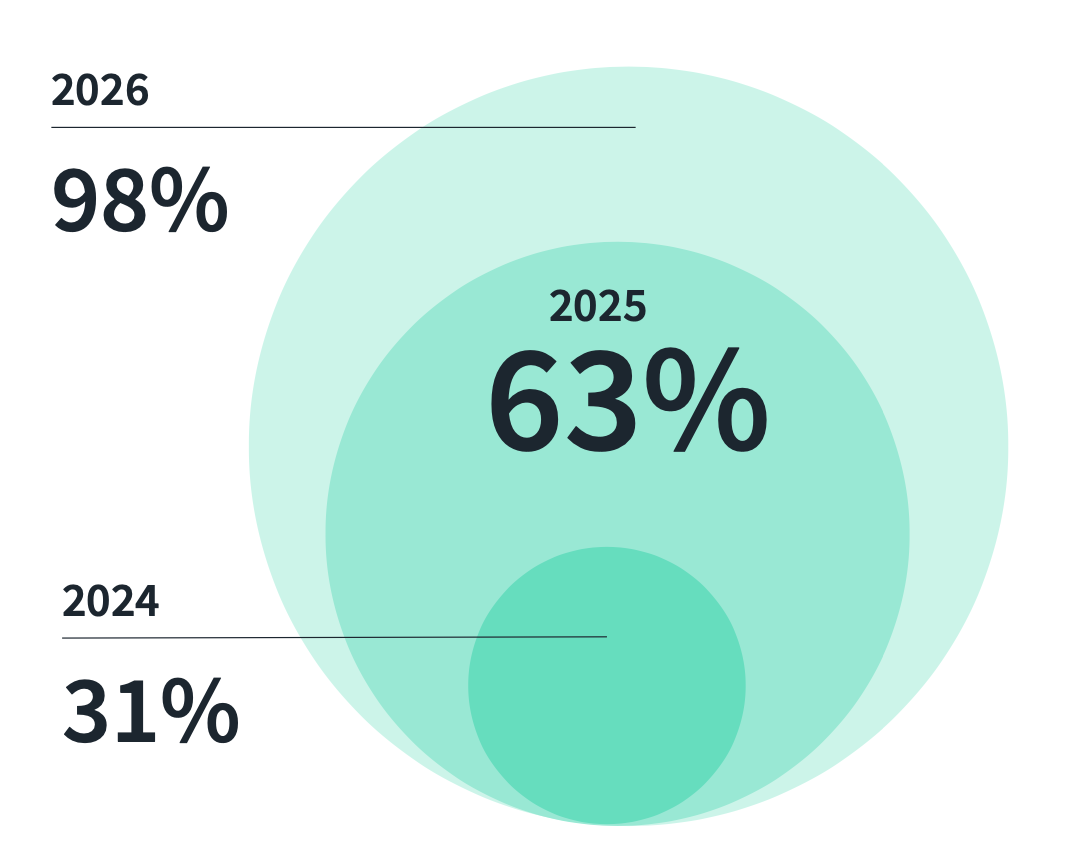
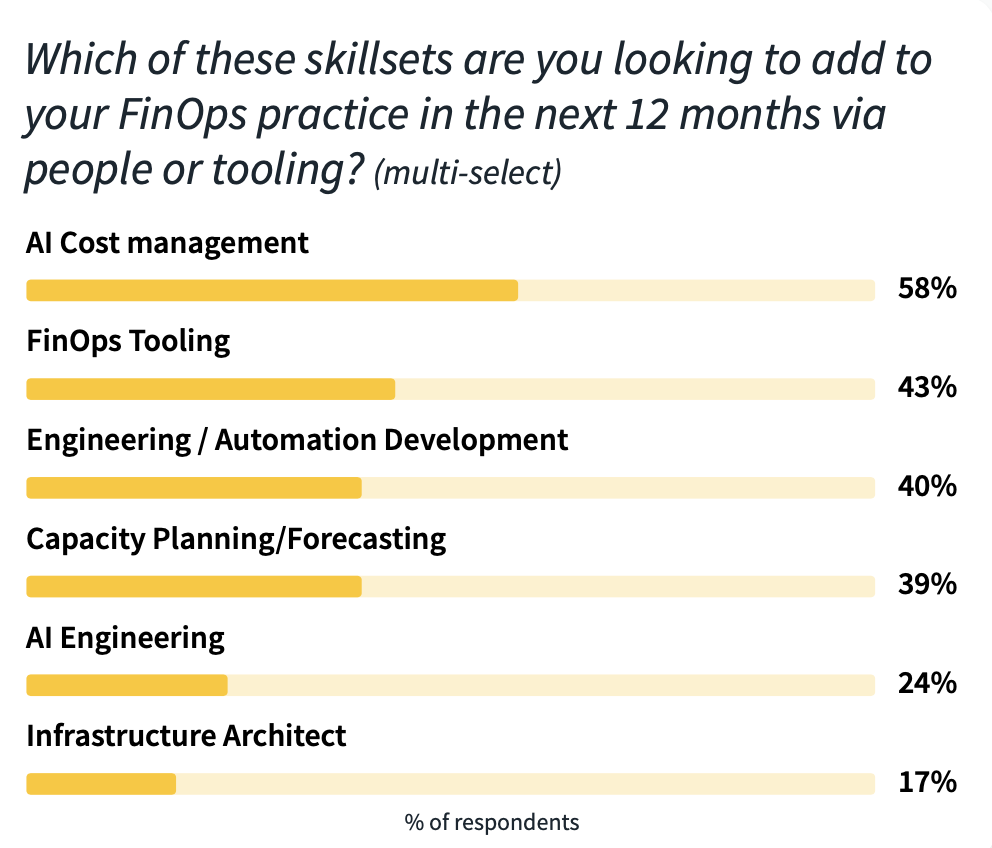
AI is now a core operating cost in 2026. That shift is reflected in staffing priorities as well. “AI cost management” is the most sought-after skillset teams say they plan to add over the next 12 months.
Related Resources from nOps:
- The Complete Guide to AI Cost Visibility
- The Essential Guide to GenAI Cost Optimization
2. Optimization Remains the Current Priority: But the Landscape Is Shifting
As FinOps has exploded in popularity, it has also matured. The early phase—finding obvious waste and quick wins—is largely behind many organizations.
Optimization is still the top priority—but it’s shifting from broad cleanup to incremental improvement. Practitioners describe having already captured the “big rocks” of waste and now facing a high volume of smaller opportunities that take more effort to identify, validate, and implement.
A real example we see every day at nOps is commitment coverage. In cloud terms, “coverage” is the share of compute usage covered by discounted commitments (like AWS Savings Plans or Reserved Instances) instead of being billed at full on-demand rates. Many teams can reach ~70–90% coverage with basic forecasting and occasional adjustments. But pushing closer to 99% is where things get hard—because usage changes constantly, and over-committing can create real financial risk.
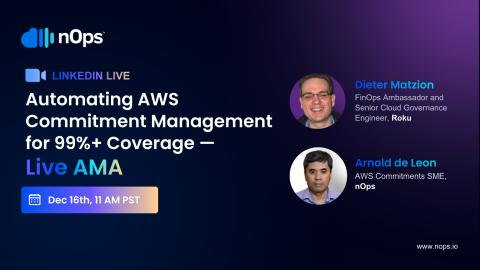
That’s exactly why automation becomes so important in this stage of FinOps maturity — a topic we explored in this recent LinkedIn Live.
3. Broad Technology Value: FinOps Scope Has Definitively Expanded Beyond Cloud
Last year, the State of FinOps 2025 headline was “Cloud+”: FinOps teams were being asked to manage more than just AWS/Azure/GCP—especially SaaS and software licensing—using the same cost discipline they apply to cloud.
In 2026, that trend is much stronger. In addition to public cloud, 90% of respondents now say FinOps manages SaaS, and many also cover licensing (64%), private cloud (57%), and data center (48%) spend.
This is exactly why FOCUS exists. FOCUS (FinOps Open Cost and Usage Specification) became generally available in June 2024, with a simple goal: standardize cost and usage data so teams can report and allocate spend consistently across different vendors and environments. (For more details, we wrote a comprehensive guide to FOCUS and how to use it.)
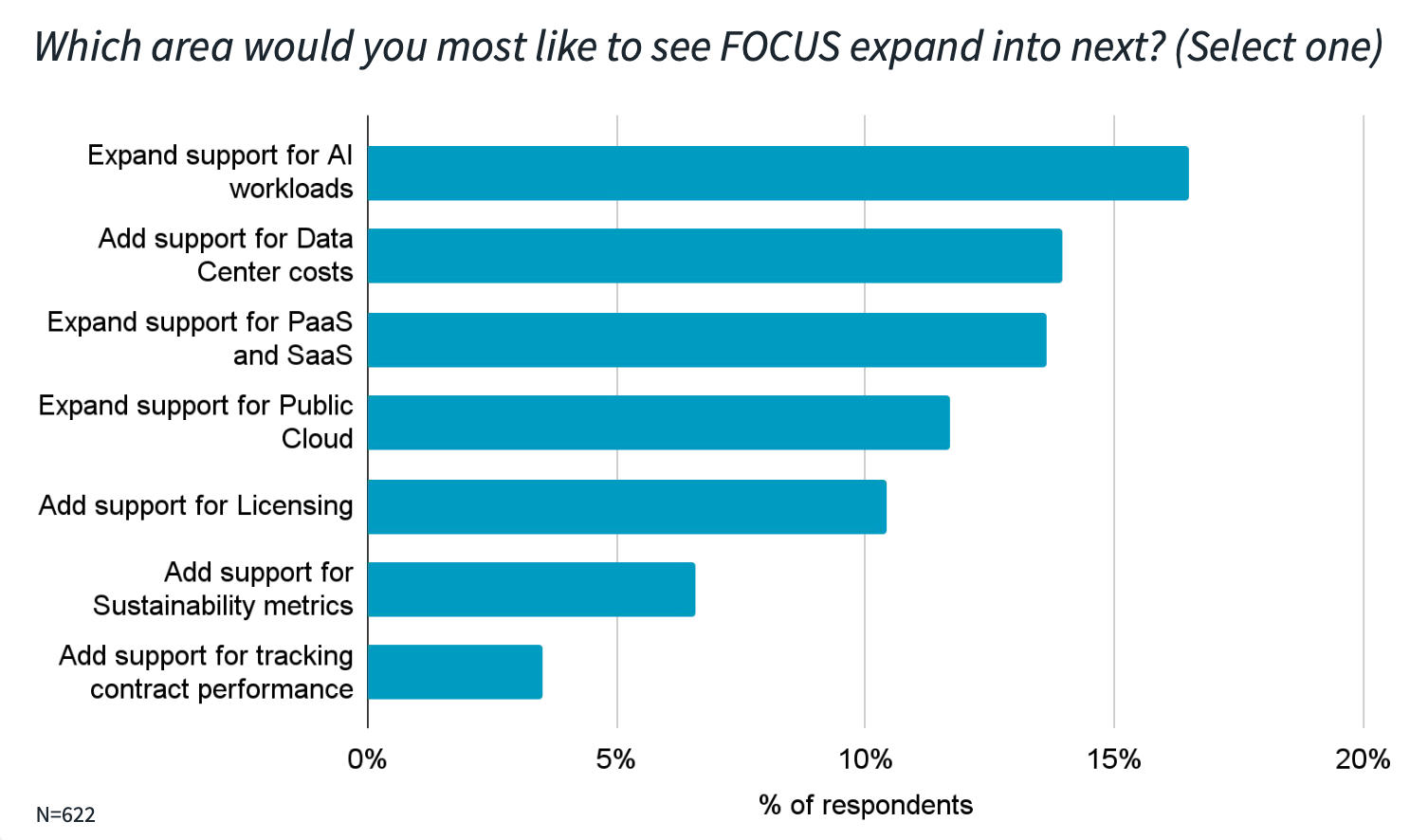
This year’s State of FinOps report also asked respondents where they want FOCUS to expand next.
4. FinOps Has Shifted Up: 78% Now Report into CTO/CIO
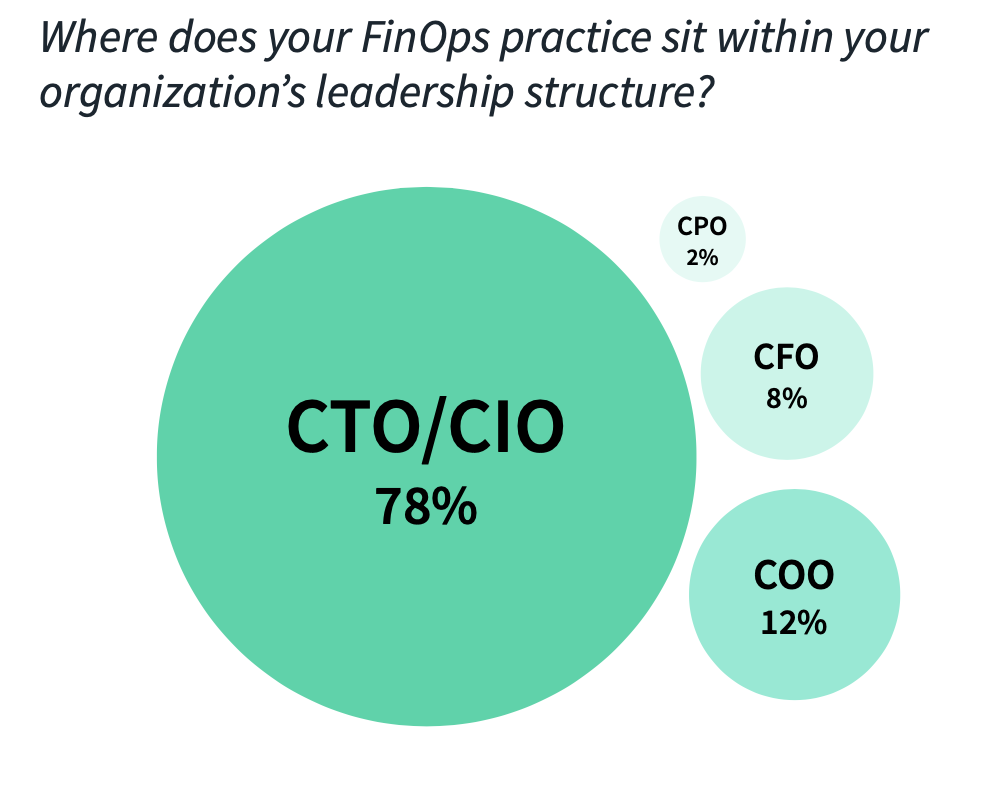
The biggest signal that FinOps is changing is where it sits in the org. In 2026, 78% of FinOps practices report into the CTO/CIO organization.
The implication is straightforward: FinOps is being treated less like a finance-adjacent reporting function and more like a core part of technology leadership.
When FinOps lives closer to the CTO/CIO, the work naturally shifts from explaining spend after the fact to shaping decisions earlier—what gets built, where it runs, and what tradeoffs are acceptable.
5. Shift Left Is Happening: but Measurement Remains Unsolved
“Shift left” basically means catching cost issues earlier—before infrastructure is deployed and bills start showing up. In 2026, teams are pushing in that direction, and the report calls out pre-deployment architecture costing as a top desired capability (i.e., being able to estimate cost from an architecture or design before it goes live).
The hard part is proving the value of prevention. When a team avoids an expensive design up front, there’s no obvious “before vs. after” bill to point to. As one practitioner put it: once you fix it early, “it’s gone”—so teams still struggle with how to measure shift-left impact and how to give developers credit for cost-prevention work.
6. Intersecting Disciplines Are Converging
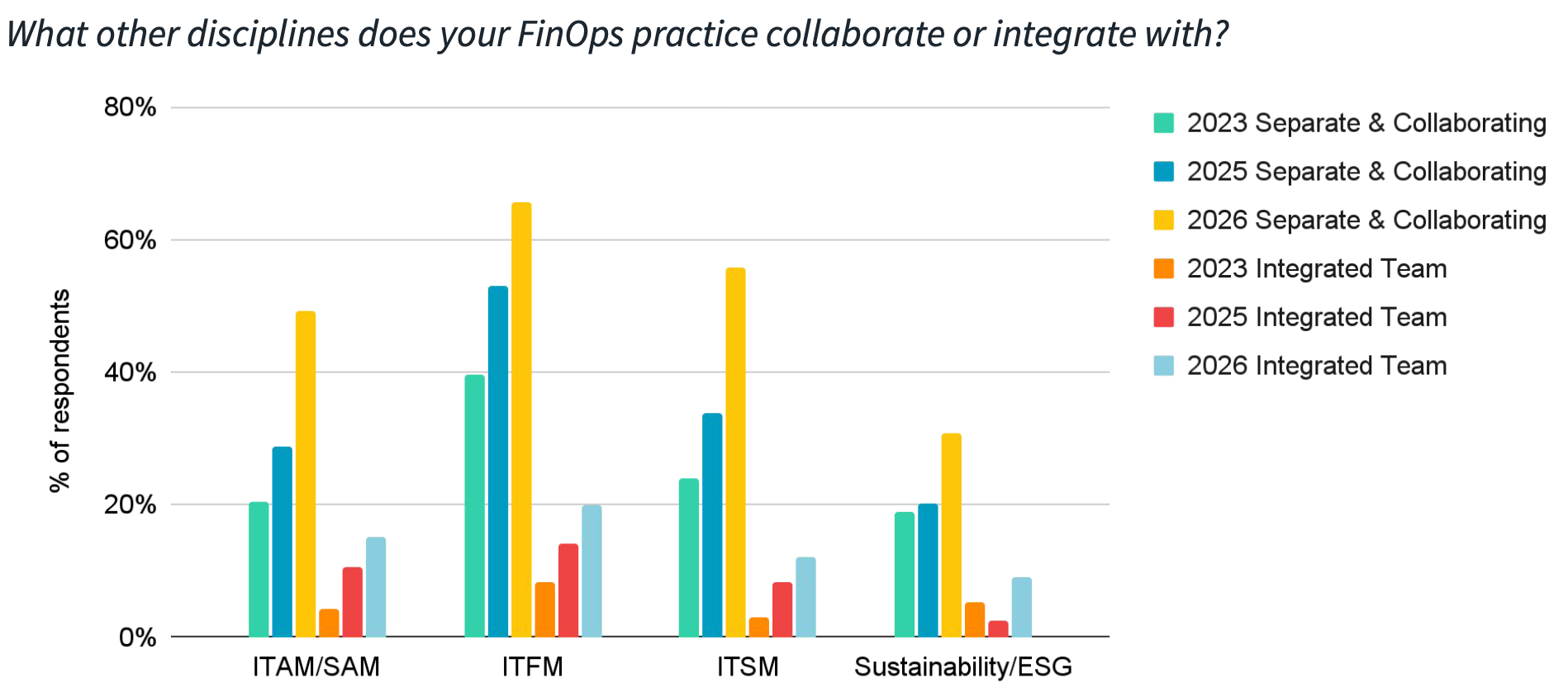
This matters because as FinOps scope expands beyond cloud into SaaS, licensing, and broader technology spend, the data and decision-making naturally overlap with these teams. Cloud cost allocation touches ITFM. SaaS and licensing governance overlaps with ITAM/SAM. Policy enforcement and service workflows intersect with ITSM. Sustainability reporting connects to ESG.
According to the report, bigger companies tend toward collaboration (separate teams working together) while smaller companies tend toward integrated teams.
7. Small Central Teams + Federated Champions Is the Operating Model
One of the clearest realities in the 2026 findings is that FinOps teams stay small—even as scope expands.
The most common structure is centralized enablement (60%), followed by a hub-and-spoke model (21%).
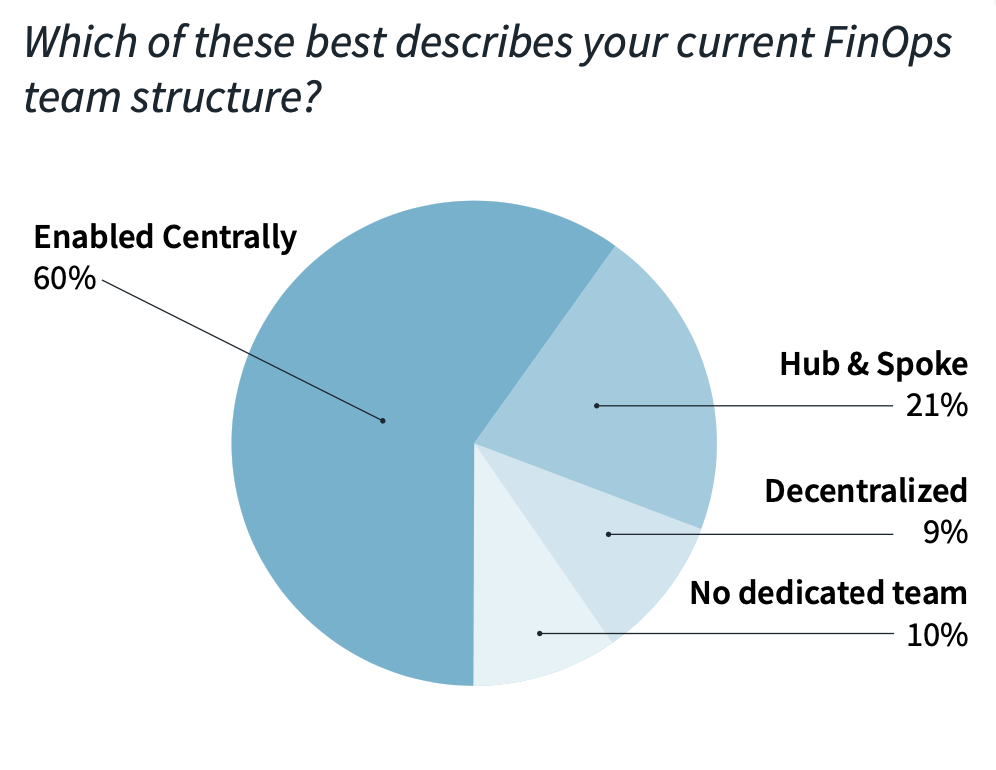
But even in large environments, team size remains lean. Among organizations spending over $100M annually, the average FinOps team is roughly 8-10 practitioners plus a few contractors or service providers.
With central teams staying small even as scope expands, automation becomes less optional and more operational — something we see consistently across customers scaling FinOps without adding headcount.
Scaling FinOps in 2026
The 2026 State of FinOps makes one thing clear: FinOps isn’t slowing down. Scope is expanding. Expectations are rising. And teams are being asked to do more with less.
This is where nOps comes in, as a purpose-built automation platform designed for FinOps in 2026.
Complete visibility with automated cost allocation
Adaptive commitment laddering: maximize savings without lock-in
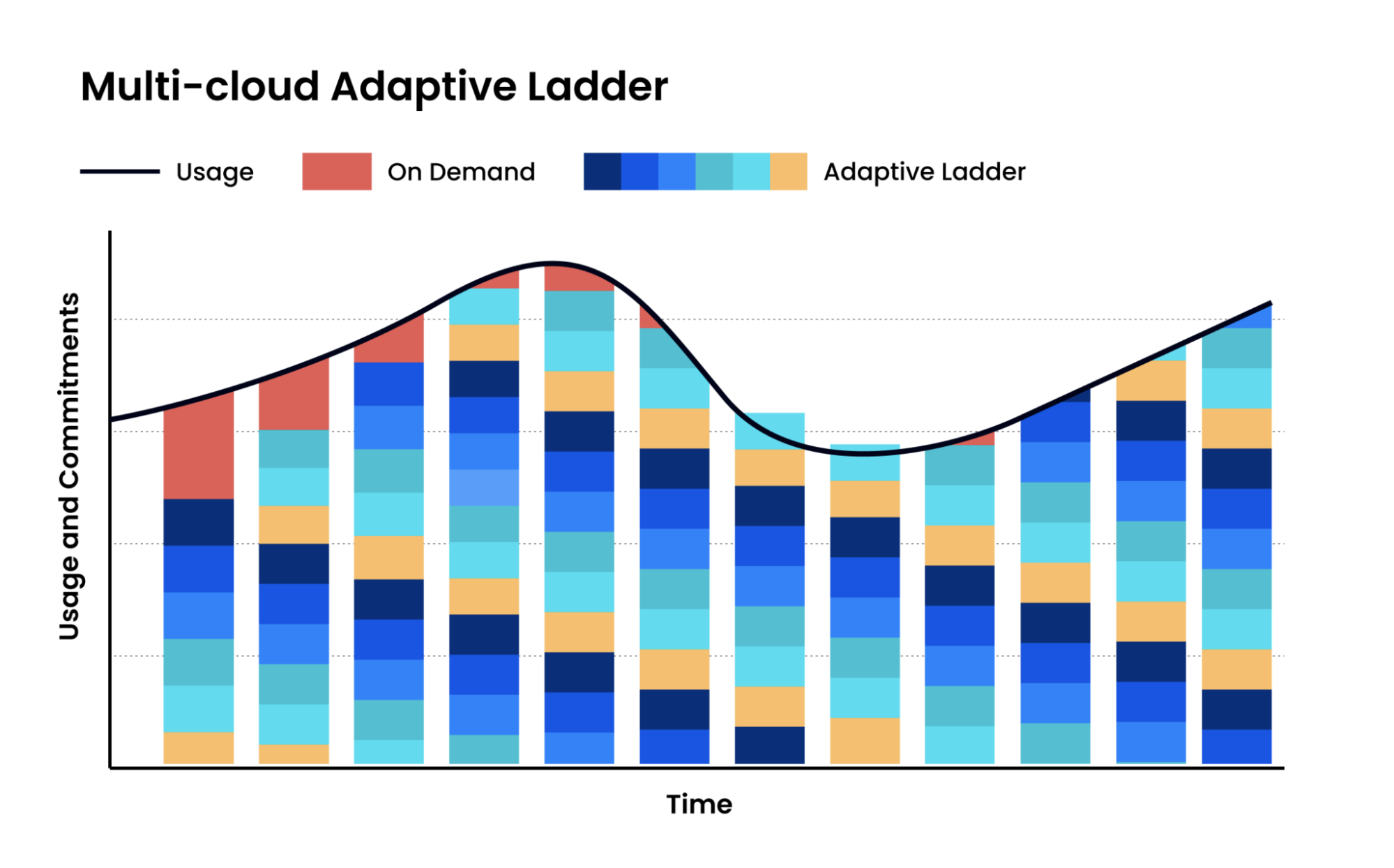
Commitment coverage is one of the clearest examples of how FinOps is shifting from picking the low-hanging fruit to achieving continuous optimization. Getting to “good enough” is simple enough — but truly maximizing savings is the hard part.
That’s where automation makes the difference. nOps continuously adjusts commitments in small increments based on real demand, helping teams achieve optimal coverage without risk or manual overhead.
Savings-first pricing
For teams being asked to self-fund new initiatives through optimization savings, the model matters just as much as the technology.
nOps only gets paid after it saves you money. There’s no upfront cost, no long-term commitment, and no risk or downside — if nOps doesn’t deliver measurable savings, you don’t pay.
Want to see it in practice? Book a demo to get a free savings analysis of your AWS/Azure/GCP spend.
nOps manages $3B+ in cloud spend and was recently rated #1 in G2’s Cloud Cost Management category.

Demo
AI-Powered Cost Management Platform
Discover how much you can save in just 10 minutes!

Last Updated: February 20, 2026, FinOps
Tags
Last Updated: February 20, 2026, FinOps