
FinOps: The Practice of Cloud Financial Management
FinOps is an operational framework and cultural practice for managing the business value of technology spending, built on collaboration between engineering, finance and business teams. It grew out of managing public cloud bills, where engineers can commit spending in seconds, and now also covers AI, SaaS, software licensing and data centers.
Whether you're starting a FinOps practice or improving one, this guide gives you the essentials at a glance with links to additional resources and in-depth coverage of each topic.
What FinOps Is
The FinOps Foundation defines FinOps as "an operational framework and cultural practice which maximizes the business value of technology, enables timely data-driven decision making, and creates financial accountability through collaboration between engineering, finance, and business teams." The name is a portmanteau of finance and DevOps. Like DevOps, which brought software development and operations together, FinOps is defined by who works together rather than by any tool, bringing finance and business teams into decisions that used to belong to engineers alone (FinOps vs DevOps).
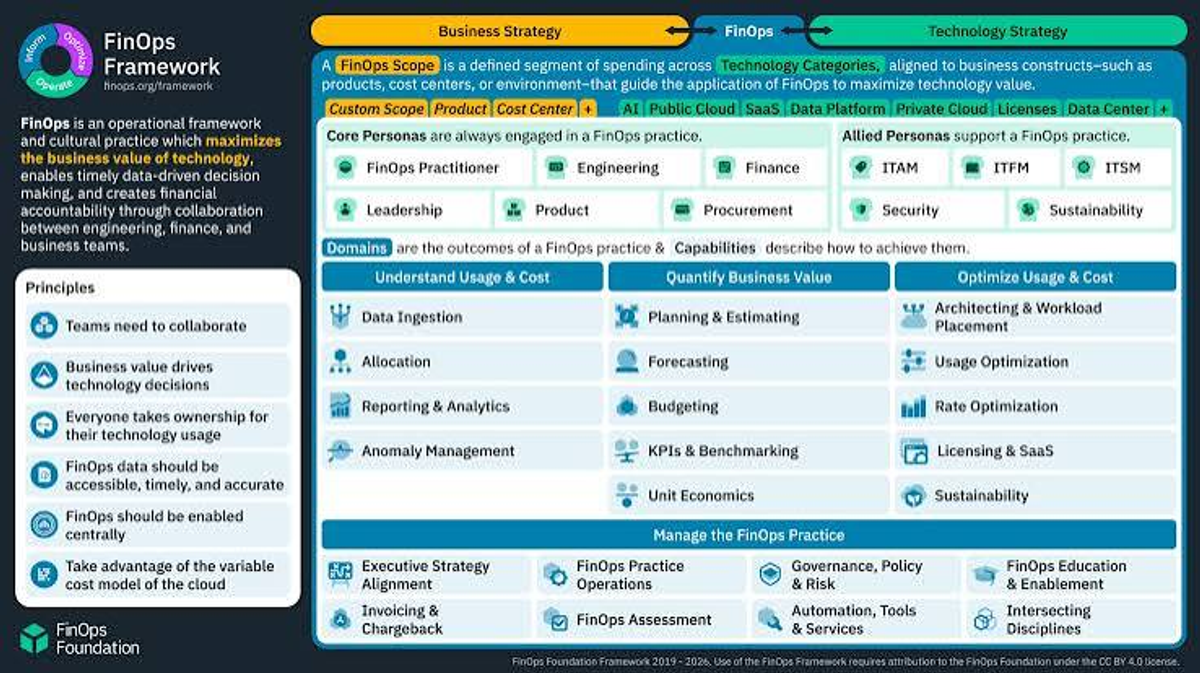
The practice exists because of how cloud spending works. On-premises infrastructure was bought through capital approval and depreciated over three to five years, so costs were fixed before anything ran. In the cloud, an engineer can provision resources in seconds, often in code, and every compute hour, gigabyte and API call is billed as it is used. FinOps puts cost information in front of the people making those decisions, makes them accountable for it, and judges success by business value, such as cost per customer or per transaction, rather than by total spend.
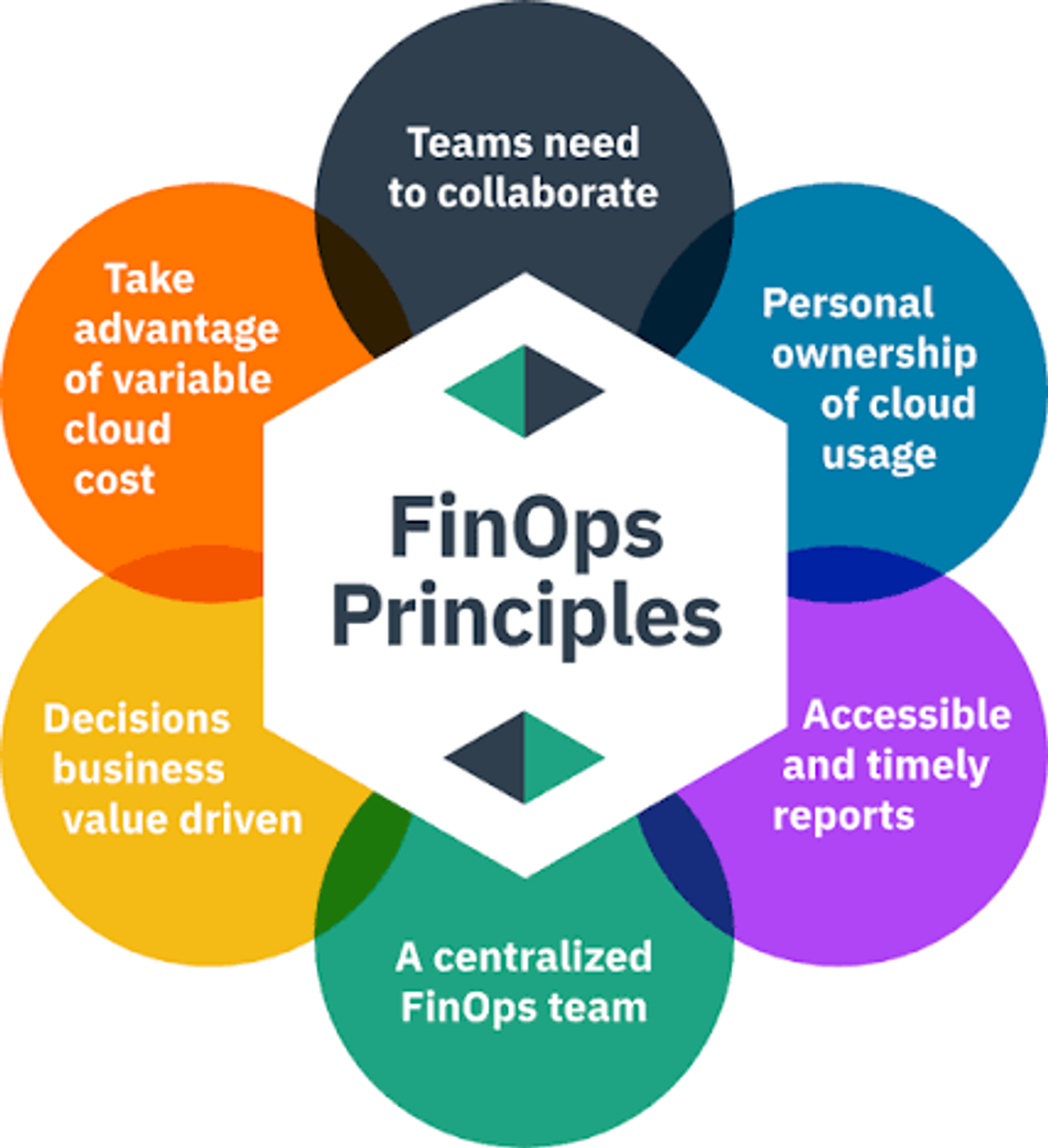
The Foundation sets this out in six principles; Gartner's FinOps framework is the best-known alternative. What is cloud FinOps covers the practice in more depth, and the FinOps glossary defines common terms.
The FinOps Lifecycle — Inform, Optimize, Operate
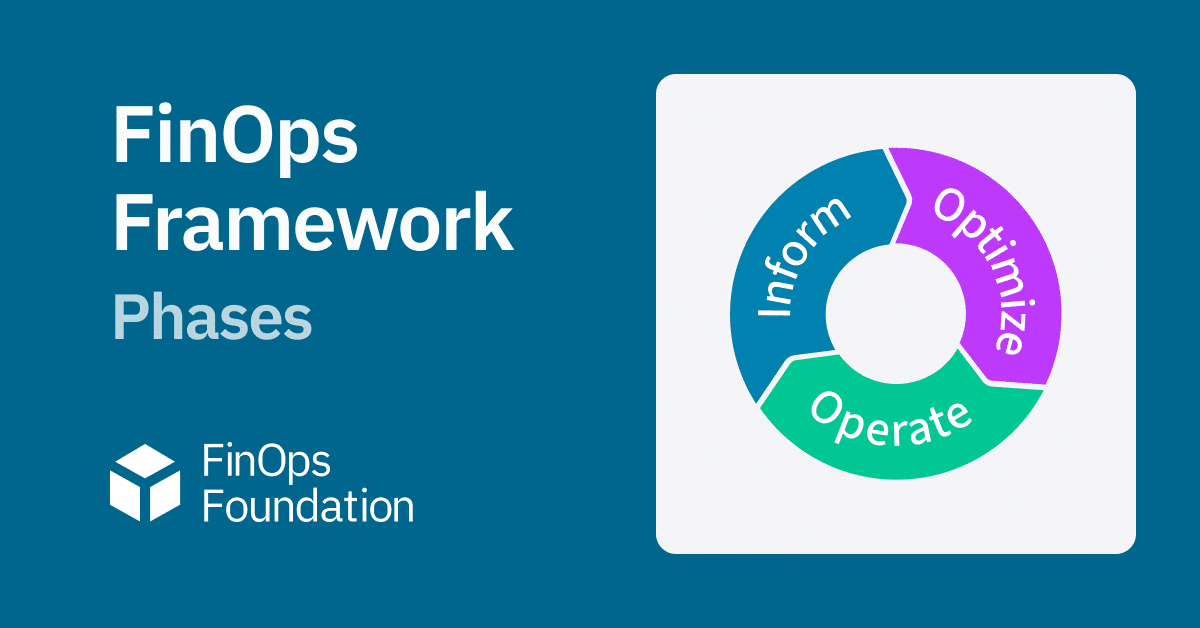
FinOps work is organized into three phases. They are not completed in order: practitioners cycle through them continuously, different team members can work in different phases at once, and each pass returns to Inform to measure whether the last round of changes worked.
Inform
Inform establishes visibility and accountability. Cost and usage data is collected, mapped to the teams and products that generated it, and compared against budgets and forecasts, so every part of the organization can see what it spends and why. Allocation is the foundation, and it depends on consistent tagging; organizations that leave tagging optional often find 40 to 60% of their resources untagged. In practice, Inform includes:
- Allocating costs to owners through tags, accounts and labels
- Reporting costs back to teams through showback, or billing them through chargeback
- Building cost allocation dashboards for engineering, finance and leadership
- Budgeting and forecasting from historical usage and planned launches
Optimize
Optimize turns visibility into savings and better value. The work falls into two kinds: reducing usage, by rightsizing oversized resources and removing idle ones, and reducing rates, mainly through commitment discounts such as Savings Plans, Reserved Instances and committed use discounts. Usage usually comes first, because a discount bought on capacity nobody needs locks the waste in. Typical Optimize work includes:
- Rightsizing compute, storage and databases to actual demand
- Removing idle resources and scheduling non-production environments to shut down outside working hours
- Buying and managing commitment discounts for steady workloads
- Choosing cheaper architectures, storage tiers and pricing models
Operate
Operate puts improvements into effect and keeps them in place. It covers the policies, processes and automation that turn one-time savings into standing practice, and the regular reviews that measure progress against targets. Common Operate activities include:
- Planning spend for new projects and reviewing actuals against targets
- Enforcing tagging, provisioning and approval policies through cost governance
- Automating recurring actions such as anomaly alerts, shutdown schedules and commitment purchases
- Holding regular cost reviews between engineering, finance and leadership
FinOps Best Practices and Tools
FinOps best practices are the habits that turn the lifecycle into a routine. Most follow from the Foundation's principles: getting accurate cost data to the people who make spending decisions while it is still timely enough to act on, building cost into design decisions before workloads ship rather than correcting them afterward, and giving teams a reason to treat efficiency as part of their job. The specific practices vary with an organization's size and maturity, and our guide to FinOps best practices covers them in detail.
Most of these practices depend on tooling. Each provider's native console covers mainly its own services, so organizations running several clouds, Kubernetes, SaaS and AI services use FinOps platforms to combine that data and route it to the teams that own it. FinOps automation acts on the data through fixed rules, and agentic FinOps tools go further, investigating cost changes and proposing or making fixes within limits people set. The cloud cost tools guide compares the options by category.
Building a FinOps Team
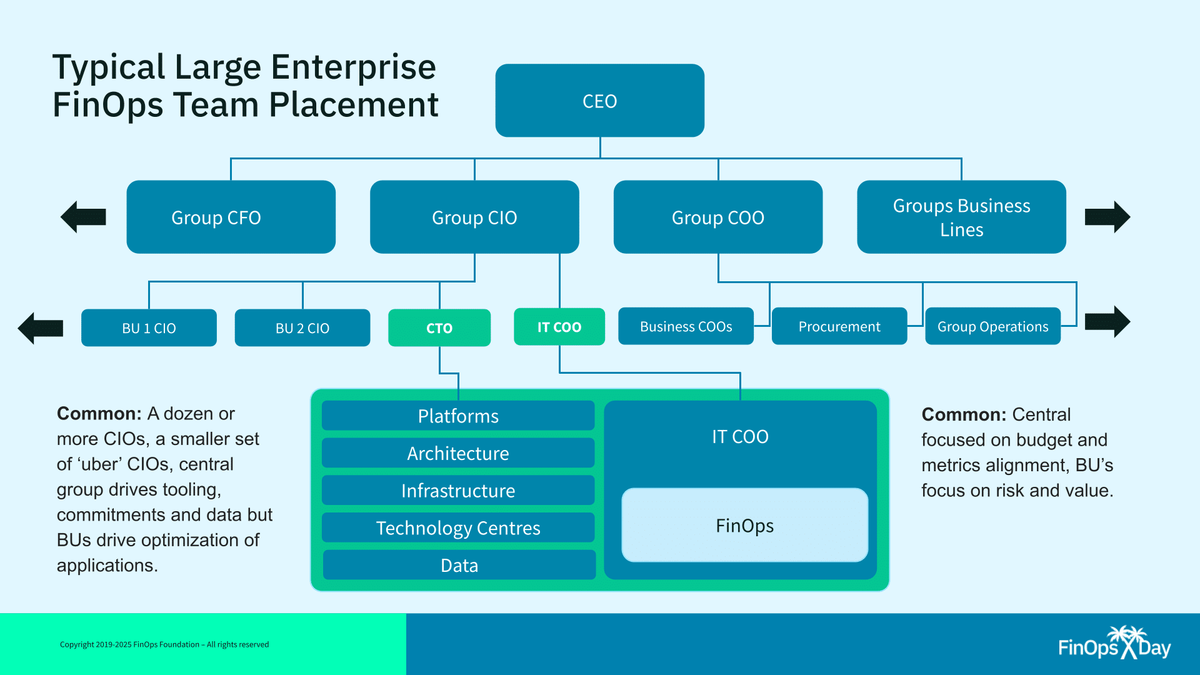
Most organizations run FinOps through a small central team that sets standards, manages commitments and supports the engineering and finance teams who make day-to-day spending decisions.
Structure
In the 2026 State of FinOps survey, 60% of organizations used centralized enablement, a central team with champions embedded in other teams; 21% used a hub-and-spoke model; and fewer than 10% were fully decentralized. Organizations spending more than $100 million a year on cloud averaged 8 to 10 practitioners plus 3 to 10 contractors, and 78% of FinOps teams reported to the CTO or CIO rather than to finance.
Roles and skills
Practitioners usually come from finance, engineering or cloud operations and need some of each: enough finance to forecast and report, and enough engineering to understand what drives a bill. Common titles include FinOps analyst and FinOps specialist. The Foundation also defines the roles FinOps works with most closely: engineering, finance, product, procurement and leadership.
Certification
The FinOps Foundation runs the main FinOps certifications:
- FinOps Certified Practitioner, the foundational credential, which gives finance, engineering and business staff a shared vocabulary
- FinOps Certified Engineer, for engineers making cost decisions in day-to-day technical work
- FinOps Certified Professional, the advanced credential for practitioners leading a practice, which requires the Practitioner certification and about six months of experience
- Specialist tracks for AI, containers and the FOCUS billing standard
AWS, Microsoft and Google Cloud also offer cost training for their own platforms, and AWS's Cloud Financial Management courses are free.
Measuring success
Practices measure progress per capability using the Foundation's crawl, walk and run maturity model, which sets sample FinOps KPIs for each stage:
Measure | Crawl | Walk | Run |
|---|---|---|---|
Costs allocated to an owner | 70%+ | 85%+ | 90%+ |
Commitment discount coverage | About 60% | 75%+ | 80%+ |
Forecast variance | Under 20% | Under 10% | Under 5% |
The Foundation's guidance is that reaching Run in every capability is not the goal. Teams should mature the capabilities that matter most to the business.
FinOps for AI
AI spending tests FinOps in ways cloud spending did not. Instead of instance hours, it is billed in input and output tokens, API calls and GPU hours, at prices that change whenever a new model ships. Many AI services cannot be tagged, a single model often serves several product features, and the people deciding which model to call include product managers, marketers and sales teams as well as engineers.
Practitioners respond by managing token economics: tracking cost per inference, per token or per customer instead of per resource, and working levers that barely exist in traditional cloud. Routing simple tasks to smaller models, caching repeated prompts and batching work that can wait can each cut costs sharply. Anthropic charges 10% of the normal input price for cached reads on most models, and OpenAI's Batch API is half price for jobs that can wait up to 24 hours.
The harder question is what the spending returns. In a 2026 Tokenomics Foundation survey of 472 companies, three in four could not confidently tie AI spend to an outcome, and in that year's State of FinOps survey, AI value management was the skill FinOps teams most wanted to add. The AI cost optimization guide and FinOps for AI capabilities cover the practice in detail.
FinOps by Platform
The principles are the same everywhere, but each platform bills, discounts and reports differently.
AWS
AWS's defining challenge is scale: more than 4 million SKUs, and a Cost and Usage Report that can reach millions of line items a month. Savings Plans and Reserved Instances are the main commitment discounts, and AWS FinOps tools build on the native Cost Explorer and Cost and Usage Report.
Azure
Azure Cost Management and Azure Advisor are the native tools. Commitments come as Reservations, which tie a one- or three-year term to specific resources for discounts of up to 72%, or Savings Plans, which commit to an hourly spend and trade some discount for flexibility. Azure FinOps covers both in detail.
Google Cloud
Google Cloud's commitment discounts are committed use discounts, and its billing data can be exported to BigQuery, where Google also provides a FOCUS-formatted view. GCP FinOps tools compares the options.
Kubernetes
Kubernetes hides cost inside shared clusters: many workloads run on the same nodes, so the bill shows nodes rather than teams. Allocation depends on splitting node costs by namespace and label, and optimization on tuning pod requests and autoscaling. See Kubernetes cost management tools.
SaaS
For third-party software, the levers are unused licenses, duplicate tools and contracts that renew automatically. For companies that sell software, SaaS FinOps also means treating the cloud cost of serving each customer as cost of goods sold. In 2026, 90% of FinOps practitioners managed SaaS spending, up from 65% a year earlier.
AI
AI is billed by tokens, API calls and GPU hours across model providers and cloud AI services, and is covered in FinOps for AI above.
FinOps Industry and Community
Three institutions shape the field: the foundation that sets its standards, the survey that benchmarks it, and the specification that standardizes its billing data.
The FinOps Foundation
The FinOps Foundation maintains the FinOps Framework, runs the main certifications and hosts the FinOps X conference. Founded in 2019, it joined the Linux Foundation in 2020, and in 2026 it changed its mission from managing the value of cloud to managing the value of technology. nOps has covered its recent events, including the FinOps X 2026 keynote and the September 2025 Foundation Summit.
The State of FinOps survey
The Foundation's annual survey is the field's main benchmark. The 2026 edition, the sixth, drew 1,192 respondents whose companies spend more than $83 billion a year on cloud, and found priorities shifting from optimization alone toward governance, forecasting and organizational alignment. More figures are collected in FinOps statistics.
FOCUS
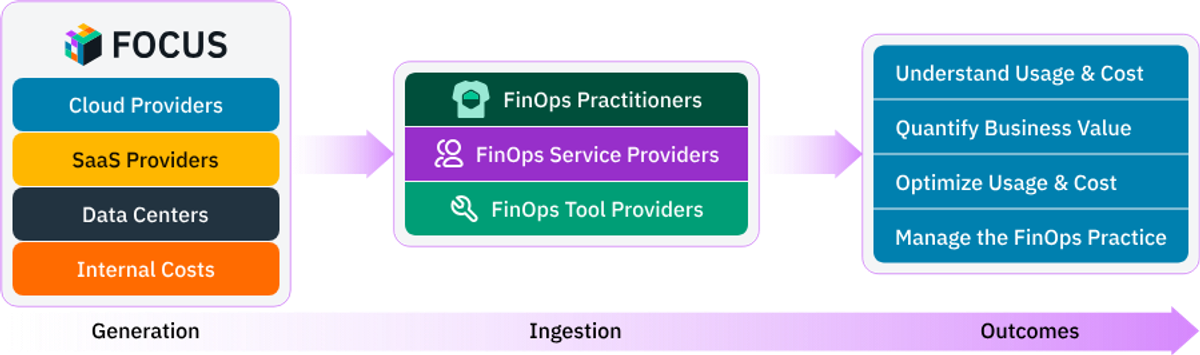
FOCUS, the FinOps Open Cost and Usage Specification, is an open standard for billing data maintained by the Foundation. Each provider formats its bills differently, and FOCUS gives them a common schema so costs can be combined and compared without custom conversion. Version 1.0 was released in November 2023; AWS, Microsoft, Google Cloud and Oracle now provide FOCUS-formatted data, and about 68% of organizations spending more than $100 million a year use or are testing it.
How nOps Helps
Cloud spending is now spread across several providers, Kubernetes clusters, SaaS tools and AI services, each with its own bill, its own discounts and its own owners. The biggest savings depend on seeing all of it in one place and buying the right commitments at the right time, which is hard to do by hand.
nOps brings that spend into one allocated view across all major providers and automates the pricing layer, so teams can see exactly where money goes and pay less for it without adding manual work:
- Unified visibility across AI, multicloud, SaaS and Kubernetes costs, allocated to the teams, products and customers that own them
- Hourly anomaly detection, with each alert tied to the responsible account, team or model, plus budgets and spend limits
- Automated commitment management that analyzes usage every hour and buys Savings Plans, Reserved Instances and committed use discounts in small increments, so coverage follows real usage
- Pricing based on the savings delivered, with read-only access and setup in minutes
Book a demo to see your cloud and AI spend in one place.
nOps manages $5 billion in AI and cloud spend and was recently ranked #1 in G2's Cloud Cost Management category.
Demo
AI-Powered Cost Management Platform
Discover how much you can save in just 10 minutes!
Book a Demo
FAQ
What is FinOps?
FinOps is a practice, not a product. It is how an organization makes engineering, finance and business teams jointly accountable for what technology costs and what it returns. Tools support it, but the practice itself is the agreement on who owns which costs and how spending decisions get made.
What does a FinOps team do?
Much of the work runs on a set cadence: engineering teams review their own costs weekly, finance and engineering compare spending with forecasts monthly, and product, finance and engineering align on budgets and pricing quarterly. Between those reviews, the central team investigates anomalies, manages commitment purchases, works with procurement on vendor contracts and trains engineers to read their own cost data.
What is the difference between FinOps and cloud cost optimization?
Cloud cost optimization is the set of technical actions that lower cloud costs, such as rightsizing, removing waste and buying commitments. FinOps is the operating model around those actions: it decides which ones to take, who takes them and how the results are measured, so savings are kept rather than made once.
What are the FinOps Foundation's phases?
Inform, Optimize and Operate. The phases are one layer of the FinOps Framework, which also organizes the work into domains, such as understanding usage and cost or quantifying business value, and capabilities, such as allocation, forecasting and rate optimization. Since 2025 it has also defined scopes, the segments of technology spending a practice covers, from public cloud to SaaS, data centers and AI.
Who owns FinOps — finance or engineering?
Ownership is split by design. Engineers own their usage decisions, finance owns budgets, forecasts and reporting, procurement owns vendor contracts and leadership sets targets. The central FinOps team owns the process itself and, under the Foundation's principles, manages rates and commitments centrally to gain economies of scale.
Do you need a FinOps certification?
No. Certification isn't required to work in FinOps or to start a practice. It helps most when a team needs a shared vocabulary quickly, and some training is free, including the FinOps Foundation's introductory course on FOCUS.
What KPIs does a FinOps team track?
Beyond the maturity measures above, common KPIs include effective savings rate, the overall discount achieved compared with on-demand prices; commitment utilization, the share of purchased commitments actually used; and the share of spend identified as waste.