
De-Risk GCP Commitments: Why Overcommitment Is the Real Threat
For years, the FinOps conversation around GCP Committed Use Discounts (CUDs) focused on “How do we get discounts on more of our spend?”
But GCP’s pricing landscape has shifted fundamentally. SUDs are disappearing on newer machine families. Net price billing changes how commitment math works. AI is accelerating the rate of workload change. And the penalty for overcommitment — paying for capacity you no longer consume — often outweighs the penalty for paying on-demand rates on a portion of your fleet.
This article breaks down:
- Why overcommitment became the bigger risk in 2026
- Why Google Cloud is uniquely susceptible to overcommitment, and
- How to structure a commitment strategy that stays resilient as workloads, demand and pricing economics change
Why Overcommitment Is Now the Bigger Problem
The traditional fear in commitment management was under-coverage: leaving on-demand spend on the table when you could have locked in a discount. That fear pushed teams toward aggressive purchasing — commit high, commit long, capture every dollar of savings.
The math has changed. Consider two scenarios for a team spending $100/hour on eligible GCP compute:
Scenario A — Under-committed by 20%: You commit $80/hour at a 28% one-year flex CUD discount. The remaining $20/hour runs at on-demand rates. Your blended discount rate: 22.4%. You leave some savings on the table, but every committed dollar is fully utilized.
Scenario B — Over-committed by 20%: You commit $120/hour at the same 28% discount. Only $100/hour of usage absorbs the commitment, but you pay fees on the full $120/hour regardless. You’re now paying $86.40/hour for $100/hour of value — an effective discount of just 13.6%, materially worse than Scenario A — and the unused $20/hour of commitment burns roughly $126,000 in fees per year for capacity you never consume.
Over-commitment doesn’t just reduce your savings rate. It can make your discount program a net-negative cost center. And unlike under-commitment (which you can fix by purchasing more), over-commitment on GCP cannot be unwound. There is no cancellation, no marketplace resale, no early termination. You pay until the term expires.
What Makes GCP Uniquely Susceptible to Overcommitment
The Google Cloud commitment model has three structural characteristics that amplify overcommitment risk beyond what AWS or Azure teams typically face.
SUDs Are Disappearing on New Machine Families
Sustained Use Discounts — the automatic 30% discount for resources running more than 25% of a billing month — only apply to N1, N2, N2D, C2, M1, and M2 machine series. The newer families that Google is actively pushing — C3, C3D, C4, N4, N4D, T2D, H3 — receive zero SUDs.
This creates a dangerous gap. Teams that modernize their fleet (as Google encourages) lose their free discount floor. A team running N2 with a 70% commitment gets the remaining 30% at a discounted on-demand rate via SUDs. That same team migrating to C4 or N4 loses the SUD entirely — the uncommitted 30% now runs at full on-demand. The reflex is to commit more aggressively to close the gap. But if the migration stalls or workloads fluctuate, that aggressive commitment becomes overcommitment overnight.
Net Price Billing Changes the Renewal Math
Google’s multiprice CUD model, active since July 2025 and automatically applied as of January 2026, fundamentally changes how commitment pricing works. Instead of a flat blended rate, each SKU gets individual pricing. Flex CUDs now apply to a broader set of services including Cloud Run and GKE Autopilot.
The overcommitment trap: under the old model, a $100/hour Compute Engine commitment was sized against Compute Engine spend alone. Under the new model, the eligible pool includes Cloud Run, GKE Autopilot, and other elastic workloads. Coverage ratios appear to drop overnight — not because anything shrunk, but because the denominator grew. Teams that react by upsizing their commitment to “match” the new pool risk over-purchasing, because serverless and container spend is far spikier than static VM spend. A commitment sized to peak Cloud Run usage is heavily underutilized during troughs.
Flex CUDs Don't Cover Everything
Flex CUDs offer billing-account-wide flexibility — but with specific exclusions that create blind spots. Resource-based CUDs are scoped to individual machine series: “If you purchase general-purpose N2, N2D, N4, N4D, N4A, C4, C4A, C4D, C3, C3D, Tau T2D, or N1 commitments, the commitments never overlap.”
This means a resource-based CUD for N2 does nothing for your N4 instances. A team in the middle of a machine family migration has two commitments that don’t share capacity: the old family’s CUD churning against declining usage, and the new family running naked at on-demand rates. The total spend looks committed, but the actual utilization tells a different story.
Flex CUDs solve the cross-family problem but at a discount-rate cost: roughly 9–11 percentage points below resource-based CUDs at the same term (28% vs. 37% at one year; 46% vs. 57% at three years on general-purpose). And some workload types — particularly T2D (Tau) instances — have historically had limited or variable flex CUD eligibility depending on the billing model version.
Commitment Strategies That Absorb Change
The tl;dr is that once you overcommit on GCP, there are fewer ways to unwind the mistake — so the best strategy is preventing underutilization before it happens.
Let’s talk about a few approaches.
The Layered Commitment Model
The quick-and-dirty DIY structure looks like this:
| Layer | Coverage Target | Instrument | Term | Purpose |
|---|---|---|---|---|
| Foundation | 50–60% of baseline | Resource-based CUDs | 1 year | Maximum discount on rock-stable workloads |
| Agile | 15–25% of variable spend | Flex CUDs | 1 year | Cross-family, cross-region flexibility |
| Peak | Remaining spend | On-demand | None | Zero commitment risk on variable workloads |
The foundation layer uses resource-based CUDs because their discount rates are higher than flex at the same term — roughly 37% on a one-year resource-based commitment for general-purpose machines, vs. 28% for one-year flex. You accept the machine-family lock-in because these are workloads you have high confidence won’t change within the term.
The agile layer uses flex CUDs to capture savings on workloads that might shift between machine families, scale up and down, or move between services. The lower discount rate (28% one-year) is the price of flexibility — and it’s still better than on-demand.
The peak layer stays uncommitted intentionally to prevent overcommitment during usage spikes, seasonal variation, or migration periods.
Blended Resource-Based and Flex CUD Strategy
Rather than choosing one instrument exclusively, layer them:
Resource-based CUDs for workloads where you know the machine family won’t change within 12 months. Database servers on N4. Batch processing pipelines on C4. Stable GKE node pools. These get the highest possible discount — 37% on a one-year resource-based commitment for general-purpose families.
Flex CUDs for environments where the service mix is evolving. Teams adopting GKE Autopilot, migrating to Cloud Run, or evaluating new machine families. The flex CUD adapts automatically as spend moves between covered services.
The blended approach means no single commitment instrument carries your entire portfolio risk. If N4 gets superseded by N5 in 18 months, only your resource-based CUDs on N4 are affected — and if those were one-year terms, they expire before the migration completes.
Adaptive Layering to Avoid Renewal Cliffs
The worst position in commitment management: having your entire CUD portfolio expire on the same date. That creates a “renewal cliff” — a single decision point where you must recommit at scale or let everything lapse.
Adaptive layering spreads expirations across many more frequent dates. Instead of making one big risky commitment bet, you’re making smaller incremental purchases with more flexibility.
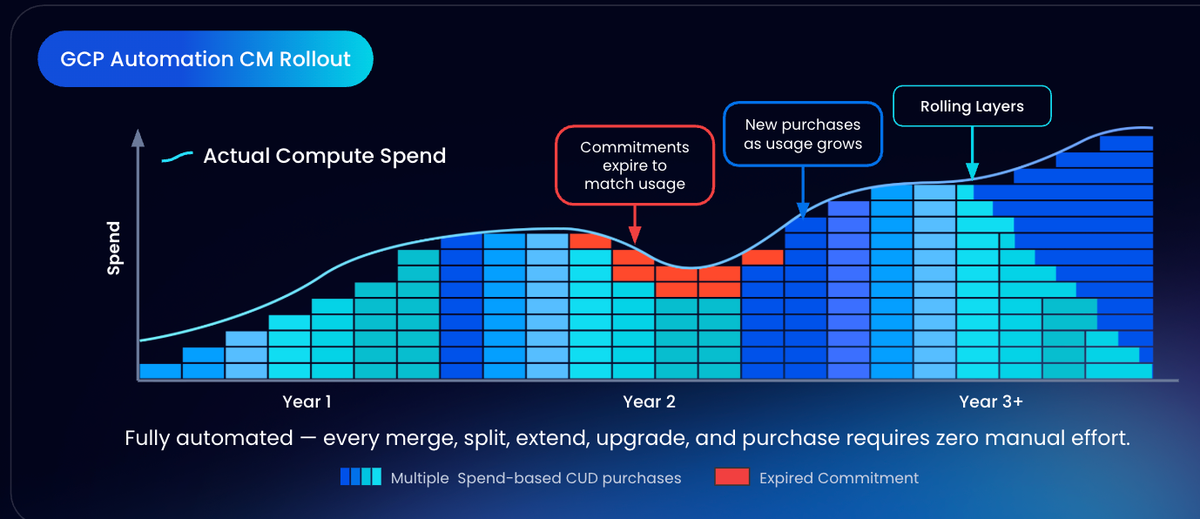
For example, say that instead of one $100/hour commitment purchased annually, you bought twelve $8-9/hour commitments — one each month. Each represents roughly 1/12 of your total commitment needs.
Benefits of this approach:
- No single point of failure. If usage drops 20% in March, you simply don’t renew March’s tranche. The other eleven continue at full utilization.
- Rolling adjustment. Each monthly renewal is an opportunity to recalibrate based on actual recent usage — not a forecast from twelve months ago.
- Migration-friendly. If engineering starts a machine family migration in Q2, you let the old-family CUDs expire naturally while purchasing new-family CUDs at the new monthly cadence.
The counterargument is operational overhead — twelve purchase decisions per year instead of one. That’s a real cost in analyst time if you’re managing commitments manually. It’s also the strongest argument for automation.
How nOps Eliminates the Overcommitment Problem
At nOps, we’ve built Commitment Management specifically to solve the overcommitment problem through continuous, automated adjustment — not periodic manual decision-making.
Here’s how our approach works for GCP:
Reduce risk with adaptive layering automation. We implement the layering strategy described above, but at a granularity no human team can replicate. Dozens of small commitments, each sized to current usage, each expiring on its own schedule. The result? More incremental savings (up to 55%), with far less risk of overcommitment.
Savings-first pricing model: Pricing is based on a portion of realized savings, which means you pay only for results.
Free Savings Analysis: See exactly how much more you can save for no work on your part. We optimize, and you get the credit.
We’ve talked to companies that can save millions on their cloud bills by switching to nOps from competitors. There’s no risk to book a free savings analysis to find out if nOps can help you get more value out of your cloud investments.
nOps manages $5B+ in cloud spend and was recently rated #1 in G2’s Cloud Cost Management category.
Demo
AI-Powered Cost Management Platform
Discover how much you can save in just 10 minutes!
Book a Demo